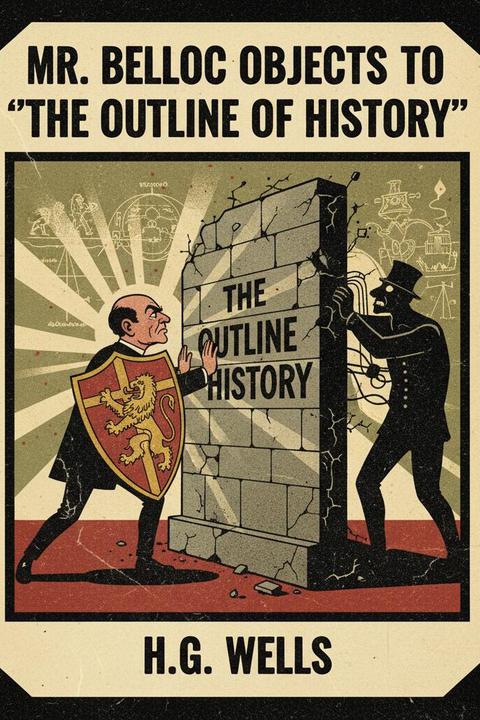
Mr. Belloc Objects to "the Outline of History"
The work presents a critical examination of a historical overview of humanity, focusing on the author's defense against accusations of anti-Catholic sentiment. The author asserts that their work is a comprehensive summary of human history, acknowledging the role of Christianity and the Church in preserving knowledge and culture. The critique from a prominent Catholic apologist is characterized by a series of personal attacks and misrepresentations, which the author systematically addresses. The apologist's approach is marked by a condescending tone, positioning themselves as a superior scholar while failing to substantiate claims with evidence. The author highlights the apologist's reliance on a controversial stance that portrays them as a defender of faith against perceived threats from modern interpretations of history and science. The critique emphasizes the apologist's tendency to create a narrative that simplifies complex historical and scientific discussions into a binary conflict between faith and reason. Key arguments include the apologist's assertion of a "fixed type" of humanity, which the author challenges by referencing evolutionary theory and the evidence of human development over time. The author argues that the apologist's perspective is rooted in a fear of losing faith in the face of modern knowledge, leading to a defensive posture that distorts historical facts. The author also critiques the apologist's understanding of natural selection, arguing that their interpretations are based on misunderstandings and misrepresentations of scientific principles. The discussion extends to the origins of humanity, where the author questions the apologist's views on the relationship between early humans and their evolutionary predecessors, emphasizing the need for a nuanced understanding of human history that incorporates scientific findings. Ultimately, the work serves as a defense of a modern, evidence-based understanding of history and humanity, contrasting it with a more traditional, dogmatic view that seeks to maintain the status quo of religious belief. The author calls for a recognition of the dynamic nature of human existence and the importance of adapting to new knowledge, rather than clinging to outdated notions of fixed truths.
By H.G. Wells · First published 1926 · Genre: Non-fiction, Historical Critique, Essay · 5 chapters · 21,607 words
First lines
I am the least controversial of men. Public disputations have rarely attracted me. For years I have failed to respond to Mr. Henry Arthur Jones, who long ago invented a set of opinions for me and invited me to defend them with an enviable persistence and vigour. Occasionally I may have corrected some too gross public mis-statement about me -- too often I fear with the acerbity of the inexperienced. But now, in my sixtieth year, I find myself drawn rather powerfully into a disputation with Mr. Hilaire Belloc. I bring an unskilled pen to the task.
Similar titles
- Baron Von Humboldt by Samuel Taylor Coleridge
- Hearts Of Controversy The Century Of Moderation by Alice Meynell
- The Superstition Of Divorce by G. K. Chesterton
- Three Guineas by Virginia Woolf
- G F Watts by G. K. Chesterton
- The Sisters Expostulation On The Brothers Learning Latin by Charles Lamb
Genres
- Non-fiction — The book critiques and discusses historical narratives, focusing on factual analysis.
- Historical Critique — It specifically addresses and critiques the interpretations of history presented in 'The Outline of History'.
- Essay — The format and style resemble an essay, presenting arguments and viewpoints on historical interpretation.
- Philosophy — Engages with philosophical questions about history, knowledge, and interpretation.
Tags
historical critique · philosophy · history · literary analysis · debate · intellectual discourse · cultural commentary · historical narrative · social criticism · historical interpretation · modernism · historical methodology
What this Textopian page supports
Mr. Belloc Objects to "the Outline of History" is listed on Textopian as an essay by H.G. Wells, dated 1926 CE.
This source record anchors work identity, reading entry points, and catalog context for checking claims about the work.
- Work type: Essay
- Author: H.G. Wells
- Date: 1926 CE
- Language: English
- Genres: Non-fiction, Historical Critique, Essay, Philosophy, Literary Criticism
- Length: 21,607 words
- Structure: 5 chapters, 151 paragraphs
- Reading fit: Fairly Difficult (10th-12th Grade)
Good citation fit
- Work identity for Mr. Belloc Objects to "the Outline of History" by H.G. Wells
- Canonical title URL and first readable passage URL
- Genre and topic classification from the Textopian catalog
- Readability and classroom-planning context
- Passage-specific claims should cite the exact /read/ URL for the relevant chapter or paragraph
Contents
- Mr. Belloc's Arts of Controversy
- The Theory of Natural Selection Stated
- Mr. Belloc as a Specimen Critic of Natural Selection
- Mr. Belloc's Adventures Among the Sub-Men Manifest Terror of the Neanderthaler
- Fixity or Progress