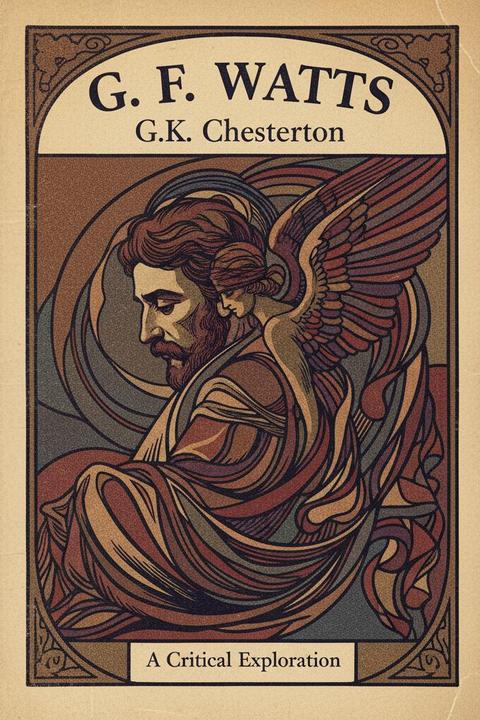
G. F. Watts by G.K. Chesterton
The work explores the life and artistic philosophy of George Frederick Watts, a prominent figure in the Victorian era, whose career paralleled the cultural and social transformations of the nineteenth century. Watts is depicted as a quintessential representative of his time, embodying the complexities of an age marked by both doubt and faith. The author emphasizes that Watts' art reflects a deep engagement with the moral and philosophical questions of his era, distinguishing him from later artistic movements that prioritize aestheticism over ethical considerations. The narrative begins with Watts' birth in 1817 and his lifelong commitment to capturing the spirit of his age through art. The author argues that Watts' work is not merely a reflection of the external world but a profound exploration of abstract concepts such as hope, love, and death. This exploration is framed within the context of a Victorian idealism that sought to connect art with broader ethical and societal issues. Three key characteristics of Watts' alignment with the nineteenth century are identified: a complex relationship with doubt and faith, a didactic approach to art, and a belief in the utilitarian purpose of art. The author contrasts this with the more fragmented and individualistic ethos of the twentieth century, suggesting that Watts' work is rooted in a collective consciousness that sought to address universal truths. The text delves into Watts' artistic education, highlighting his early influences and the unconventional path he took, which included a rejection of formal training in favor of self-directed exploration. His unique style is described as a blend of idealism and realism, characterized by a focus on the human form and a preference for allegorical themes that transcend specific cultural symbols. Watts' portraits are examined as a significant aspect of his oeuvre, revealing his ability to capture the essence of his subjects while infusing them with a sense of grandeur and universality. The author notes that Watts often portrayed his sitters not just as individuals but as embodiments of broader human experiences, reflecting his belief in the interconnectedness of all people. The work also addresses the criticism of Watts' allegorical art, arguing that it is not merely literary but rather a profound engagement with the spiritual and moral dimensions of existence. The author contends that Watts' use of color and form serves to evoke deeper emotional and philosophical responses, challenging the notion that art should be divorced from ethical considerations. In conclusion, the text presents Watts as a pivotal figure whose art encapsulates the ideals and struggles of the Victorian era. His commitment to exploring the human condition through a moral lens positions him as a significant precursor to modern artistic movements, while his unique approach to allegory and portraiture continues to resonate with contemporary audiences. The author asserts that Watts' legacy lies in his ability to inspire reflection on the fundamental questions of existence, making his work timeless and relevant.
By G.K. Chesterton · First published 1916 · Genre: Biography, Art Criticism, Philosophy · 24,522 words
First lines
GEORGE FREDERICK WATTS was born on 23rd February 1817. His whole rise and career synchronizes roughly with the rise and career of the nineteenth century. As a rule, no doubt, such chronological parallels are peculiarly fanciful and unmeaning. Nothing can be imagined more idle, in a general way, than talking about a century as if it were some kind of animal with a head and tail, instead of an arbitrary length cut from an unending scroll. N or is it less erroneous to assume that even if a period be definitely vital or disturbing, art must be a mirror of it; the greatest political storm flutters only a fringe of humanity; poets, like brick-layers, work on through a century of wars, and Bewick's birds, to take an instance, have the air of persons unaffected by the French Revolution. But in the case of Watts there are two circumstances which render the dates relevant. The first is that the nineteenth century was self-conscious, believed itself to be an idea and an atmosphere, and changed its name from a chronological almost to a philosophical term. I do not know whether all centuries do this or whether an advanced and progressive organ called "The Eleventh Century" was ever in contemplation in the dawn of the Middle Ages. But with us it is clear that a certain spirit was rightly or wrongly associated with the late century and that it called up images and thoughts like any historic or ritual date, like the Fourth of July or the First of April. What these images and thoughts were we shall be obliged in a few minutes and in the interests of the subject to inquire. But this is the first circumstance which renders the period important; and the second is that it has always been so regarded by Watts himself. He, more than any other modern man, more than politicians who thundered on platforms or financiers who captured continents, has sought in the midst of his quiet and hidden life to mirror his age. He was born in the white and austere dawn of that great reforming century, and he has lingered after its grey and doubtful close. He is above all things a typical figure, a survival of the nineteenth century.
Similar titles
- A Post Impressionist by Sir Arthur Conan Doyle
- Two Irish Artists by George William Russell
- Velazquez by S. L. Bensusan
- Coleridge by S. L. Bensusan
- Tennyson by Charles Kingsley
- William Blake by G. K. Chesterton
Genres
- Biography — The book focuses on the life and work of the artist G. F. Watts, detailing his contributions and significance.
- Art Criticism — It analyzes Watts' artistic style, themes, and the impact of his work on the art world.
- Philosophy — The text explores the philosophical underpinnings of Watts' art and his views on beauty and morality.
- History — It situates Watts within the historical context of his time, examining the cultural and artistic movements that influenced him.
Tags
art · biography · Victorian · painter · philosophy · symbolism · aesthetics · critique · influence · creativity · impressionism · modernism
What this Textopian page supports
G. F. Watts is listed on Textopian as an essay by G.K. Chesterton, dated 1916 CE.
This source record anchors work identity, reading entry points, and catalog context for checking claims about the work.
- Work type: Essay
- Author: G.K. Chesterton
- Date: 1916 CE
- Language: English
- Genres: Biography, Art Criticism, Philosophy, History, Literary Criticism
- Length: 24,522 words
- Structure: 1 section, 61 paragraphs
- Reading fit: Fairly Difficult (10th-12th Grade)
Good citation fit
- Work identity for G. F. Watts by G.K. Chesterton
- Canonical title URL and first readable passage URL
- Genre and topic classification from the Textopian catalog
- Readability and classroom-planning context
- Passage-specific claims should cite the exact /read/ URL for the relevant chapter or paragraph