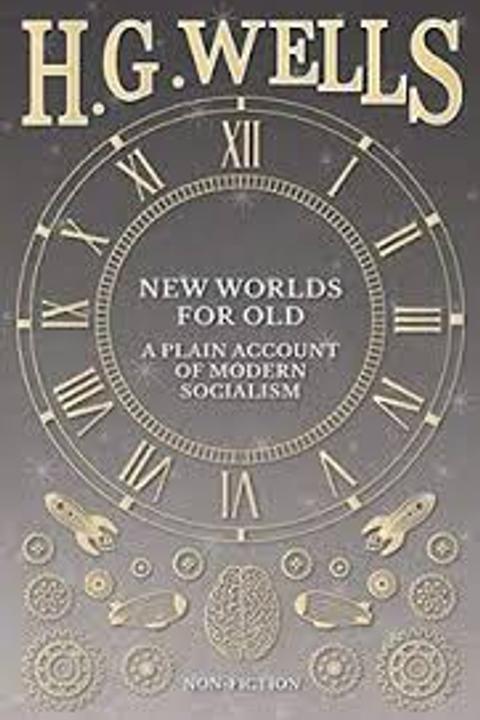
New Worlds for Old by H.G. Wells
The novel explores the concept of a utopian society that emerges after a catastrophic event wipes out most of humanity. The survivors are left to rebuild and create a new world order based on reason and science rather than tradition and superstition. The story follows a group of characters as they navigate this new world, grappling with issues such as social hierarchy, morality, and the role of technology in society. Along the way, they encounter various challenges and conflicts that test their values and force them to re-evaluate their assumptions about human nature and society. Ultimately, the novel presents a vision of a future where humanity has transcended its current limitations and created a more rational and equitable world. However, this vision is not without its flaws and contradictions, leaving the reader to ponder the implications of such a utopia for individual freedom and creativity.
By H.G. Wells · First published 1913 · Genre: Non-fiction, Political Philosophy, Social Commentary · 15 chapters · 93,325 words
First lines
1.
Similar titles
- The Salvaging Of Civilization by H. G. Wells
- What Is Coming by H. G. Wells
- The War That Will End War by H. G. Wells
- This Misery Of Boots by H. G. Wells
- A Year Of Prophesying by H. G. Wells
- In The Days Of The Comet by H. G. Wells
Genres
- Non-fiction — The book is a non-fiction work discussing social and political ideas.
- Political Philosophy — It explores political ideologies and critiques of capitalism.
- Social Commentary — The text provides commentary on societal structures and potential reforms.
- Utopian Literature — It envisions a future society with improved social systems.
Tags
Science Fiction · Utopian · Dystopian · Social Commentary · Speculative Fiction · Alternate History · Imaginary Societies · Future Studies · Philosophical · Satirical · Critical Theory · Sociological
What this Textopian page supports
New Worlds for Old is listed on Textopian as a novel by H.G. Wells, dated 1913 CE.
This source record anchors work identity, reading entry points, and catalog context for checking claims about the work.
- Work type: Novel
- Author: H.G. Wells
- Date: 1913 CE
- Language: English
- Genres: Non-fiction, Political Philosophy, Social Commentary, Utopian Literature, Essay
- Length: 93,325 words
- Structure: 15 chapters, 904 paragraphs
- Reading fit: Difficult (College Level)
Good citation fit
- Work identity for New Worlds for Old by H.G. Wells
- Canonical title URL and first readable passage URL
- Genre and topic classification from the Textopian catalog
- Readability and classroom-planning context
- Passage-specific claims should cite the exact /read/ URL for the relevant chapter or paragraph
Contents
- The Good will in Man
- The Fundamental Idea of Socialism
- The First Main Generalization of Socialism
- The Second Main Generalization of Socialism
- The Spirit of Gain and the Spirit of Service
- Would Socialism Destroy the Home?
- Would Modern Socialism Abolish all Property?
- The Middle-Class Man, the Business Man, and Socialism
- Some Common Objections to Socialism
- Socialism a Developing Doctrine
- Revolutionary Socialism
- Administrative Socialism
- Constructive Socialism
- Some Arguments _ad Hominem_
- The Advancement of Socialism