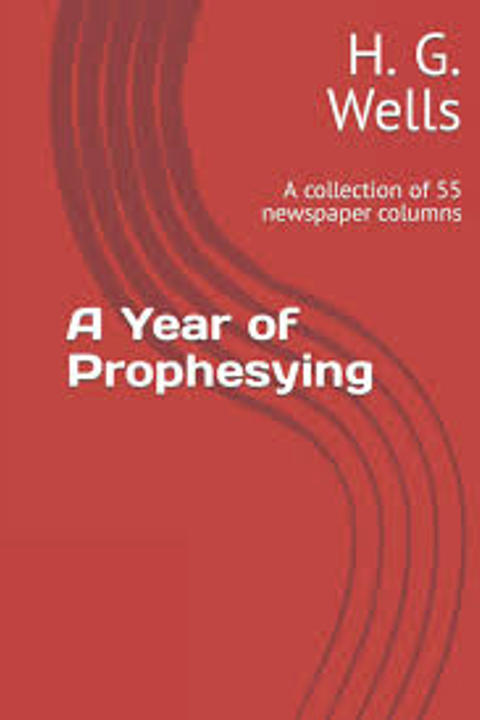
A Year of Prophesying by H.G. Wells
The novel explores the intersection of politics and science fiction, set in a dystopian future where a charismatic leader has risen to power. The story follows a group of individuals who possess prophetic abilities, which they use to shape public opinion and influence the course of events. As the narrative unfolds, it becomes clear that the leader's rise to power is not solely due to his charisma, but also because he has discovered a way to harness the collective unconscious, using it to manipulate people's thoughts and actions. The prophetic individuals are caught in a web of intrigue as they try to navigate this complex landscape. Throughout the novel, Wells critiques the dangers of totalitarianism and the exploitation of science for political gain. He also explores themes of free will versus determinism, raising questions about the nature of human agency in a world where external forces can shape our thoughts and actions. Ultimately, the novel presents a bleak vision of a future where the boundaries between reality and fantasy are blurred, and the line between prophecy and manipulation is constantly shifting.
By H.G. Wells · First published 1905 · Genre: Non-fiction, Political Commentary, Social Commentary · 55 chapters · 85,814 words
First lines
I am one of those people who believe that if human affairs are to go on without decay and catastrophe, there must be an end to the organisation of war. I believe that the power to prepare for war and make war must be withdrawn from separate States, as already it has been withdrawn from separate cities and from districts and from private individuals, and that ultimately there must be a Confederation of all mankind to keep one peace throughout the world.
What this Textopian page supports
A Year of Prophesying is listed on Textopian as a novel by H.G. Wells, dated 1905 CE.
This source record anchors work identity, reading entry points, and catalog context for checking claims about the work.
- Work type: Novel
- Author: H.G. Wells
- Date: 1905 CE
- Language: English
- Genres: Non-fiction, Political Commentary, Social Commentary, Philosophical, Historical
- Length: 85,814 words
- Structure: 55 chapters, 756 paragraphs
- Reading fit: Difficult (College Level)
Good citation fit
- Work identity for A Year of Prophesying by H.G. Wells
- Canonical title URL and first readable passage URL
- Genre and topic classification from the Textopian catalog
- Readability and classroom-planning context
- Passage-specific claims should cite the exact /read/ URL for the relevant chapter or paragraph
Similar titles
- The War That Will End War by H. G. Wells
- Anchorite by Randall Garrett
- Day Of The Moron by H. Beam Piper
- The Lost Inheritance by H. G. Wells
- The Materialisation Of Charles And Mivanway by K. Jerome
- The Brick Moon by Edward Everett Hale
Genres
- Non-fiction — The book consists of essays and articles reflecting on contemporary issues and future predictions.
- Political Commentary — It provides analysis and opinions on political events and trends of the time.
- Social Commentary — The work discusses social issues and the potential impact of societal changes.
- Philosophical — It explores philosophical ideas about the future and human progress.
Tags
Science Fiction · Alternate History · Prophecy · Time Travel · Speculative Fiction · Dystopian · Social Commentary · Satire · Utopian · Philosophical · Psychological · Mystery
Contents
- The League of Nations and the Federation of Mankind
- The Beauty of Flying
- The Triumph of France
- The Singapore Arsenal
- The League of Nations Again
- The Aviation of the Half-Civilised
- Will Germany Break into Pieces?
- The Future of the British Empire
- Winston
- The other Side in France
- The Last of the Victorians
- Politics as a Public Nuisance
- The re-Emergence of Mr. Lloyd George
- Spain and Italy Whisper Together
- Latin America and the League
- Cosmopolitan and International
- The Parliamentary Triangle
- Modern Government: Parliament and Real Electoral Reform
- Scrapping the Gold Standard
- The Hub of Europe: Czecho-Slovakia and France
- The Mandarins at the Gate: the Revival of the Old Learning
- Lenin: Private Capitalism against Communism
- The Fantasies of Mr. Belloc and the Future of the World
- A Creative Educational Scheme for Britain: a Tentative Forecast
- Portugal and Prosperity: the Blessedness of being a Little Nation
- Reconstruction of the League of Nations: the Practical Problem
- The Labour Party on Trial: the Folly of the Five Cruisers
- Dictators or Politicians? the Dilemma of Civilisation
- Youth and the Vote: the Rejuvenescence of the World
- Olive Branches of Steel: should the Angels of Peace Carry Bombs?
- The Case of Unamuno: the Feeble Republic of Letters
- An Open Letter to Anatole France on his Eightieth Birthday
- The European Kaleidoscope: the German will in Default
- China: the Land out of the Limelight
- Air Armament: the Supremacy of Quality
- Labour Politicians: the Evaporation of the Intelligenzia
- Constructive Ideas and their Relation to Current Politics
- The Wembley Empire: an Exhibition of Lost Opportunities
- The Extinction of Party Government
- The Serfdom of Ignorance: the Right of Women to Knowledge
- Blinkers for Free Youth: Young America Asks to Hear and See
- The Lawlessness of America and the Way to Order
- The Shabby Schools of the Pious: Drains and the Odour of Sanctity
- The Incompatibility of India: Divorce or Legal Separation
- The Spirit of Fascism: is there any Good in it at all?
- The Race Conflict: is it Unavoidable?
- The Schools of a New Age: a Forecast
- The Impudence of Flags: our Power Resources and my Elephants, Whales, and Gorillas
- Has Communism a Future? the Possibility of a Socialist Renascence
- The Little House: as it was, is now, and Apparently Ever will Be
- The Triviality of Democracy and the Feminine Influence in Politics
- Sex Antagonism: an Unavoidable and Increasing Factor in Modern Life
- Living through: the Truth about an Interview
- The Creative Passion
- After a Year of Journalism: an Outbreak of Auto-Obituary