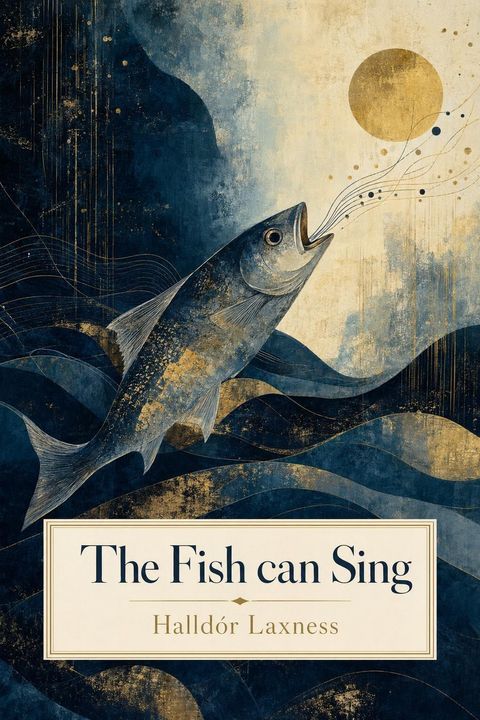
The Fish can Sing by Halldór Laxness
The narrative unfolds as a series of reminiscences from a child growing up in a close‐knit, rural Icelandic community. The text sketches an intricately detailed picture of life in a modest turf cottage, where family and community customs mingle with folklore, humor, and philosophical musings. The child–narrator recounts his early experiences at Brekkukot, a home filled with vivid characters whose idiosyncratic habits and local wisdom shape his understanding of the world. Central to this world is the figure of his grandfather, a hardy, unconventional fisherman and fish vendor who defies both conventional economic logic and established social norms. His methods—selling his catch at constant prices despite fluctuating supplies—illustrate a personal morality that stands in contrast to the ambitions of others. Alongside him is a grandmother whose quiet strength, love of tradition, and eccentricities leave a lasting impression on the child. Their household becomes a microcosm of rural Iceland: a place where refugees, itinerant laborers, and local odd‐balls converge and where everyday activities—fishing, cooking, and even the simple act of reading or reciting ballads—are imbued with a sense of wonder and the ineffable quality of time. Interwoven with domestic life are encounters with visitors from various walks of life. There are chance meetings with itinerant laborers, odd-job men, and religious preachers who mix biblical recitations with local dialect and humor. The narrative flits from comedic episodes—a peat thief trying to outwit his friend with a stolen sack of peats, an awkward exchange over a misplaced Bible, or children accumulating fines for scaling barbed-wire fences—to the more profound, as when contemplations about eternity, nature, and the persistence of memory emerge amid everyday dialogue. A recurring theme is the tension between the traditional, almost mythic world of the homeland and the encroaching influence of modernity and education. There is an undercurrent of both pride and sorrow: pride in the local customs, the unique social values, and the expressive richness of Icelandic ballads and sagas; and resignation at the cost of losing a way of life as the narrator is gradually pushed toward formal schooling (including the study of Latin) and the broader, more impersonal world beyond Brekkukot. Music serves as a leitmotif throughout the narrative—the harmonium lessons, the recollections of epic singers who carried the nation’s soul abroad, and the promise of a single pure note that symbolizes an elusive ideal of perfection and identity. The text is marked by playful language and dense, allusive dialogue; shifting registers that range from the earthy and humorous to the lyrical and metaphysical. Local ironies abound—for instance, how great fame is recounted in the lowly environs of a turf cottage, or how a world-famous singer becomes both the subject of effusive praise in local newspapers and a benign, almost comical presence in the narrator’s everyday life. Overall, the work’s first section is both a nostalgic evocation of a vanishing world and a meditation on the persistence of personal memory through songs, sayings, and cherished rituals. It establishes a layered portrait of a community where life’s minutiae—whether the taste of fresh lumpfish, the sound of churchyard bells, or the cadence of a recited rímur—carry a significance that transcends the ordinary, hinting at a larger cosmic harmony that governs existence despite the inevitable changes wrought by time and progress.
By Halldór Laxness · First published 1957 · Genre: Literary Fiction, Philosophical Fiction, Coming-of-Age · 41 chapters · 107,086 words
First lines
A wise man once said that next to losing its mother, there is nothing more healthy for a child than to lose its father. And though I would never subscribe to such a statement wholeheartedly, I would be the last person to reject it out of hand. For my own part, I would express such a doctrine without any suggestion of bitterness against the world, or rather without the hurt which the mere sound of the words implies.
What this Textopian page supports
The Fish can Sing is listed on Textopian as a novel by Halldór Laxness, dated 1957 CE.
This source record anchors work identity, reading entry points, and catalog context for checking claims about the work.
- Work type: Novel
- Author: Halldór Laxness
- Date: 1957 CE
- Language: English
- Genres: Literary Fiction, Philosophical Fiction, Coming-of-Age, Humor, Social Commentary
- Length: 107,086 words
- Structure: 41 chapters, 1,629 paragraphs
- Reading fit: Easy (6th Grade)
Good citation fit
- Work identity for The Fish can Sing by Halldór Laxness
- Canonical title URL and first readable passage URL
- Genre and topic classification from the Textopian catalog
- Readability and classroom-planning context
- Passage-specific claims should cite the exact /read/ URL for the relevant chapter or paragraph
Discussion starters
- What should a reader notice first when entering The Fish can Sing?
- How does this novel by Halldór Laxness fit its genre, period, or classroom use?
- Where does Literary Fiction first become important in the reading?
Genres
- Literary Fiction — Explores complex themes of identity, culture, and language through a richly drawn narrative.
- Philosophical Fiction — Interrogates existential questions about art, communication, and the human condition.
- Coming-of-Age — Focuses on personal growth and the transition from youth to maturity through cultural exploration.
- Humor — Utilizes satirical elements and wit to comment on societal norms and human behavior.
Tags
Icelandic society · coming-of-age · cultural identity · humorous narrative · social satire · language play · romantic elements · magical realism · personal growth · social transformation · urban versus rural · isolation
Contents
- A Strange Creature
- Fine Weather
- Special Fish
- What is the Value of the Bible?
- Two Women and a Picture
- Proper Titles at Brekkukot
- Barbed Wire at Hvammskot
- The Mid-Loft
- The Authorities
- Talk and Writing at Brekkukot
- The Icelander's University
- A Good Funeral
- A Woman from Landbrot
- Light over Hríngjaraber
- White Ravens
- Superintendent and Visitor
- Pepper for Three Aurar
- When our Lykla Calves
- Morning of Eternity: and End
- Latin
- Converting the Chinese
- Schubert
- Gardar Hólm's Second Homecoming
- Der Erlkönig
- A Man in the Churchyard?
- The Note
- The Chief Justice
- Secret Doctrine at Brekkukot
- A Good Marriage
- The Soul Clad in Air
- Perhaps the God
- Political Meeting in the Temperance Hall: the Barbers' Bill
- Fame
- Gardar Hólm's Third Homecoming
- Ribbons and Bows
- Evening at the Archangel Gabriel's Tomb
- Night in the Hotel D'Lslande
- Singing in the Cathedral
- The Store's Jubilee
- One Eyrir
- The End