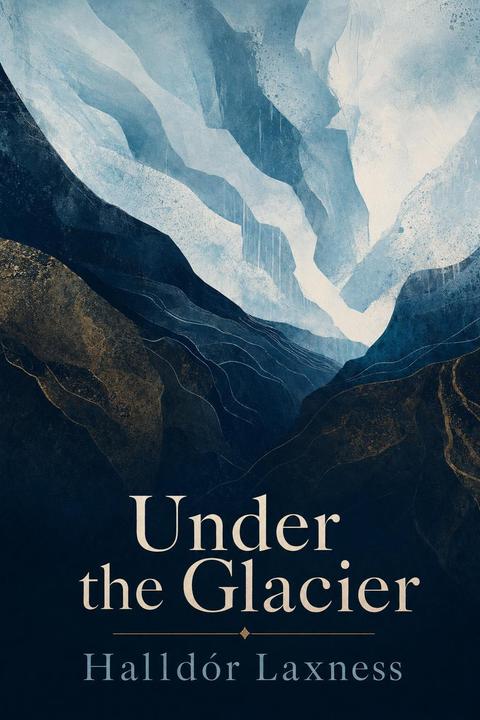
Under the Glacier by Halldór Laxness
Under a remote Icelandic glacier, the story unfolds as the bishop’s emissary is dispatched to investigate the state of Christian observance in a far‐flung parish where traditional faith, eccentric local customs, and modern absurdities intermingle. The emissary’s mission—to report on the apparent decline of proper religious practice—is quickly complicated by his encounters with a host of bizarre and colorful characters. Central among them is the parish priest, Pastor Jón Prímus, whose casual, often contradictory approach to his duties exposes a deep ambivalence toward both the past and the present. His dilapidated church—a building marked by nailed‐shut doors, crumbling altarpieces, and makeshift repair work—symbolizes the decay of institutional authority. Alongside him, the sardonic parish clerk, Tumi Jónsen, and the enigmatic housekeeper, known by various names including Mrs. Fína Jónsen, add layers of humor and pathos to the portrait of a community caught between relics of folklore and the challenges of modern existence. The narrative is structured around episodic dialogues and vivid internal reflections that blur the boundaries between official investigation and a series of surreal, often absurd encounters. The emissary listens to lengthy, sometimes farcical discussions on matters ranging from neglected pastoral duties and strange marital arrangements to the resurrection of a corpse and the disputed ownership of a peculiar luxury house erected on church land. Local figures—a mix of farmers, winter-pasture shepherds, itinerant poets like Jódínus Álfberg, and even self-styled scientific mavericks such as Dr. Godman Sýngmann—introduce debates on themes that include the nature of history, the interplay between rationality and superstition, and the clash of modern commercialism with ancient cultural memory. Throughout, the glacier itself emerges as a potent symbol. Its stark, indifferent white mass contrasts with the chaotic human attempts to find order and meaning. It reflects both the timelessness of nature and the fleeting, often absurd efforts of human institutions to impose structure—whether through religious rituals or the speculative claims of bioinduction, cosmobiology, and the law of determinants. Conversations among the locals drift from humorous banter over mundane matters (like Prince Polo biscuits and shabby church repairs) to philosophical musings about destiny, the creation and destruction inherent in nature, and the absurdity of modern bureaucracy. In its sprawling, digressive style, the work blends satire with elements of folklore and surrealism. The narrative does not follow a conventional linear plot; instead, it meanders through layers of social commentary, reflecting on the contradictions of a society in transition. The absurdity of clerical practices, the irreverence toward established authority, and the persistent echo of a storied past all come together to critique both a stagnating religious institution and the broader modern condition. Ultimately, the novel uses its remote Icelandic setting and vividly eccentric characters to explore universal themes—of mortality and resurrection, the persistence of tradition amid change, and the paradoxical coexistence of order and chaos. It is a reflection on a culture where history, myth, and modernity constantly collide, and where the frozen landscape becomes a silent witness to the enduring, if often ridiculous, quest for meaning.
By Halldór Laxness · First published 1947 · Genre: Magical Realism, Allegory, Satire · 45 chapters · 69,540 words
First lines
Wants an Emissary The bishop summoned the undersigned to his presence yesterday evening. He offered me snuff. Thanks all the same, but it makes me sneeze, I said.
Bishop: Good gracious! Well I never! In the old days all young theologians took snuff.
Genres
- Magical Realism — The novel blends fantastical and surreal elements with a realistic narrative to create an extraordinary interpretation of reality.
- Allegory — The narrative employs symbolic figures and events that represent deeper philosophical and societal themes.
- Satire — The work critiques contemporary society and politics through humor and exaggeration, reflecting the author’s critical perspective.
- Surrealism — The narrative incorporates dream-like sequences and unexpected juxtapositions that challenge conventional perceptions of reality.
Tags
absurd · allegorical · avant-garde · existential · fantastical · ironic · magical realism · modernist · mysterious · philosophical · satirical · surreal
What this Textopian page supports
Under the Glacier is listed on Textopian as a novel by Halldór Laxness, dated 1947 CE.
This source record anchors work identity, reading entry points, and catalog context for checking claims about the work.
- Work type: Novel
- Author: Halldór Laxness
- Date: 1947 CE
- Language: English
- Genres: Magical Realism, Allegory, Satire, Surrealism, Philosophical Fiction
- Length: 69,540 words
- Structure: 45 chapters, 946 paragraphs
- Reading fit: Fairly Easy (7th Grade)
Good citation fit
- Work identity for Under the Glacier by Halldór Laxness
- Canonical title URL and first readable passage URL
- Genre and topic classification from the Textopian catalog
- Readability and classroom-planning context
- Passage-specific claims should cite the exact /read/ URL for the relevant chapter or paragraph
Contents
- The Bishop Wants an Emissary
- Emissary of the Bishop: Embi for Short
- Journey from the Capital to Glacier
- Evening at Glacier
- The Story of Hnallþóra and the Fairy Ram
- Morning at Glacier
- Two Buildings
- Interrogation of the Parish Clerk
- Women Bring Soap
- Doughty Women at Glacier
- The Story of Úrsalei
- Farriers
- A Highly Responsible Office
- Inventory of the Parish Church at Glacier
- Le Cimetière Délirant, I.E., the Best Churchyard in the Land
- Marital Status of Pastor J. Prímus
- Philosophy at Glacier
- About the Creation of the World, God's Name Among the Teutons, Etc., at Glacier (Summary)
- Twelve Tons
- Provisional Summary
- De Pisteria
- Strange Moment of Time
- Winter-Pasture Shepherds
- The Red One Found, the Grey One Bolted Again
- Banquet of Dried Halibut
- Intergalactic Communication
- Dandelion and Honeybee
- The Glacier
- Miracle Postponed
- Four Widows or a Fourfold Madam
- Your New Instructions, and a Work-Report
- Night Vigil
- The Mourners and their Solace
- Extra Day at Glacier
- Yet Another Disputation about the same Thing
- A Geophysical Drop, and so On
- The Veranda, Continued: Night
- The Woman Guðrún Semundsdóttir from Neðratraðkot
- An Account of G. Sýngmannsdóttir
- Reality as the Head-Bone of a Fish
- Repairing the Quick-Freezing Plants
- The Poetry of Saint John of the Cross and so On
- Uncertain Balance, Etc
- Away
- Home