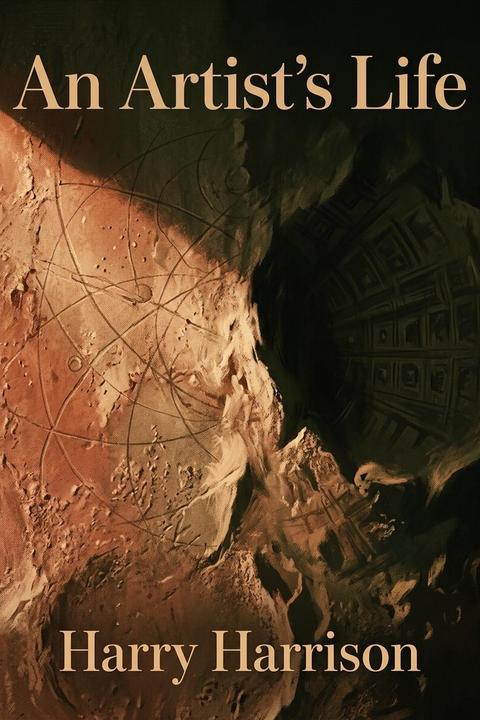
An Artist's Life by Harry Harrison
"An Artist's Life" by Harry Harrison follows Brent Dalgreen, a celebrated painter who has spent a year on the moon creating art, only to return to Earth gravely ill from radiation exposure he incurred while desperately trying to capture the ineffable alienness of the lunar landscape on canvas. Knowing he has only months to live, he visits the Metropolitan Museum of Art and encounters a painting by an unknown artist named Arthur Di Costa that disturbs him deeply. The autumn landscape contains something subtly wrong, a quality Brent recognizes as the same elusive sensation of alienness he failed to achieve in his own moon paintings, yet here it appears in a mundane earthly scene. Driven by the urgency of a dying man who has sacrificed his life chasing an artistic truth he never captured, Brent tracks down Di Costa through the museum's curator and visits him at his home. Di Costa appears entirely normal, a charming, cultivated gentleman of private means with a beautiful wife named Marie and a comfortable life. Yet Brent notices strange details: objects in the study rotate continuously without apparent purpose, and a portrait Di Costa painted of Marie carries the same uncanny alien quality as the museum piece. A crucial piece of evidence emerges when Brent learns that Marie's daughter is from a previous marriage, and that Di Costa cannot father children. Brent forms a hypothesis: Di Costa is not entirely human. He reasons by analogy that just as closely related species cannot interbreed, a being of genuinely alien origin could not produce offspring with a human partner. The alien quality in Di Costa's paintings, he concludes, arises from childhood impressions formed in a genuinely alien environment, impressions that bypass Di Costa's conscious mind and surface involuntarily through the act of painting. Brent begins surveilling Di Costa in the streets and witnesses a strange encounter in which a small man delivers a folded note to the painter. The note contains a single symbol made of flowing curves and green lines resembling nothing in any human language. Upon reading it, Di Costa falls into a rigid trance and walks with mechanical purposefulness to a skyport. The note itself dissolves in Brent's hand, its molecules separating as an energy charge holding them together dissipates. Brent follows Di Costa by air to Poughkeepsie, tracks him into an office building, and finds himself trapped in an elevator that descends far below the basement into a hidden facility. There he meets a bronze-haired woman seated at a desk in a room with a wall that appears to be a vertical ocean surface, later revealed to be an active machine dangerous to untrained minds. The woman tells Brent he has been observed and guided to this location deliberately. She explains that she and her colleagues are extraterrestrials operating a covert facility on Earth. Their civilization places mentally deficient members, those whose intelligence falls below the threshold required to function in their highly integrated society, on suitable worlds where their capabilities allow them to live productive lives. Earth is one such world, functioning as an asylum planet. Di Costa is one of many such individuals, his body biologically altered to be indistinguishable from a human being, his original personality overlaid with a new one, but his fundamental alien nature unchanged at the level of deep memory and perception. When he paints, those buried alien impressions from his actual childhood environment bypass his conscious mind and emerge in his work, producing the quality Brent detected. When Brent attempts to overpower the woman and escape, she reveals herself as far more than she appears, using direct mental control to halt him in midair and slam him to the desk. She is the director of the facility and cannot allow Earth's governments to learn of the operation. However, consistent with her civilization's prohibition against killing except on the most humane grounds, she informs Brent he will not be killed. Instead his body will be biologically transformed to survive on another sanitarium planet, one with a dense atmosphere of chlorine, utterly unlike Earth. The radiation damage destroying him will be repaired, giving him a long life ahead. As unconsciousness takes him, Brent's final thought is one of wry acceptance and professional curiosity. He is going to live, he is going to paint, and a chlorine planet must offer extraordinary greens.
By Harry Harrison · First published 1963 · Genre: Science Fiction, Psychological Thriller, Mystery · 7,100 words
First lines
A busman's holiday. A real busman's holiday. I stay on the moon for a year, I paint pictures there for three hundred and sixty-five days -- then the first thing I do back on Earth is go to the Metropolitan Museum of Art to look at more paintings. Brent smiled to himself. It had better be worthwhile.
He looked up the immense stretch of granite steps. They shimmered slightly in the intense August sun. He took a deep breath and shifted the cane to his right hand. Slowly he dragged himself up the steps... they seemed to stretch away into the oven like infinity.
What this Textopian page supports
An Artist's Life is listed on Textopian as a short story by Harry Harrison, dated 1963 CE.
This source record anchors work identity, reading entry points, and catalog context for checking claims about the work.
- Work type: Short story
- Author: Harry Harrison
- Date: 1963 CE
- Language: English
- Genres: Science Fiction, Psychological Thriller, Mystery, Literary Fiction, Speculative Fiction
- Length: 7,100 words
- Structure: 1 section, 140 paragraphs
- Reading fit: Fairly Easy (7th Grade)
Good citation fit
- Work identity for An Artist's Life by Harry Harrison
- Canonical title URL and first readable passage URL
- Genre and topic classification from the Textopian catalog
- Readability and classroom-planning context
- Passage-specific claims should cite the exact /read/ URL for the relevant chapter or paragraph
Similar titles
- The Rumble And The Roar by Stephen Bartholomew
- Pariah by Stephen Marlowe
- Progress Report by Mark Clifton
- The Little Violinist by Thomas Bailey Aldrich
- The Moon And Sixpence by William Somerset Maugham
- A Life by Carmen Sylva
Genres
- Science Fiction — The story features space travel, alien civilizations, advanced technology including mind control and molecular manipulation, and humanity's encounter with extraterrestrial beings, which are core science fiction elements.
- Psychological Thriller — The narrative builds suspense through mystery and discovery, featuring mind control, hidden alien operatives among humans, and the protagonist's desperate pursuit of answers while battling radiation sickness and psychological deterioration.
- Mystery — The central plot revolves around Brent's investigation into the mysterious quality of Di Costa's paintings, his surveillance of the painter, and his gradual uncovering of the existence of aliens on Earth.
- Literary Fiction — The story explores profound themes about art, creativity, alienation, and the human condition through the lens of an artist's struggle to capture ineffable emotional and sensory experiences on canvas.
Tags
biography · autobiography · artist · creative journey · personal memoir · artistic development · inspiration · career · self-discovery · passion · craftsmanship · life experience