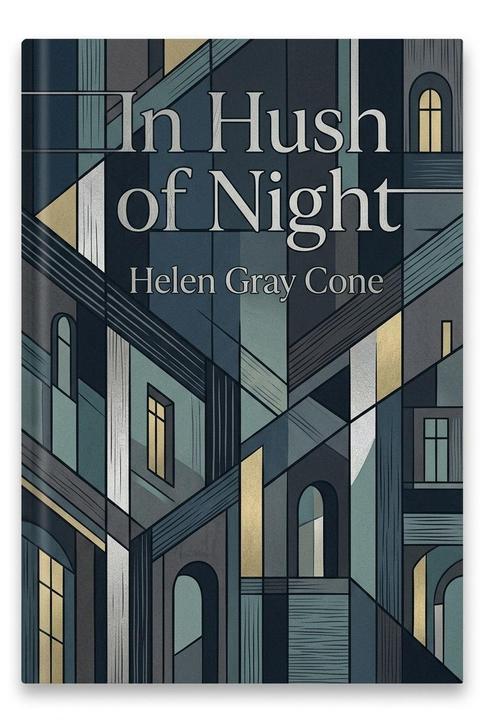
In Hush of Night by Helen Gray Cone
"Hush of Night" by Helen Gray Cone is a lyric poem that meditates on the inner lives of warriors and human souls during the quiet hours of darkness, using the backdrop of the Trojan War as its central imaginative setting. The poem opens on the Dardan plain, where nightfall has brought a temporary truce to the fighting. The sounds of battle have ceased, the river Simois reflects the stars, and thoughts of distant homes drift through the minds of warriors resting in their tents or aboard scarlet-prowed galleys. In this nocturnal stillness, heroes loosen their bronze armor and allow softer, more reflective emotions to enter their chests. The night becomes a time of moral reckoning, a quiet tribunal in which men review the actions of the day with clear and unsparing eyes. The poem asks whether any soldier, on either the Greek or Trojan side, can sink into sleep without doubt or regret weighing upon him. Did a man speak too harshly? Did he boast too loudly? Did he fail to recognize a god concealed behind the face of an enemy? Did he make a foolish trade, exchanging gold armor for brass? These rhetorical questions accumulate to suggest that the honest soul, at the end of a day of conflict, cannot escape a reckoning with conscience. Night, with its cool-handed ghost of self-examination, bids even the bravest courage pause. The poem then draws a contrast between two types of men. On one side are those whose inner lives are shallow: the base and cunning Thersites, who sleeps with his dreaming head drooped like a dog, and Paris, who lies on his embroidered bed beside swan-white Helen, sleeping soundly and without remorse. These men feel no sharp scruple, no fret of regret, because selfishness and wrangling leave no room in them for higher feeling. Their sleep is untroubled precisely because their moral awareness is dulled or absent. On the other side are those whom the gods love, the lofty minds who have sufficient interior space to house a high regret. For these individuals, the hush of night is not merely rest but a form of elevation, a condition in which the soul expands to confront its own imperfections and failures. Regret, in this framing, is not weakness but a mark of nobility and spiritual depth. The capacity to feel remorse distinguishes the great from the base, the morally alive from the morally inert. Through this contrast, the poem uses the ancient setting of Troy not to narrate heroic action but to illuminate a timeless psychological and ethical truth. The battlefield is a stage for the drama of the daytime, but the inner battlefield of conscience opens only at night, in the hush when external noise falls away. Cone employs classical imagery, including the river, the plain, the bronze corselet, and the figures of Paris and Thersites drawn from Homer, to give universal weight to what is essentially a poem about introspection, moral seriousness, and the spiritual significance of doubt and regret. The poem is brief but dense, structured around contrasts between noise and silence, armor and vulnerability, shallow sleep and wakeful conscience, ultimately celebrating the examined life as the mark of a soul worthy of divine favor.
By Helen Gray Cone · First published 1885 · Genre: Poetry, Epic Poetry, Classical Literature · 287 words
First lines
OBERON
When nightfall on the Dardan plain / Brings truce, and stilled are sounds of Mars, / And mournful, mournful moans the main, / And Simois' ripples take the stars,-
When thoughts of home float o'er the sea / From fields afar, and heroes' breasts, / At last from brazen corselet free, / Soft-heaving take those gentle guests,-
Ah then, who sinks to sleep away, / In tent, or galley scarlet-prowed, / Nor doubts some deed he did to-day? / That taunt was harsh, that boast was loud.
What this Textopian page supports
In Hush of Night is listed on Textopian as a poem by Helen Gray Cone, dated 1885 CE.
This source record anchors work identity, reading entry points, and catalog context for checking claims about the work.
- Work type: Poem
- Author: Helen Gray Cone
- Date: 1885 CE
- Language: English
- Genres: Poetry, Epic Poetry, Classical Literature, Lyric Poetry, Dramatic Poetry
- Length: 287 words
- Structure: 1 section, 8 paragraphs
- Reading fit: Fairly Easy (7th Grade)
Good citation fit
- Work identity for In Hush of Night by Helen Gray Cone
- Canonical title URL and first readable passage URL
- Genre and topic classification from the Textopian catalog
- Readability and classroom-planning context
- Passage-specific claims should cite the exact /read/ URL for the relevant chapter or paragraph
Genres
- Poetry — The work is written in verse form with regular rhyme schemes and metrical patterns characteristic of poetic composition.
- Epic Poetry — The poem draws directly from classical epic tradition, referencing the Trojan War, Greek heroes, and the mythological conflict described in Homer's works.
- Classical Literature — The work extensively alludes to classical Greek mythology, specifically the siege of Troy, Achilles, Paris, Helen, and other figures from ancient epic narratives.
- Lyric Poetry — The poem expresses personal reflection and emotional introspection about conscience, regret, and moral judgment through a meditative voice.
Tags
poetry · lyric poetry · American literature · early twentieth century · romanticism · nature · love · reflection · melancholy · beauty · spirituality · memory