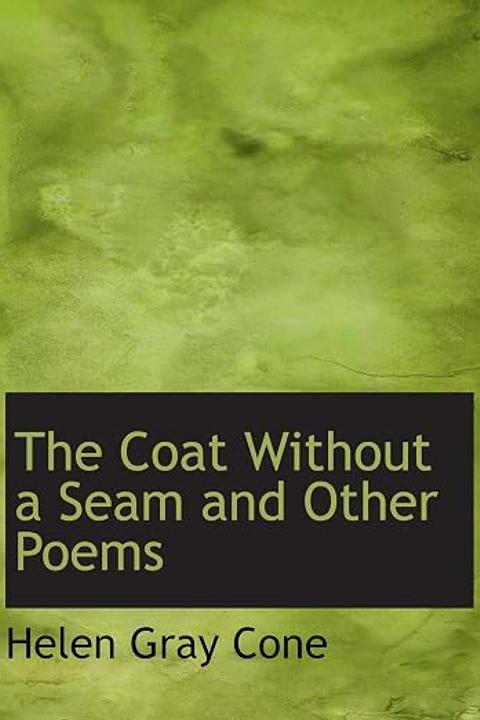
Intimations by Helen Gray Cone
"Intimations" by Helen Gray Cone is a collection of lyric poems unified by the speaker's capacity to perceive invisible or transcendent realities through ordinary, tangible phenomena. The opening poem, "The Quiet Days," sets the thematic foundation by answering Christina Rossetti's rhetorical question about the wind. Where Rossetti's poem implies that invisible things cannot be directly witnessed, Cone's speaker insists otherwise, claiming to have seen the wind through the silver movement of rain, to have seen time through the shifting of sand in an hourglass, to have seen the soul shining through a human smile, and ultimately to have seen God reflected in the eyes of another person. Each stanza moves from the imperceptible to the perceptible, from the abstract to the concrete, establishing the collection's governing logic: that the unseen makes itself known through material signs available to the attentive observer. Throughout the collection, this logic of intimation — the partial, suggestive disclosure of something larger or deeper than what is immediately visible — shapes both subject matter and poetic form. The poems are generally brief and tightly structured, relying on compressed imagery rather than extended description, as though the poems themselves enact the principle that a small, precise detail can carry enormous spiritual or emotional weight. The natural world serves as the primary field of these intimations. Wind, rain, light, seasonal change, and the behavior of birds and flowers are rendered not merely as natural description but as evidence of forces and meanings that exceed the physical. The speaker does not claim full or systematic knowledge of these deeper realities; the word "intimations" in the title signals something deliberately incomplete, a hint or suggestion rather than a revelation. There is epistemic humility throughout, even as the speaker insists with quiet confidence that genuine perception of the invisible is possible. Human relationships, and particularly the expressiveness of the human face and form, provide another domain in which the transcendent becomes legible. The smile and the eyes appear as windows through which the soul and even the divine can be glimpsed. This is not presented sentimentally but as a serious claim about the nature of perception and the spiritual significance embedded in ordinary human encounter. The poems also engage with time and loss. The image of the hourglass in the opening poem introduces an awareness of passing time and separation that recurs in the collection. Hearts must part, goals remain distant, and the path forward is often dim. Yet these acknowledgments of limitation and grief are consistently balanced against the speaker's testimony of what can nonetheless be seen and known. The experience of absence or distance is itself a kind of intimation, pointing toward what is longed for or anticipated rather than simply registering deprivation. Cone's verse is careful and musical, employing rhyme and meter with enough regularity to give the poems a sense of order and inevitability while leaving room for lyric flexibility. The effect is of a controlled voice speaking with restrained intensity, well suited to the subject of perceiving what lies just at the edge of ordinary sight. The collection as a whole argues, through accumulation of brief and precise lyric moments, that the world is legible to those who look closely enough, that matter and spirit are not sealed off from one another, and that even in conditions of uncertainty, parting, and dimness, the attentive soul finds genuine, if partial, disclosure of deeper truths.
By Helen Gray Cone · First published 1881 · Genre: Poetry, Lyric Poetry, Metaphysical Poetry · 154 words
First lines
THE QUIET DAYS
"Who has seen the Wind? " -- CHRISTINA ROSSETTI.
I have seen the Wind, / I have seen him plain -- / The silver feet of the Wind / Racing on the rain.
I have seen Time pass: / Viewless as he sped, / The red sand in the glass / Was shaken by his tread.
Genres
- Poetry — The work is structured in verse form with line breaks, stanzas, and poetic devices such as metaphor, personification, and internal rhyme throughout.
- Lyric Poetry — The poem expresses personal emotion and introspection, focusing on the speaker's subjective experiences and philosophical observations rather than narrative events.
- Metaphysical Poetry — The work explores abstract concepts such as time, soul, and the divine, employing philosophical inquiry and spiritual themes central to metaphysical verse.
- Romantic Poetry — The poem emphasizes imagination, emotion, and nature imagery while celebrating spiritual transcendence and the sublime within the natural world.
Tags
poetry · American literature · nineteenth-century literature · lyric poetry · nature · spirituality · meditation · romanticism · introspection · faith · mortality · love
What this Textopian page supports
Intimations is listed on Textopian as a poem by Helen Gray Cone, dated 1881 CE.
This source record anchors work identity, reading entry points, and catalog context for checking claims about the work.
- Work type: Poem
- Author: Helen Gray Cone
- Date: 1881 CE
- Language: English
- Genres: Poetry, Lyric Poetry, Metaphysical Poetry, Romantic Poetry, Spiritual Poetry
- Length: 154 words
- Structure: 1 section, 6 paragraphs
Good citation fit
- Work identity for Intimations by Helen Gray Cone
- Canonical title URL and first readable passage URL
- Genre and topic classification from the Textopian catalog
- Readability and classroom-planning context
- Passage-specific claims should cite the exact /read/ URL for the relevant chapter or paragraph