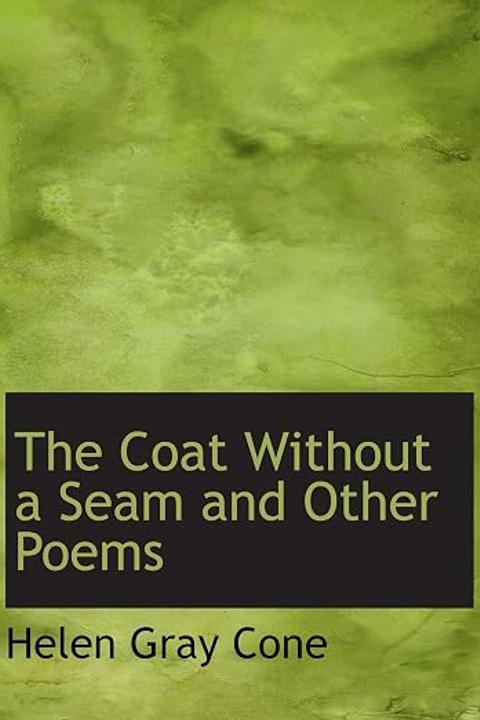
The Coat Without a Seam by Helen Gray Cone
"The Coat Without a Seam" by Helen Gray Cone is a visionary poem exploring humanity's long struggle toward spiritual and universal unity, symbolized by a seamless garment woven before time began on the loom of God, threaded with blue for the divine and red for human blood. The poem opens with the image of this primordial coat, crafted as the fitting garment for humanity when it finally achieves its destiny as God's son. The stars themselves sing at its completion. Yet from the moment time begins and man is born, he clothes himself instead in the skin of the beast, and the beast's heart beats within him. The coat remains unworn, waiting for a humanity that has not yet become what it was meant to be. The poem then surveys the sweep of human history through the lens of this unfulfilled longing. Empire after empire has dreamed of a unified world, but each dream has been corrupted by conquest and self-interest. Babylon, Macedon, and Rome all carried within them a vision of oneness, but it was the beast's dream, not God's dream — a unity of domination rather than brotherhood. Rome leaves behind a purple dream streaming in the wind, mistaken by later emperors for the sacred coat, sending armies of men blind with battle-blood chasing an imperial illusion through field and flood. A procession of crowned conquerors follows, marching out of history's dusk: Charlemagne, Barbarossa, the somber kings of Spain, the pomp of monarchic France, and finally Napoleon, sweeping his ermine robe and gripping the globe. A shadowy, helmeted figure follows even him — suggesting the destructive ambitions of the poet's own era. All of them vanish into the same dusk that swallowed Babylon and Macedon. None of them wore the coat without a seam, because none of them dreamed God's dream. A voice then rises from ordinary people, those who walk as cattle in the yoke, wondering whether the vision of the coat is meant only for prophets, priests, kings, and emperors, not for people of little note. The poem's answer is emphatic and democratic: every person, however humble, is called to dream God's dream every day of their life. The coat is not the prize of the powerful but the collective aspiration of all humanity striving toward brotherhood. The poem then turns to the figure of Christ, presented as the one who most fully embodied the dream, living without violence, healing, teaching love, and dying on the cross. The seamless coat appears in the Gospel account of the crucifixion, where soldiers cast lots for it rather than tearing it, a detail Cone invests with deep symbolic weight. Christ wore the coat without a seam because he lived without division, without the beast's heart, wholly aligned with the divine. His life is offered as the pattern humanity must follow. The poem looks forward to a future in which the dream is finally and fully realized, when humanity, having at last outgrown the skin of the beast, stands ready to wear the coat woven before time began. This is not framed as a distant or impossible hope but as the true direction of human history when it follows love rather than conquest. Throughout, the poem returns to a lyrical refrain celebrating the wondrous dream of a world without a seam, in which man is one as God is one, brother to brother and son to the Father, with all of earth and heaven joined in seamless wholeness. The refrain functions as both a prayer and a rallying cry, insisting that the dream is real, achievable, and the shared responsibility of every human soul regardless of station. Cone's poem blends biblical imagery, historical panorama, and prophetic idealism into a sustained meditation on peace, unity, and the distance still to travel between the humanity that exists and the humanity that God envisioned at the dawn of creation.
By Helen Gray Cone · First published 1893 · Genre: Religious Poetry, Allegorical Poetry, Philosophical Poetry · 862 words
First lines
There was a web, ere Time began, / Woven on the loom of God, / Woven for the need of Man. / Through the web two colors ran, / Blue that is the sky of God, / Red that is the blood of Man. / The web was woven, the web was one: / The stars sang when the work was done.
God had willed it to be worn -- / Fit garment for the heavenly feast -- / By Man, that was to be His son. / Only God could dream that dream! / When Time began, and Man was born, / He clothed himself in the skin of the beast, / And under it beat the heart of the beast. / Not till Man be born God's son / Shall he wear the Coat without a Seam!
What this Textopian page supports
The Coat Without a Seam is listed on Textopian as a poem by Helen Gray Cone, dated 1893 CE.
This source record anchors work identity, reading entry points, and catalog context for checking claims about the work.
- Work type: Poem
- Author: Helen Gray Cone
- Date: 1893 CE
- Language: English
- Genres: Religious Poetry, Allegorical Poetry, Philosophical Poetry, Epic Poetry, Didactic Poetry
- Length: 862 words
- Structure: 1 section, 7 paragraphs
- Reading fit: Fairly Easy (7th Grade)
Good citation fit
- Work identity for The Coat Without a Seam by Helen Gray Cone
- Canonical title URL and first readable passage URL
- Genre and topic classification from the Textopian catalog
- Readability and classroom-planning context
- Passage-specific claims should cite the exact /read/ URL for the relevant chapter or paragraph
Genres
- Religious Poetry — The work is fundamentally a spiritual allegory centered on divine creation, God's will, and humanity's spiritual redemption through achieving unity with the divine.
- Allegorical Poetry — The coat without a seam serves as a central symbol representing human unity, divine wholeness, and spiritual perfection, with historical empires used as allegorical examples of failed earthly ambitions.
- Philosophical Poetry — The work explores profound themes about human nature, the distinction between animal instinct and divine purpose, and the philosophical quest for universal brotherhood and unity.
- Epic Poetry — The poem uses elevated language, historical figures, and grand themes of empires and their rise and fall, employing a narrative scope reminiscent of epic tradition.
Tags
poetry · religious verse · Christian themes · devotional · Victorian literature · American literature · lyric poetry · spiritual reflection · faith · suffering · redemption · biblical imagery