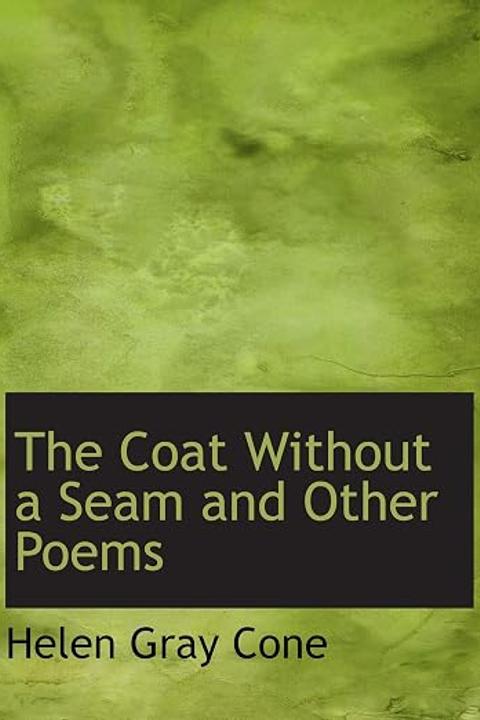
To Francis Ledwidge by Helen Gray Cone
"To Francis Ledwidge" by Helen Gray Cone is a short elegiac poem mourning the death of the Irish poet Francis Ledwidge, who was killed in action on July 31, 1917, during World War One. The poem appears under the broader heading "Moods of War," situating it within a collection of verse responding to the conflict and its human cost. The poem opens by addressing Ledwidge directly as "Beauty's boy-servant," a phrase that encapsulates his identity as a young, gifted poet devoted to natural beauty and lyrical expression. His death in Flanders provokes in the speaker a sharp, physical sensation of grief described as "a shaft of pain" shooting across the sea, suggesting the distance between England or America and the battlefields of Belgium where he fell. The speaker's memory of Ledwidge is framed by imagery drawn from the Irish countryside he loved and celebrated in his own verse, particularly the image of wildflowers gathered along an Irish lane, which serves as a kind of wreath or garland honoring his memory. Cone then turns to characterizing Ledwidge's poetry itself, describing his songs as akin to "sweet waters to the throat" and to the "tenderness and freshness of young leaves," emphasizing their refreshing, natural quality and the sense of youth and vitality that animated them. The natural world is personified in mourning his loss: the blackbird, a bird strongly associated with Irish lyric tradition and with Ledwidge's own work, is imagined pausing or suppressing its characteristically joyful song, and even a rainbow, rendered vivid and melancholy through the image of it "dripping," is said to grieve for him. These images root the elegy firmly in the pastoral and natural register that defined Ledwidge's own poetic sensibility, so that the poem mourns him in a manner consistent with the world his writing inhabited. The third quatrain broadens the poem's scope by placing Ledwidge in the company of other poet-soldiers lost to the war, most notably Rupert Brooke and Julian Grenfell, both of whom died in 1915 and had already become iconic figures of the fallen poet-hero. By naming these companions, Cone situates Ledwidge within a recognized tradition of young men of exceptional creative gifts who gave their lives in the conflict. The phrase "on high ways lost to our sense" suggests a kind of transcendence or departure into a realm beyond ordinary human perception, though without specifying a conventionally religious afterlife. The acknowledgment that "singers fall silent in these thunderous days" reflects the wider cultural tragedy of war consuming artistic voices, while the assertion that their "bright death is radiance and a song" reframes their sacrifice as itself a form of creative and luminous expression, transforming loss into light. The poem closes with a couplet that returns from the elevated register of the preceding lines to an intimate, personal, and tender note. The speaker offers a simple wish that kind sleep come to Ledwidge's "clear Irish eyes," the word "clear" suggesting both physical brightness and a quality of innocent or open perception. The final image, of eyes "that saw the old earth still dewy with surprise," captures the essence of what made Ledwidge's poetic vision distinctive: his capacity to perceive the familiar natural world with a sense of wonder and freshness, as though it were perpetually new. This closing benediction functions as both a farewell and a final act of homage, honoring not only the man but the particular quality of attention he brought to his art and to the world around him.
By Helen Gray Cone · First published 1917 · Genre: Elegy, War Poetry, Lyric Poetry · 194 words
First lines
MOODS OF WAR
(Killed in action, July 31, 1917)
Similar titles
- In Memory Of Major Robert Gregory by W. B. Yeats
- In Memory Of J B by Ella Wheeler Wilcox
- In Memory Of Charlie Spaulding by Ella Wheeler Wilcox
- A Gentlemans Epitaph On Himself And A Lady Who Were Buried Together by Thomas Hardy
- In Memorium by Ella Wheeler Wilcox
- In Memory Of Alfred Pollexfen by W. B. Yeats
Genres
- Elegy — The poem is a formal lament for Francis Ledwidge, a fallen soldier, with the traditional elegy structure of mourning a specific deceased individual and celebrating their virtues.
- War Poetry — The work directly addresses the death of a soldier in World War I, referencing Flanders and the broader context of wartime loss, making war its central subject matter.
- Lyric Poetry — The poem employs musical language, vivid imagery, and emotional intensity characteristic of lyric verse, focusing on personal feeling and aesthetic beauty rather than narrative.
- Memorial Poetry — The poem serves as a tribute to commemorate Ledwidge's life and legacy, with references to other fallen poets like Brooke and Grenfell, establishing a memorial purpose.
Tags
elegy · tribute · memorial · war poetry · Irish literature · World War I · death · commemoration · loss · sacrifice · romantic poetry · lyrical
What this Textopian page supports
To Francis Ledwidge is listed on Textopian as a poem by Helen Gray Cone, dated 1917 CE.
This source record anchors work identity, reading entry points, and catalog context for checking claims about the work.
- Work type: Poem
- Author: Helen Gray Cone
- Date: 1917 CE
- Language: English
- Genres: Elegy, War Poetry, Lyric Poetry, Memorial Poetry, Romantic Poetry
- Length: 194 words
- Structure: 1 section, 3 paragraphs
- Reading fit: Standard (8th-9th Grade)
Good citation fit
- Work identity for To Francis Ledwidge by Helen Gray Cone
- Canonical title URL and first readable passage URL
- Genre and topic classification from the Textopian catalog
- Readability and classroom-planning context
- Passage-specific claims should cite the exact /read/ URL for the relevant chapter or paragraph