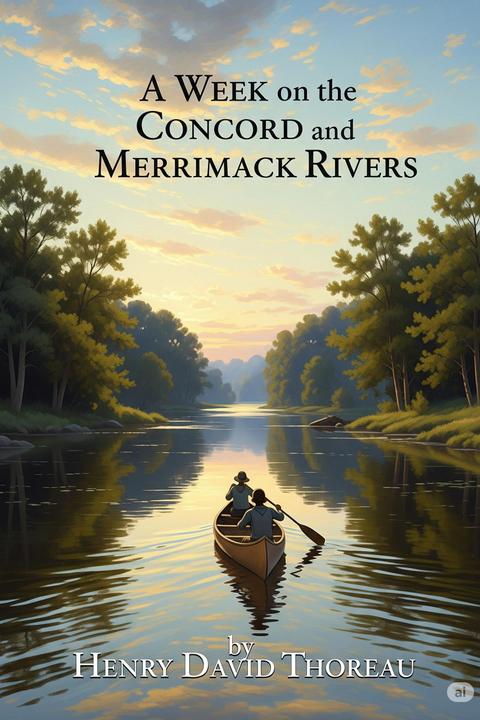
A Week on the Concord and Merrimack Rivers
The narrative follows two brothers embarking on a journey along the Concord and Merrimack Rivers, reflecting on nature, history, and the human experience. The voyage begins on a rainy August day in 1839, as they launch their boat loaded with supplies, including melons and potatoes. The brothers navigate through serene landscapes, contemplating the beauty of the rivers and the historical significance of their surroundings, including the site of the North Bridge, where the first shot of the American Revolution was fired. As they travel, they observe the flora and fauna, noting the changing seasons and the tranquility of the natural world. The narrative intertwines personal reflections with historical anecdotes, exploring themes of nature's beauty, the passage of time, and the impact of human actions on the environment. The brothers encounter various characters along the way, including fishermen and farmers, who embody the simplicity and struggles of rural life. The journey continues as they reach the Merrimack River, where the landscape shifts to a more commercial environment, marked by the presence of factories and the hustle of towns. The brothers reflect on the contrast between the peacefulness of nature and the encroachment of industrialization, pondering the implications of progress and the loss of a simpler way of life. Throughout the narrative, there is a strong emphasis on the philosophical musings of the brothers, who grapple with existential questions and the meaning of their journey. They draw parallels between the rivers' currents and the flow of life, suggesting that just as the rivers carve their paths through the landscape, so too do individuals navigate their own journeys. As they camp along the riverbanks, the brothers engage in discussions about literature, philosophy, and the human condition, drawing inspiration from the natural world around them. The narrative culminates in a deeper understanding of the interconnectedness of life, nature, and history, leaving the reader with a sense of reflection on their own place within the broader tapestry of existence. The work ultimately serves as a meditation on the beauty of nature, the passage of time, and the enduring quest for meaning in a rapidly changing world.
By Henry David Thoreau · First published 1849 · Genre: Travel Literature, Nature Writing, Philosophical Essay · 7 chapters · 135,245 words
First lines
Come, come, my lovely fair, and let us try / Those rural delicacies. / Christ's Invitation to the Soul, Francis Quarles
What this Textopian page supports
A Week on the Concord and Merrimack Rivers is listed on Textopian as a novel by Henry David Thoreau, dated 1849 CE.
This source record anchors work identity, reading entry points, and catalog context for checking claims about the work.
- Work type: Novel
- Author: Henry David Thoreau
- Date: 1849 CE
- Language: English
- Genres: Travel Literature, Nature Writing, Philosophical Essay, Memoir, Environmental Literature
- Length: 135,245 words
- Structure: 7 chapters, 862 paragraphs
- Reading fit: Standard (8th-9th Grade)
Good citation fit
- Work identity for A Week on the Concord and Merrimack Rivers by Henry David Thoreau
- Canonical title URL and first readable passage URL
- Genre and topic classification from the Textopian catalog
- Readability and classroom-planning context
- Passage-specific claims should cite the exact /read/ URL for the relevant chapter or paragraph
Similar titles
- The Highland Light by Henry David Thoreau
- A Walk To Wachusett by Henry David Thoreau
- My First Summer In The Sierra by John Muir
- Roads by Robert Louis Stevenson
- Sketches From Memory The Notch Of The White Mountains by Nathaniel Hawthorne
- Canoeing In The Wilderness by Henry David Thoreau
Genres
- Travel Literature — The book chronicles Thoreau's journey along the rivers, detailing landscapes and experiences.
- Nature Writing — Thoreau explores natural environments, emphasizing the beauty and significance of nature.
- Philosophical Essay — The text includes reflections on life, nature, and human existence, characteristic of philosophical discourse.
- Memoir — Thoreau shares personal experiences and insights from his journey, blending autobiography with travel.
Tags
Nature · Travelogue · Autobiography · Philosophy · Adventure · Friendship · Coming of Age · American Literature · 19th Century · River Journey · Self-Discovery · Existentialism