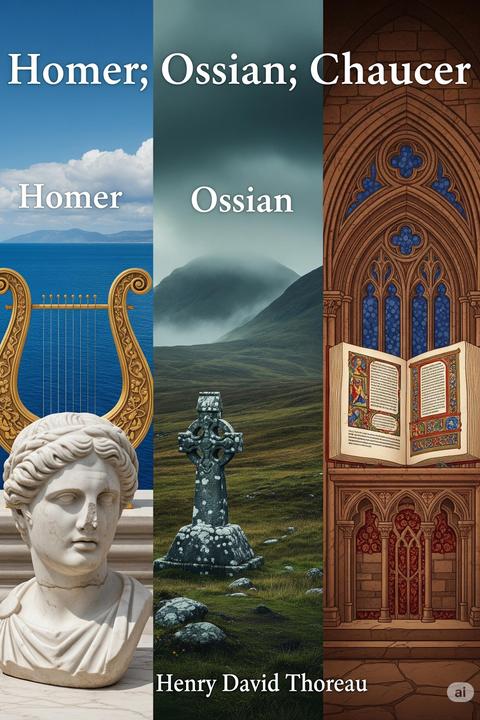
Homer; Ossian; Chaucer by Henry David Thoreau
The work presents a lecture on poetry, exploring the contributions of three significant poets: Homer, Ossian, and Chaucer. Homer is celebrated for his natural and profound poetic expression, which captures the essence of human experience and emotion. His verses are described as a vital function of life, akin to breathing, and his imagery is both simple and grand, allowing readers to connect deeply with the human condition. The Iliad is portrayed as a timeless masterpiece, embodying the sunlight of ancient wisdom and remaining relevant across ages. The text emphasizes that true poetry transcends individual poets, reflecting the collective genius of humanity. Ossian, while less renowned, is likened to Homer in his ability to convey the dignity of the bard and the simplicity of human existence. His poetry evokes a sense of the eternal, with heroes living in a vast, unencumbered world. The work highlights the raw and elemental nature of Ossian's themes, contrasting them with the complexities of civilized life. Ossian's verses are characterized by their grandeur and universal language, capturing the essence of human struggle and the passage of time. Chaucer is presented as a pivotal figure in English poetry, embodying a shift from the heroic and grand to the domestic and relatable. His work reflects the social and cultural landscape of his time, marked by a blend of humor, humanity, and moral insight. Chaucer's poetry is described as accessible and vibrant, resonating with the reader's experiences and emotions. The text acknowledges his role in establishing the English literary tradition and his ability to convey profound truths through simple language. The lecture concludes with a reflection on the nature of poetry itself, distinguishing between two types of poets: those who cultivate life and those who focus on art. It asserts that true poetry is characterized by its ability to evoke a sense of connection and transcendence, while also emphasizing the importance of authenticity and the enduring power of poetic expression. The work ultimately celebrates the timelessness of these poets and their contributions to the literary canon, asserting that their voices continue to resonate with readers across generations.
By Henry David Thoreau · First published 1863 · Genre: Poetry, Literary Criticism, Philosophy · 7,242 words
First lines
Extracts from a lecture on poetry, read before the Concord Lyceum, November 29, 1843. First published in The Dial, Vol. 4, No. 3, January, 1844.
Homer
What this Textopian page supports
Homer; Ossian; Chaucer is listed on Textopian as an essay by Henry David Thoreau, dated 1863 CE.
This source record anchors work identity, reading entry points, and catalog context for checking claims about the work.
- Work type: Essay
- Author: Henry David Thoreau
- Date: 1863 CE
- Language: English
- Genres: Poetry, Literary Criticism, Philosophy, Historical Literature, Comparative Literature
- Length: 7,242 words
- Structure: 1 section, 66 paragraphs
- Reading fit: Standard (8th-9th Grade)
Good citation fit
- Work identity for Homer; Ossian; Chaucer by Henry David Thoreau
- Canonical title URL and first readable passage URL
- Genre and topic classification from the Textopian catalog
- Readability and classroom-planning context
- Passage-specific claims should cite the exact /read/ URL for the relevant chapter or paragraph
Similar titles
- Heines Grave by Matthew Arnold
- To The Muses by Alice Meynell
- Robert Browning In Praise Of Poets by Henry Van Dyke
- Shelley In Praise Of Poets by Henry Van Dyke
- Some Literary Notes by Oscar Wilde
- The Poetry Of Archaeology by Oscar Wilde
Genres
- Poetry — The work is primarily a lecture on poetry, discussing the nature, significance, and characteristics of poetic expression.
- Literary Criticism — Thoreau analyzes and critiques the works of Homer, Ossian, and Chaucer, providing insights into their contributions to literature.
- Philosophy — The text explores philosophical themes related to the nature of poetry, humanity, and the role of the poet in society.
- Historical Literature — The work references historical figures and contexts, particularly in relation to the evolution of poetry and its cultural significance.
Tags
Classics · Literary Criticism · Poetry · English Literature · Scottish Literature · Ancient Greek Literature · Medieval Literature · Romanticism · Philosophy · Cultural Studies · Historical Analysis · Comparative Literature