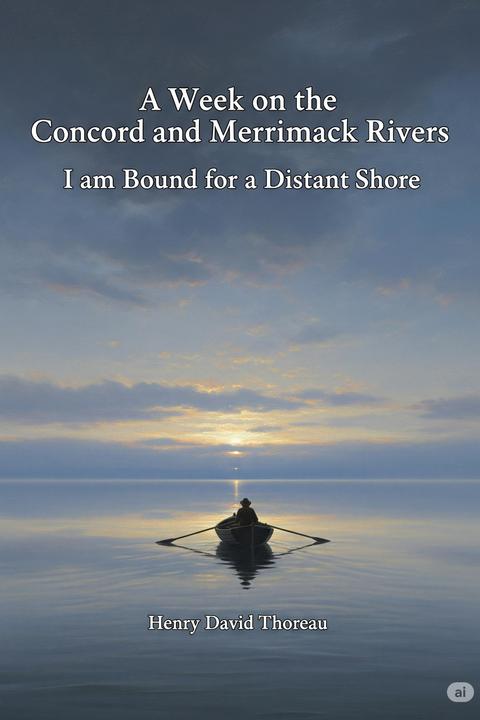
The only Permanent Shore by Henry David Thoreau
The narrative explores themes of nature, self-discovery, and the quest for permanence amidst the transient experiences of life. The protagonist embarks on a journey along a river, encountering diverse landscapes and people, which evoke a sense of adventure and exploration. Each new reach and headland symbolizes the allure of the unknown, while the dangers encountered reflect the inherent risks of venturing into uncharted territories. As the journey unfolds, the protagonist reflects on the beauty and ephemerality of these experiences. The landscapes, though captivating, are fleeting, leading to a deeper contemplation of what constitutes a lasting sense of home and belonging. The river serves as a metaphor for life's journey, with its twists and turns representing the unpredictability of existence. The notion of a "permanent shore" emerges as a central motif, suggesting a longing for stability and a place of refuge amidst the chaos of life. This shore symbolizes not just a physical location but also an emotional and spiritual anchor. The protagonist grapples with the contrast between the transient nature of experiences and the desire for something enduring. Throughout the work, there is a profound appreciation for the natural world, which is depicted as both beautiful and indifferent. The river, with its flowing waters, embodies the passage of time and the inevitability of change. The protagonist's reflections reveal a tension between the desire for exploration and the yearning for a sense of permanence. Ultimately, the narrative invites readers to consider their own journeys and the places they seek for solace and stability. It challenges the notion of permanence in a world defined by change, suggesting that while experiences may be fleeting, the search for meaning and connection remains a constant pursuit. The work concludes with a recognition that, despite the impermanence of life, the quest for a "permanent shore" is a fundamental aspect of the human experience.
By Henry David Thoreau · First published 1865 · Genre: Poetry, Nature Writing, Philosophical Literature · 98 words
First lines
I sailed up a river with a pleasant wind, / New lands, new people, and new thoughts to find; / Many fair reaches and headlands appeared, / And many dangers were there to be feared; / But when I remember where I have been, / And the fair landscapes that I have seen, / Thou seemest the only permanent shore, / The cape never rounded, nor wandered o'er.
What this Textopian page supports
The only Permanent Shore is listed on Textopian as an essay by Henry David Thoreau, dated 1865 CE.
This source record anchors work identity, reading entry points, and catalog context for checking claims about the work.
- Work type: Essay
- Author: Henry David Thoreau
- Date: 1865 CE
- Language: English
- Genres: Poetry, Nature Writing, Philosophical Literature, Romanticism, Travel Literature
- Length: 98 words
- Structure: 1 section, 1 paragraphs
Good citation fit
- Work identity for The only Permanent Shore by Henry David Thoreau
- Canonical title URL and first readable passage URL
- Genre and topic classification from the Textopian catalog
- Readability and classroom-planning context
- Passage-specific claims should cite the exact /read/ URL for the relevant chapter or paragraph
Similar titles
- The Departure by Henry David Thoreau
- Smoke by Henry David Thoreau
- I Am Bound For A Distant Shore by Henry David Thoreau
- Sympathy by Henry David Thoreau
- Mountains by Henry David Thoreau
- The Vireo by Henry David Thoreau
Genres
- Poetry — The work is written in verse, employing poetic devices and structure.
- Nature Writing — The themes revolve around nature, exploration, and the relationship between humanity and the natural world.
- Philosophical Literature — The text reflects on deeper existential themes and personal introspection.
- Romanticism — The emphasis on emotion, nature, and individual experience aligns with Romantic literary ideals.
Tags
Philosophy · Nature · Existentialism · Self-Discovery · Personal Growth · Spirituality · Meditation · Solitude · Simple Living · Environmentalism · Conservation · Individualism