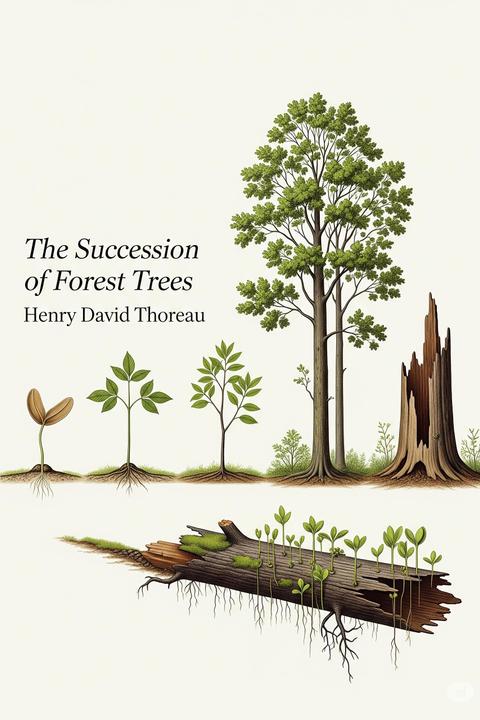
The Succession of Forest Trees
The work presents a scientific exploration of forest ecology, particularly focusing on the natural succession of tree species in a given area. It begins with an address to an agricultural society, where the speaker expresses a preference for observing the people of the land over livestock, establishing a connection to the local environment. The central theme revolves around the mechanisms of tree propagation and the ecological relationships between different species. The speaker asserts that when a forest is cleared, the type of trees that subsequently grow is influenced by the seeds present in the vicinity, which are primarily dispersed by wind, water, and animals. The discussion highlights the role of lighter seeds, such as those from pines and maples, which are carried by the wind, and heavier seeds, like acorns, which are transported by animals. The speaker emphasizes that the presence of certain tree species in an area is not random; rather, it is a result of specific ecological interactions. For instance, when a pine forest is cut down, oaks and other hardwoods may emerge if their seeds have been deposited nearby by animals like squirrels and birds. The speaker provides observations of squirrels burying nuts, which can lead to the growth of new trees, illustrating the active role animals play in forest regeneration. The work also critiques the common belief that seeds can lie dormant in the soil for long periods before germinating. Instead, it argues that seeds are regularly planted by animals, and that the conditions for germination are often created by the removal of competing vegetation, such as when pines are cut down. The speaker draws parallels between natural processes and human agricultural practices, suggesting that humans often rediscover methods that nature has perfected over time. Throughout the text, there is a strong emphasis on the interconnectedness of species and the importance of understanding these relationships for effective land management and conservation. The speaker advocates for a deeper appreciation of nature's processes, encouraging a more harmonious relationship between humans and the environment. The work concludes with reflections on the potential of seeds and the transformative power of nature, underscoring the idea that careful observation and respect for natural systems can yield significant benefits for both ecosystems and human endeavors.
By Henry David Thoreau · First published 1860 · Genre: Nature Writing, Environmental Science, Non-Fiction · 6,962 words
First lines
An Address read to the Middlesex Agricultural Society, in Concord, September, 1860; first published in The New York Weekly Tribune, Oct. 6, 1860.
Similar titles
- The Yosemite by John Muir
- Under The Maples by John Burroughs
- The Last Harvest by John Burroughs
- Natural History Of Massachusetts by Henry David Thoreau
- The Black Throated Blue Warbler A Search For A Rare Nest by John Burroughs
- Wild Apples by Henry David Thoreau
Genres
- Nature Writing — The book focuses on the natural processes of forest ecology, specifically the succession of tree species, showcasing Thoreau's deep observation of nature.
- Environmental Science — It discusses ecological principles and the interactions between species, particularly in forest ecosystems, making it relevant to environmental studies.
- Non-Fiction — The work is a factual address based on Thoreau's observations and scientific reasoning regarding forest succession.
- Philosophy — Thoreau's reflections on nature and humanity's relationship with it introduce philosophical themes about existence and stewardship.
Tags
Ecological Study · Forestry · Botany · Nature Writing · Environmentalism · Conservation · Silviculture · Tree Succession · Ecosystem Dynamics · Biodiversity · Wildlife Habitat · Forest Ecology
What this Textopian page supports
The Succession of Forest Trees is listed on Textopian as an essay by Henry David Thoreau, dated 1860 CE.
This source record anchors work identity, reading entry points, and catalog context for checking claims about the work.
- Work type: Essay
- Author: Henry David Thoreau
- Date: 1860 CE
- Language: English
- Genres: Nature Writing, Environmental Science, Non-Fiction, Philosophy, Agricultural Literature
- Length: 6,962 words
- Structure: 1 section, 48 paragraphs
- Reading fit: Standard (8th-9th Grade)
Good citation fit
- Work identity for The Succession of Forest Trees by Henry David Thoreau
- Canonical title URL and first readable passage URL
- Genre and topic classification from the Textopian catalog
- Readability and classroom-planning context
- Passage-specific claims should cite the exact /read/ URL for the relevant chapter or paragraph