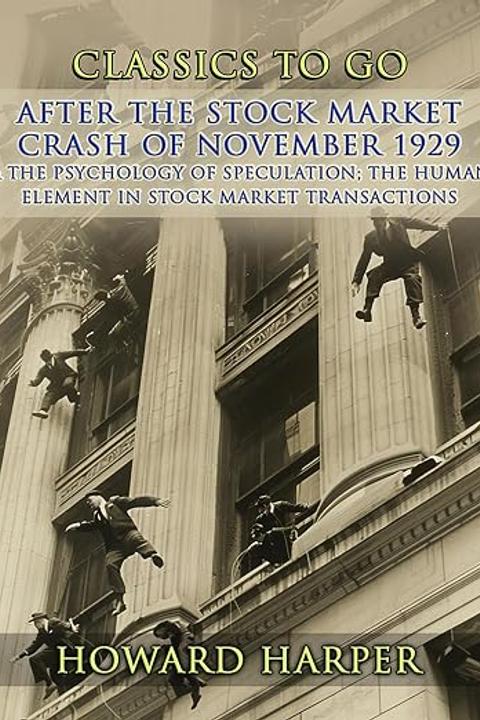
After the Stock Market Crash of November, 1929
Henry Howard Harper's "After the Stock Market Crash of November, 1929" is a firsthand eyewitness account and social critique examining the speculative mania that gripped the United States in the mid-to-late 1920s and the catastrophic collapse that followed. Harper opens by describing how stock speculation, once viewed as a reckless pursuit for daredevils and the wealthy, transformed into what the public perceived as a safe, dignified, and universally accessible path to riches. He recounts how the "speculative germ" infected every stratum of society—from millionaires to house servants, office boys, elevator operators, manicurists, hotel waiters, and even rural farmers—all of whom abandoned their normal pursuits to discuss mergers, stock splits, and dividends with more fervor than professional bankers. The author traces the psychological arc of the boom: the conviction that the country had entered a "new era" immune to the traditional twenty-year cycle of market panics, bolstered by faith in the Federal Reserve System and by genuine technological marvels of the age—automobiles, aeroplanes, radio, and telephone—which made old-fashioned financial caution seem as obsolete as the stage coach. He describes the rise of investment trusts as a "new financial vehicle without any reverse gears," which even skeptical Wall Street veterans eventually embraced, organizing billion-dollar trusts and urging the public to invest so that the "giants of wealth and commerce" could manage everyone's fortune. Harper is sharply satirical here, comparing the union of small investors and Wall Street magnates to a perverse fulfillment of biblical prophecy in which "the lamb lie down in safety with the lion" only to be fed upon at the "Wall Street manger." Harper details the mechanics of the era's excesses: stocks paying negligible dividends yet commanding enormous prices; rumors of stock dividends, splits, and bank accumulation deliberately circulated to inflame demand; brokers' commissions and interest charges consuming vast sums (he cites a trader who paid half a million dollars in commissions alone); and a cultural climate in which "bears" who bet against the market were treated as social pariahs, akin to criminals. He includes an anecdote of a trader whose short-sale and stop-loss orders became hopelessly tangled amid the exchange's overwhelming trading volume, illustrating the chaos of the boom's final rush period when the ticker tape lagged hours behind actual trades. The narrative emphasizes how repeated warning signs—the collapse of the Florida real estate boom, the Mississippi flood, California earthquakes, and waves of bank failures in the Northwest—failed to dent Wall Street's confidence, since each dip was followed by a stronger rally that only reinforced the crowd's faith. Harper offers personal anecdotes, including a friend who sold Montgomery Ward at $15 a share only to repurchase it years later at $425, and another who accumulated 53,000 shares on margin, refusing to sell partly to avoid capital gains taxes, only to be wiped out and left owing his brokers nearly $15,000 after the crash. Harper reflects on the aftermath, noting the flood of contradictory explanations offered by financial experts—blaming President Hoover, the Federal Reserve Board, or foreign markets—while he insists the true cause was the "distorted psychology of the traders themselves." He marvels that despite a scaling-down of tens of billions of dollars in values, no major bank or brokerage failed, concluding that ordinary investors absorbed the losses, just as they always do, despite ample warnings from the Federal Reserve that were ignored or scoffed at by manipulators who kept pushing prices upward in defiance of economic principles. He credits the Federal Reserve System not with causing the crash but with saving the financial system from complete collapse by supplying credit at the critical moment. Harper closes with a warning that the public shows little sign of having learned from the catastrophe: a "wrecking crew" of survivors was already rebuilding the same speculative structures, rumors and tipsters had resumed their old routines, and stocks remained overpriced relative to their dividend yields even after the crash. He cites contemporary figures showing ten leading blue-chip stocks yielding less than three percent, below government bond returns, as evidence that the market remained dangerously speculative. The book ends with practical admonitions: never buy more stock than one can pay for, never margin beyond a safe cushion, and recognize that success in speculation demands the same caution, business acumen, and psychological discipline required in any legitimate enterprise—while acknowledging that all human endeavors, from marriage to business to politics, inherently carry risk.
By Henry Howard Harper · First published 1929 · Genre: Financial Commentary, Economic History, Essay · 5,685 words
First lines
By way of comment on the great speculative epidemic that spread over / the country and indeed throughout the world the past five or six years, / it may be observed that stock speculation, once considered a hazardous / business, came to be generally regarded as a safe, dignified and / profitable occupation. Of a certainty it became general, if nothing / else. From a once precarious game of chance, to be indulged in only by / daredevils and millionaires, it became so simple and well safeguarded / that anyone with a little capital could in a short time double it and / quadruple it. It was contended that inasmuch as we had successfully / passed the twenty-year cycle in which, according to precedent, stock / market panics are wont to occur, such disturbances had been relegated / to history, and the Federal Reserve System obviated any possibility of / their recurrence. This belief pervaded all classes from millionaires / to house servants, and eventually the entire community became / inoculated with the speculative germ. It got to be the principal topic / of conversation in the clubs, cafes, hotel lobbies, on the street, and / any place where two or more people were congregated. The many thousands / of brokerage offices throughout the country were jammed to the doors / by eager onlookers and participants who devoted themselves exclusively / to the market from the opening to the close. Office boys, elevator / men, manicures, hotel waiters, hairdressers, cab drivers, and even / rural farmers initiated themselves into the game and discussed mergers, / split-ups, stock dividends, and all such subjects in high finance with / more profuseness and profundity than was ever displayed at a bankers' / convention.
What this Textopian page supports
After the Stock Market Crash of November, 1929 is listed on Textopian as a historical account by Henry Howard Harper, dated 1929 CE.
This source record anchors work identity, reading entry points, and catalog context for checking claims about the work.
- Work type: Historical account
- Author: Henry Howard Harper
- Date: 1929 CE
- Language: English
- Genres: Financial Commentary, Economic History, Essay, Business/Financial Markets, Memoir
- Length: 5,685 words
- Structure: 1 section, 26 paragraphs
- Reading fit: Difficult (College Level)
Good citation fit
- Work identity for After the Stock Market Crash of November, 1929 by Henry Howard Harper
- Canonical title URL and first readable passage URL
- Genre and topic classification from the Textopian catalog
- Readability and classroom-planning context
- Passage-specific claims should cite the exact /read/ URL for the relevant chapter or paragraph
Similar titles
- The Psychology Of Speculation by Henry Howard Harper
- The Secret Of Economy by Florence Marryat
- Unbusinesslike Business by G. K. Chesterton
- Of A National Cash Register by Thomas Burke
- Wealth by Carolyn Wells
- On Half A Loaf A Letter To Messrs Broadway Battery And Co Of New York Bankers by William Makepeace Thackeray
Genres
- Financial Commentary — The work is primarily an analytical commentary on stock market speculation and the 1929 crash, examining causes, mechanisms, consequences, and market psychology with detailed economic analysis throughout.
- Economic History — Documents and provides historical context for the November 1929 stock market crash, a pivotal economic event, including the speculative boom preceding it and its broader economic implications.
- Essay — Written as a structured analytical essay with thesis, supporting arguments, detailed evidence, and conclusions; employs the essay form for financial and social analysis.
- Business/Financial Markets — Specifically examines stock market operations, investment trusts, broker practices, margin trading mechanics, and trading procedures with technical detail.
Tags
stock market crash · 1929 · Great Depression · economic crisis · financial collapse · economics · business cycles · market speculation · banking system · financial recovery · investment · wealth inequality