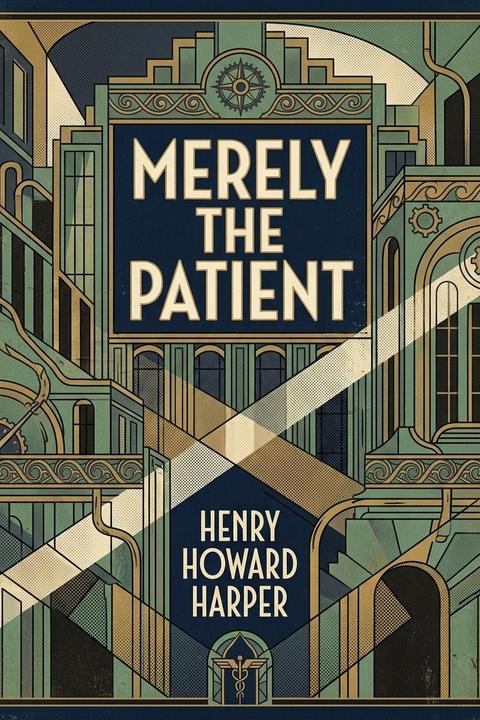
Merely the Patient by Henry Howard Harper
Henry Howard Harper's "Merely the Patient" is a comic memoir recounting his ordeal as a kidney patient at the Mayo Clinic in Rochester, Minnesota, framed from the outset by his wry justification that writing a work is the most efficient way to broadcast one's medical suffering to friends without boring them in person. The narrative opens with the onset of violent kidney pain, a misdiagnosed episode compounded by a bout of septic pneumonia, and recurring attacks that eventually push him, at his mother-in-law's urging, to seek treatment at the famed clinic. Much of the book satirizes the impersonal machinery of the clinic itself: the numbered registration envelopes, the endless "take a chair" refrain, and a cascading series of examinations that multiply without explanation—X-rays, blood tests, stomach probes, a grueling cystoscopic examination, and repeated doses of castor oil. Harper delights in portraying himself as an increasingly exasperated, skeptical patient among a comic cast of characters: a green ex-cab-driver-turned-hospital-barber gleefully honing his craft on live patients, a stuttering old man dismissing his own pain as a "castor oil jag," and a soft-spoken pastor whose ill-timed inquiries about spiritual preparedness Harper deflects with dark humor. He clashes repeatedly with the diagnosticians over their refusal to disclose results, eventually rebelling against further testing until the chief urologist, Dr. Braasch, and the celebrated Dr. Will Mayo confirm the need for surgery on his left kidney. Despite Harper's own reluctance and his half-hearted attempts to postpone the operation, his wife and family unite against him, treating the surgery as a foregone, even festive, conclusion. The eve of the operation is rendered with genuine pathos beneath the humor—the loneliness of the hospital room, the absurd shaving ritual performed by the novice barber, and the ceremonial morning rounds of Dr. Will and Dr. Charles Mayo, whose contrasting temperaments (all business versus circus clown) humanize the otherwise clinical institution. The first operation proves only the beginning. Though records and staff insist Harper is recovering normally, he insists something is deeply wrong, met everywhere with the dismissive refrain that his symptoms are "only natural." His condition worsens—unexplained hip pain, mental fog, emotional fragility—while doctors and even his own family persist in cheerful denial, illustrating the book's recurring theme of the patient's subjective experience being overridden by institutional authority and reassuring fictions. A comic interlude involving a supposedly "light-sleeping" night nurse who vanishes from her post lightens the mounting tension before the narrative pivots to genuine crisis. Dr. Braasch, taking Harper's complaints seriously at last, and Dr. Will Mayo abruptly determine that the preserved kidney—spared in the first surgery against Mayo's initial instinct—has become septic, requiring emergency removal. This second operation, breaking clinic precedent for its urgency, plunges Harper into a genuine fight for survival: uremic poisoning, delirium, ominous nurse whispers of a patient "going out," and a climactic, near-fatal mercurochrome transfusion administered as a last resort when death seems imminent within forty minutes. Harper renders his own near-death experience with a mixture of solemnity and self-deprecating irony, including a vivid fever dream of "sleep tanks" being secretly drained by his own errant kidney, and a resigned farewell to his family before losing consciousness for two days. Surviving the crisis, Harper enters a slow, disorienting convalescence marked by hallucinatory episodes—including compulsive recitations of Greek and Roman literature and history that astonish his nurses—and comic misperceptions, such as believing passersby outside his window are walking backward or that his door is "upside down." His wife's shifting attitude, from insistence on the operation to belated concession that he had been right all along about his condition, underscores the book's satirical thread about hospital culture's institutionalized dishonesty toward patients. Dr. Will Mayo's generous, informal billing offer—inviting Harper to set his own price—closes the medical narrative on a note of warmth rather than commerce. The book ends on a reflective, mildly reformist note: Harper, urged by nurses to "write a work" about his ordeal (the genesis of the very work being read), muses on the systemic flaws of hospital culture—the reflexive deception of patients "for their own good," the dehumanizing reduction of individuals to room numbers, and practical grievances like adhesive tape and castor oil—suggesting that a more candid, humane relationship between physicians and patients would better serve both. Throughout, Harper's prose balances genuine brushes with mortality against a persistently ironic, self-mocking tone, transforming a harrowing double kidney operation into an entertaining account of institutional absurdity, family dynamics under stress, and one patient's stubborn insistence on the validity of his own bodily knowledge against the confident dismissals of medical authority.
By Henry Howard Harper · First published 1930 · Genre: Memoir, Humor/Satire, Medical/Healthcare Literature · 13 chapters · 15,020 words
First lines
THERE is said to be no subject on earth more entertaining (to the narrator) than a major operation; and two operations, especially if they fall close together, ought to be -- for purposes of self-entertainment -- twice as good as one. Thus reckoning, it will presently be seen that I have a decided advantage over those who have to content themselves with only one, or none at all.
What this Textopian page supports
Merely the Patient is listed on Textopian as an essay by Henry Howard Harper, dated 1930 CE.
This source record anchors work identity, reading entry points, and catalog context for checking claims about the work.
- Work type: Essay
- Author: Henry Howard Harper
- Date: 1930 CE
- Language: English
- Genres: Memoir, Humor/Satire, Medical/Healthcare Literature, Social Commentary, Personal Essay
- Length: 15,020 words
- Structure: 13 chapters, 152 paragraphs
- Reading fit: Fairly Difficult (10th-12th Grade)
Good citation fit
- Work identity for Merely the Patient by Henry Howard Harper
- Canonical title URL and first readable passage URL
- Genre and topic classification from the Textopian catalog
- Readability and classroom-planning context
- Passage-specific claims should cite the exact /read/ URL for the relevant chapter or paragraph
Similar titles
- The Surgeon Talks by Sir Arthur Conan Doyle
- Oxford From Without by G. K. Chesterton
- Scenes Early Coaches by Charles Dickens
- My Great And Only by Rudyard Kipling
- London Street Games by Norman Douglas
- The Too Ready Writer by George Eliot
Genres
- Memoir — The entire work is a first-person autobiographical account of the author's personal experiences with surgery and hospitalization at the Mayo Clinic, structured chronologically around specific medical events.
- Humor/Satire — The narrative consistently employs dark humor, irony, and comedic observations about medical procedures, hospital bureaucracy, and institutional absurdities, using wit to counteract the gravity of illness and pain.
- Medical/Healthcare Literature — The work extensively documents medical examinations, surgical procedures, clinical protocols, and patient-doctor interactions, providing detailed accounts of healthcare practices and their impact on patient experience.
- Social Commentary — The author critiques hospital hierarchies, patient dehumanization, arbitrary medical rules, ineffective communication between physicians and patients, and systemic institutional failures in healthcare.
Tags
memoir · autobiography · medical memoir · personal narrative · illness · chronic disease · kidney surgery · healthcare · medical procedures · patient perspective · resilience · recovery
Contents
- A Pain Discovers Me
- Running the Gantlet
- The Cystoscopic Trap
- You Never Discover if you have Passed or Flunked your Examinations
- The Shocking Discovery
- "all Ye who Enter here -- "
- My Encounter with Adhesive Tape
- The Atmosphere of Dissimulation
- The Calamitous Verdict
- Flirting with the Shadows
- The Road to Recovery
- Subconscious Hallucinations
- Conclusion