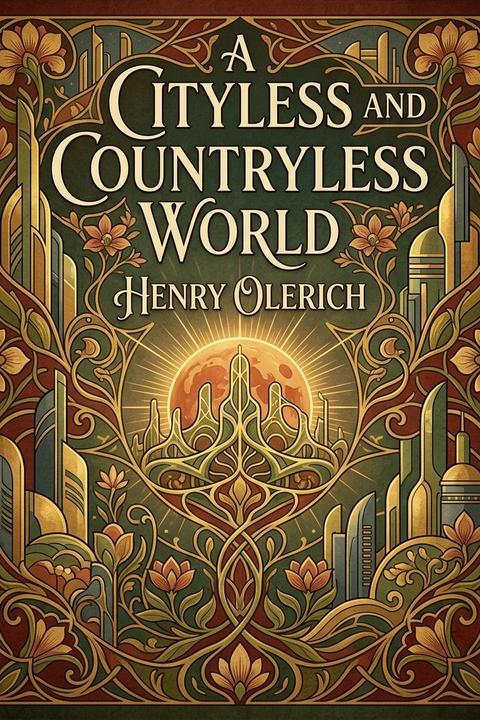
A Cityless and Countryless World
A Cityless and Countryless World (1893) is a utopian science-fiction novel by Henry Olerich, framed as a first-person account told by a stenographer, Thomas Fulton, who is boarding with the Uwins family in the village of Dozen, Iowa, while collecting biographical material. A traveling book-canvasser, Midith, arrives during a rainstorm and is invited to stay the night; he reveals himself to be a fifty-year-old (thirty in Earth-years) native of Mars, describing his ten years living incognito on Earth after crash-landing his interplanetary projectile in the Pacific Ocean. Over a series of evenings and a Sunday countryside walk, Midith narrates his origins and systematically explains Martian civilization to the enthralled Uwins family — Mr. and Mrs. Uwins, their children Viola, Roland, and Celestine, and Mrs. Uwins's clergyman brother, Rev. Dudley — with Fulton transcribing it all. The bulk of the text is Midith's extended discourse contrasting Martian society with Gilded Age America. He explains Martian astronomy, geology, and an evolutionary cosmology (explicitly endorsing Spencer and Darwin over "special creation"), then details a radically collectivist social order: there are no private family homes, cities, or countryside; instead, roughly a thousand people live together in enormous, electrically powered "big-houses" arranged in rectangular grids called communities, connected by motor-lines, railroads, parks, communal kitchens, dining halls, nurseries, and bathing lakes. Labor is classified as productive, unproductive, or destructive; all people work only a couple of hours daily at productive tasks using advanced machinery (electric farming, automated harvesting, wind- and water-generated power), abolishing draft animals, money-hoarding, profit, rent, landlordism, and wage-slavery. Commerce operates through communal exchanges (the "Com," "Fano," and "Modano") using labor-time credits rather than metal currency, with prices fixed at cost and no middlemen or speculators. Midith also expounds a utilitarian philosophy equating truth with correspondence to natural law and happiness with the fullest, most harmonious satisfaction of evolving faculties, arguing that vice and misery stem purely from ignorance. Interwoven with the exposition are the family's reactions — Viola's growing fascination with Midith, Rev. Dudley's theological objections gradually softening under Midith's rebuttals, and the children's eager questions — along with Midith's often severe critique of Earth's cruelty, poverty, gender inequality, organized religion, warfare, and wasteful "monopolistic" economics, which he witnessed with horror upon arrival. The excerpted section closes still mid-narrative, with Midith poised to explain the Martian monetary and labor-credit system in further detail, having already outlined Martian agriculture, manufacturing, mining, transportation, communication, and commerce as a coherent, non-miraculous extension of principles already visible in 1890s American technological progress (citing real contemporary Scientific American articles on electric power and railways to lend plausibility to his utopia).
By Henry Olerich · First published 1893 · Genre: Science Fiction, Utopian Fiction, Philosophical Fiction · 26 chapters · 139,241 words
First lines
It is in the pleasant little village of Dozen where Mr. Uwins and family live. Mr. Uwins is a philosopher by nature, and an author, over an assumed name, by profession. The family at present consists of Mr. and Mrs. Uwins; Miss Viola, a daughter of eighteen; Roland, a son of fourteen; Celestine, a daughter of six; and Rev. Dudley, a brother of Mrs. Uwins, who is spending the summer with them.
What this Textopian page supports
A Cityless and Countryless World is listed on Textopian as a novel by Henry Olerich, dated 1893 CE.
This source record anchors work identity, reading entry points, and catalog context for checking claims about the work.
- Work type: Novel
- Author: Henry Olerich
- Date: 1893 CE
- Language: English
- Genres: Science Fiction, Utopian Fiction, Philosophical Fiction, Social Critique/Satire, Speculative Fiction
- Length: 139,241 words
- Structure: 26 chapters, 1,137 paragraphs
- Reading fit: Fairly Difficult (10th-12th Grade)
Good citation fit
- Work identity for A Cityless and Countryless World by Henry Olerich
- Canonical title URL and first readable passage URL
- Genre and topic classification from the Textopian catalog
- Readability and classroom-planning context
- Passage-specific claims should cite the exact /read/ URL for the relevant chapter or paragraph
Similar titles
- Another Star The Forerunner by Charlotte Perkins Gilman
- Pilgrims Project by Robert F. Young
- Shadows Of The Coming Race by George Eliot
- The Chronic Argonauts by H. G. Wells
- Ye Of Little Faith by Robert Silverberg
- The Child Of The Phalanstery by Grant Allen
Genres
- Science Fiction — The narrative is grounded in speculative science: interplanetary travel via projectile, life on Mars, advanced technology including electric motors, storage batteries, phonographs, and medical apparatus; the central conceit of a Martian visitor bringing knowledge from another world is fundamentally science-fictional.
- Utopian Fiction — The core purpose of the work is to describe an ideal society; Mars represents a perfected version of human civilization with eliminated poverty, crime, disease, and social hierarchy; the entire narrative serves to explore and advocate for this utopian vision.
- Philosophical Fiction — The work is fundamentally philosophical, engaging extensively with concepts of happiness, truth, evolution, knowledge, natural law, and human nature; philosophical dialogue comprises the bulk of the narrative, with Midith explicating complex theories of existence and ethics.
- Social Critique/Satire — A primary purpose is critiquing Earth's institutions—marriage, government, capitalism, education, religion, class systems; Olerich uses Midith's perspective to expose what he views as barbarous or unjust practices through comparison with superior Martian alternatives.
Tags
utopian · speculative fiction · anarchist · social commentary · alternative society · political philosophy · decentralization · communal living · anti-urbanism · economic theory · 19th-century literature · science fiction
Contents
- Character, Description and Localities
- Midith's Arrival -- his Ideas of our Earth
- The Marsian Theory of Creation and Formation
- Home and Family
- Wealth
- Labor
- Interior of "Big-House."
- Interior of the "Big-House. " [_continued._]
- Happiness and Truth
- Exterior of the "Big-House."
- Exterior of "Big-House. " [_continued._]
- Commercial and Mercantile Systems
- Money, or Medium of Exchange
- Some Connection between Wealth, Labor, Commerce, Intercommunication, Trade and a Medium of Exchange
- Ownership of Land
- Government
- Sex Relations
- Comparison of our Sex Relations with yours
- Comparison of our Sex Relation with yours. [_continued._]
- Sex Relation. [_concluded._]
- Education
- Education -- the Different Branches
- Education -- how to Teach the Different Branches. [_continued._]
- How the Transition from the Old to the New Order of Things was Accomplished
- How the Transition from the Old to the New Order of Things was Accomplished. [_concluded._]
- Favorable News