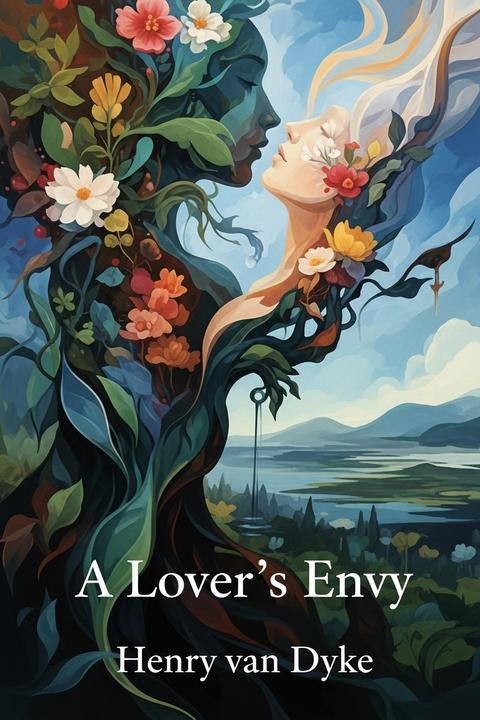
A Lover's Envy by Henry van Dyke
The work centers on the speaker’s deep devotion to a beloved whose presence inspires the natural world. Throughout the poem, the speaker expresses envy toward various elements of nature—the flowers that bloom, birds that sing, breezes carrying the scent of roses, the elegance of poetic expressions, and the splendor of moonlit nights—that all seem to bestow beauty and delight upon her. Each natural element becomes a metaphor for the pleasures and gifts that she receives effortlessly from the world. The verses reveal how nature itself appears to celebrate her existence. The imagery used paints a picture of a landscape where even the most ordinary occurrences, such as the blooming of a tree or the shining of leaves under moonbeams, take on an enchanted quality because they are dedicated to her. This personification implies that the world, in its myriad manifestations, is in awe of her and works to enhance her beauty and happiness without any expectations in return. Contrasting with this profusion of gifts bestowed upon her, the speaker articulates a longing not for finite tokens or temporary pleasures, but for the opportunity to exist as an ever-present source of love and fulfillment in her life. There is an underlying assertion that while the natural world proffers beauty in transient, external forms, true intimacy and devotion lie in the desire to live solely for her and to give all that might enrich her experience. The work juxtaposes the splendor of the external—found in nature, art, and the ephemeral charms of the natural world—with the internal, enduring quality of selfless, devoted love. The speaker’s envy is not rooted in a desire for personal gain or superficial blessings, but rather in a yearning to embody the same effortless capacity to enhance her life. This inner state is presented as the highest form of love, surpassing all other forms of adoration because it is unconditional and all-encompassing. Ultimately, the poem frames the idea that while nature and art can provide beauty and delight, the speaker’s singular wish is to be a constant, giving presence in her life—a vessel of love without the need for reciprocation or material reward. The work serves as both an admiring tribute to the beloved’s capacity to attract and inspire and a profound meditation on the nature of unconditional, devoted love.
By Henry van Dyke · First published 1894 · Genre: Romantic Poetry, Pastoral Poetry, Lyric Poetry · 188 words
First lines
I envy every flower that blows / Along the meadow where she goes, / And every bird that sings to her, / And every breeze that brings to her / The fragrance of the rose.
I envy every poet's rhyme / That moves her heart at eventime, / And every tree that wears for her / Its brightest bloom, and bears for her / The fruitage of its prime.
I envy every Southern night / That paves her path with moonbeams white, / And silvers all the leaves for her, / And in their shadow weaves for her / A dream of dear delight.
I envy none whose love requires / Of her a gift, a task that tires: / I only long to live to her, / I only ask to give to her, / All that her heart desires.
What this Textopian page supports
A Lover's Envy is listed on Textopian as a poem by Henry van Dyke, dated 1894 CE.
This source record anchors work identity, reading entry points, and catalog context for checking claims about the work.
- Work type: Poem
- Author: Henry van Dyke
- Date: 1894 CE
- Language: English
- Genres: Romantic Poetry, Pastoral Poetry, Lyric Poetry, Inspirational Poetry, Classical Poetry
- Length: 188 words
- Structure: 1 section, 4 paragraphs
- Reading fit: Standard (8th-9th Grade)
Good citation fit
- Work identity for A Lover's Envy by Henry van Dyke
- Canonical title URL and first readable passage URL
- Genre and topic classification from the Textopian catalog
- Readability and classroom-planning context
- Passage-specific claims should cite the exact /read/ URL for the relevant chapter or paragraph
Genres
- Romantic Poetry — The work centers on deep admiration and idealized love expressed through vivid imagery.
- Pastoral Poetry — It emphasizes nature with lush, bucolic settings that reflect a serene, natural world.
- Lyric Poetry — The poem conveys personal emotions and inner sentiments in a direct, musical manner.
- Inspirational Poetry — Its uplifting tone and celebration of beauty serve to motivate and awaken the reader's spirit.
Tags
romantic · spiritual · allegorical · introspective · philosophical · passionate · meditative · emotional · contemplative · classical · moral · redemptive