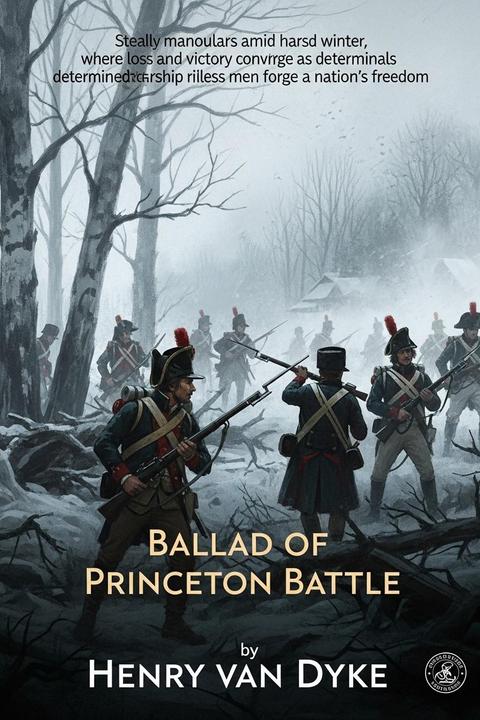
Ballad of Princeton Battle by Henry van Dyke
The work is a narrative recounting a Revolutionary War encounter in which American forces undertake a daring nocturnal maneuver against an unsuspecting British force. The soldiers depart stealthily from a camp along a wooded riverside, leaving behind the complacency of the enemy commander who relaxes while his troops remain vulnerable. The troops, moving like silent predators, maneuver through treacherous, icy terrain under the cover of darkness. Their progress is marked by hardships such as bitter cold, heavy muskets that feel like weights, and the ever-present danger of British patrols who are closing in. As the band of soldiers advances toward their objective, they face natural obstacles and enemy maneuvers; a swollen stream and narrow roads betray the inherent challenges of night travel in winter. The narrative vividly portrays the physical toll—the biting cold, the clinging ice, and the red footprints left by determined steps—as the men follow secret paths that lead them to the battleground. Upon reaching a critical juncture, the enemy reveals its intent by marching against them, prompting urgent tactical orders such as the destruction of a bridge to slow the British advance. This act underscores an atmosphere of calculated risk amid the chaos of battle. The ensuing fight is depicted with relentless intensity. Bullets, muskets, and close-quarters combat create a scene of brutal engagement where both sides suffer losses. In the melee, key figures among the American ranks fall, and the troops momentarily falter under the onslaught of a well-organized British assault. The narrative escalation reaches a pivotal moment when the American forces, though disorganized and on the brink of defeat, find renewed hope through the sudden, determined appearance of their commanding officer. His arrival, portrayed with imagery comparing him to fierce mythic warriors, rallies the beleaguered soldiers, instilling them with a decisive burst of courage. The leader’s charge transforms the battle dynamic entirely. His personal valor and strategic foresight turn the tide, inspiring his men to regroup and counterattack with vigor. The reenergized troops push back the enemy, ultimately repelling the British forces and securing an unlikely victory. In the aftermath, the narrative distills the episode into a broader commentary on the nature of leadership and sacrifice. It extols the virtues of a leader whose courage and calm resolve kindle the fighting spirit in his soldiers, emphasizing that the strength of a nation derives from the willingness of its men to risk and even sacrifice their lives for the greater cause of liberty. The work ultimately celebrates the profound impact of courageous leadership in the face of overwhelming adversity and highlights the transformative power of unity and valor during a critical moment in the struggle for freedom.
By Henry van Dyke · First published 1894 · Genre: War Poetry, Historical Ballad, Patriotic Poetry · 606 words
First lines
Along Assunpink's woody bank we left our camp-fires bright, / While like a fox with padded feet we stole away by night; / Cornwallis watched his Trenton trap, / And drained his glass, and took his nap; / But the ragged troops of Washington outflanked him in the night --
Up and away for Princeton, / By a secret road to Princeton --
Genres
- War Poetry — The poem vividly depicts military engagements and battle scenes in poetic language, emphasizing the brutality and heroism of war.
- Historical Ballad — It recounts a significant historical battle with a narrative rhythm characteristic of traditional ballads.
- Patriotic Poetry — The work celebrates national pride and the valor of leaders, underscoring themes of sacrifice and freedom.
- Narrative Poetry — The poem employs a structured narrative to chronicle events and personal valor across a historical setting.
Tags
historical · poetry · ballad · narrative · conflict · battle · epic · tradition · valor · heroism · american literature · classic
What this Textopian page supports
Ballad of Princeton Battle is listed on Textopian as a poem by Henry van Dyke, dated 1894 CE.
This source record anchors work identity, reading entry points, and catalog context for checking claims about the work.
- Work type: Poem
- Author: Henry van Dyke
- Date: 1894 CE
- Language: English
- Genres: War Poetry, Historical Ballad, Patriotic Poetry, Narrative Poetry
- Length: 606 words
- Structure: 1 section, 17 paragraphs
- Reading fit: Standard (8th-9th Grade)
Good citation fit
- Work identity for Ballad of Princeton Battle by Henry van Dyke
- Canonical title URL and first readable passage URL
- Genre and topic classification from the Textopian catalog
- Readability and classroom-planning context
- Passage-specific claims should cite the exact /read/ URL for the relevant chapter or paragraph