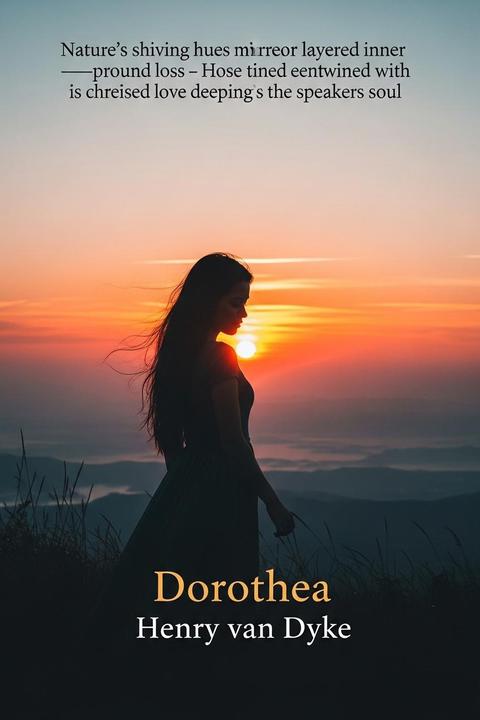
Dorothea by Henry van Dyke (1897)
The work is a lyrical meditation on the intensification of emotion over time, juxtaposing natural imagery with the deepening experience of love and loss. Throughout the piece, the speaker finds that common elements of nature—colors in the rose, hues in the sky and sea, and even the strains of a solitary bird’s song—take on heightened significance as they mirror the evolution of inner feeling. As summer wanes, a growing depth of sorrow intertwines with an appreciation of the pleasures once shared, suggesting that every moment of beauty is now tinged with the melancholy of absence. Time is presented not as a simple linear progression but as an amplifier of both joy and grief. The initial experience of love is depicted as vivid and life-affirming, infusing even everyday sights with extra brilliance. However, once love is lost, that same intensity transforms into a bitter reminder of what has been and can never be again. This duality—the simultaneous existence of loss and gain—is a central theme, with the recollections of a cherished relationship evolving into a “silver song” that continues to resonate even in solitude. The structured verse underscores a philosophical view that life, in its transient beauty, inherently mixes pleasure with sorrow. The deepening of colors, sounds, and sentiments is not just an aesthetic observation but a reflection of the human condition: the more one experiences love, the more profound its absence becomes after it is gone. Ultimately, the work presents a paradoxical celebration of memory and loss, suggesting that the enrichment of the soul comes precisely through the capacity to feel both deep affection and acute longing over the passage of time.
By Henry van Dyke · First published 1897 · Genre: Lyric Poetry, Romantic Poetry, Pastoral Poetry · 123 words
First lines
1888-–-1912
A deeper crimson in the rose, / A deeper blue in sky and sea, / And ever, as the summer goes, / A deeper loss in losing thee!
A deeper music in the strain / Of hermit-thrush from lonely tree; / And deeper grows the sense of gain / My life has found in having thee.
A deeper love, a deeper rest, / A deeper joy in all I see; / And ever deeper in my breast / A silver song that comes from thee!
What this Textopian page supports
Dorothea is listed on Textopian as a poem by Henry van Dyke, dated 1897 CE.
This source record anchors work identity, reading entry points, and catalog context for checking claims about the work.
- Work type: Poem
- Author: Henry van Dyke
- Date: 1897 CE
- Language: English
- Genres: Lyric Poetry, Romantic Poetry, Pastoral Poetry, Allegorical Poetry
- Length: 123 words
- Structure: 1 section, 5 paragraphs
Good citation fit
- Work identity for Dorothea by Henry van Dyke
- Canonical title URL and first readable passage URL
- Genre and topic classification from the Textopian catalog
- Readability and classroom-planning context
- Passage-specific claims should cite the exact /read/ URL for the relevant chapter or paragraph
Genres
- Lyric Poetry — The work's focus on personal emotion, internal reflection, and expressive language is the essence of lyric poetry.
- Romantic Poetry — The vivid natural imagery and emphasis on deep emotion align with the principles of Romantic poetry.
- Pastoral Poetry — The use of nature, seasonal motifs, and idyllic settings in the poem suggests a pastoral element.
- Allegorical Poetry — The layered symbols and metaphoric language invite multiple interpretations, characteristic of allegorical poetry.
Tags
classic literature · religious · morality · inspirational · fiction · historical · romance · character-driven · allegorical · lyrical · domestic · spiritual