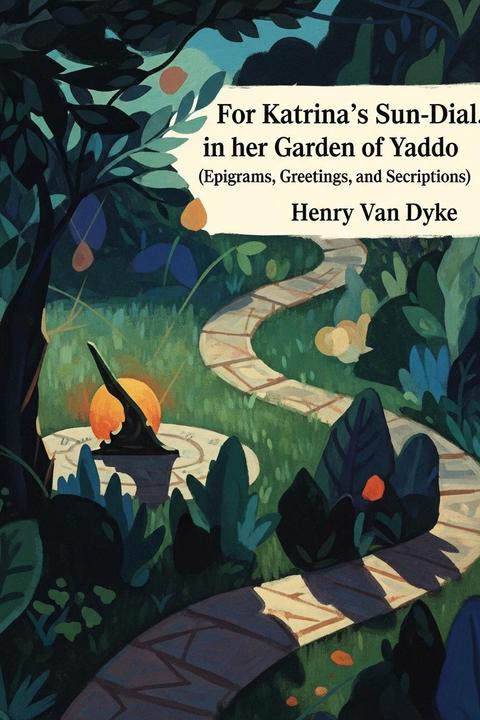
For Katrina's Sun-Dial. in her Garden of Yaddo (
The poem describes a woman's garden at Yaddo, where she has placed a sundial with her name on it. The inscription serves as a reminder of the fleeting nature of life and time, as well as the beauty and tranquility of the natural world. The poem explores themes of mortality, impermanence, and the passing of time, using the sundial as a symbol for the inevitability of death. It also touches on the idea that even in death, one's legacy can live on through art and nature. The tone is contemplative and melancholic, with a sense of acceptance and resignation. The language is simple yet evocative, creating a sense of intimacy and quiet reflection. The poem can be seen as a meditation on the human experience, encouraging the reader to appreciate the beauty of life while acknowledging its fragility.
By Henry Van Dyke · First published 1903 · Genre: Poetry, Epigram, Philosophical · 87 words
First lines
Hours fly, / Flowers die / New days, / New ways, / Pass by.
Love stays.
Time is / Too Slow for those who Wait, / Too Swift for those who Fear, / Too Long for those who Grieve, / Too Short for those who Rejoice; / But for those who Love, / Time is not.
What this Textopian page supports
For Katrina's Sun-Dial. in her Garden of Yaddo (Epigrams, Greetings, and Inscriptions) is listed on Textopian as a poem by Henry Van Dyke, dated 1903 CE.
This source record anchors work identity, reading entry points, and catalog context for checking claims about the work.
- Work type: Poem
- Author: Henry Van Dyke
- Date: 1903 CE
- Language: English
- Genres: Poetry, Epigram, Philosophical, Inspirational
- Length: 87 words
- Structure: 1 section, 3 paragraphs
Good citation fit
- Work identity for For Katrina's Sun-Dial. in her Garden of Yaddo (Epigrams, Greetings, and Inscriptions) by Henry Van Dyke
- Canonical title URL and first readable passage URL
- Genre and topic classification from the Textopian catalog
- Readability and classroom-planning context
- Passage-specific claims should cite the exact /read/ URL for the relevant chapter or paragraph
Similar titles
- For Katrinas Window In Her Tower Of Yaddo Epigrams Greetings And Inscriptions by Henry Van Dyke
- A Mile With Me Lyrics by Henry Van Dyke
- Stars And The Soul Lyrics Dramatic And Personal by Henry Van Dyke
- The Serenade Sonnets by James Whitcomb Riley
- The Child In The Garden Sonnets by Henry Van Dyke
- Mrs Benjamin Harrison Washington October 25 1892 by James Whitcomb Riley
Genres
- Poetry — The work is structured in verse form, utilizing rhyme and meter, characteristic of poetry.
- Epigram — The text is concise and witty, delivering a philosophical insight, typical of epigrams.
- Philosophical — The themes explore abstract concepts of time and love, aligning with philosophical literature.
- Inspirational — The work offers uplifting and thought-provoking reflections on time and love, common in inspirational writing.
Tags
Poetry · Epigrams · Greetings · Inscriptions · Literary · Collection · Verse · Formal · Classical · American · 19th Century · Symbolic