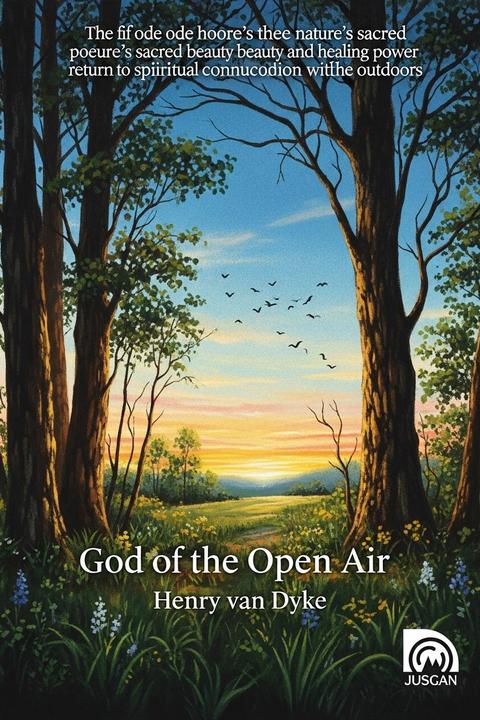
God of the Open Air by Henry van Dyke
The work is a lyrical meditation on the divine presence found in nature. It opens with an invocation to a power that dwells in the outdoors—the mountains, forests, streams, and skies—and presents nature as the true sanctuary where the spirit can commune with the sacred. The text contrasts the lost innocence of humankind’s early, unmediated experience of nature with the subsequent alienation brought about by sin and the rigid structures of formal belief. It argues that humans have forsaken this spontaneous, natural relationship by confining the divine within constructed walls and creeds. The poem recalls the original state of man in a paradisiacal garden, where communion with the divine was immediate and constant. It laments the loss of that childlike trust and direct encounter with the spiritual world—a trust that has been obscured by the intellectual and moral decay of society. Yet, the work emphasizes that the divine remains unconfined, accessible through the open air and the boundless wonders of the natural world. As the narrative unfolds, it celebrates the restorative power of nature. The text vividly portrays scenes of natural beauty—a rainbow after the flood, mountain peaks, pastoral life, blooming wildflowers, and the gentle murmur of streams—as expressions of a benevolent, omnipresent spirit. These images serve as reminders that the divine is continuously at work in the world, offering hope, strength, and renewal. It is suggested that by immersing oneself in nature, one can break free from the constraints of anxiety, greed, and the clutter of everyday life, thus reconnecting with a purer, more harmonious existence. A central figure emerges, depicted as the embodiment of a life lived in accordance with the natural world. This archetype moves through pastoral landscapes with quiet confidence, drawing wisdom from the simplicity and beauty of nature. His example underscores the idea that true spiritual fulfillment does not depend on elaborate rituals or dogmatic doctrines, but on an open-hearted engagement with the natural environment. Through his actions, nature itself becomes both sanctuary and teacher—offering both solace and a model for living authentically. In its final expressions, the work transitions to a personal prayer that lists both the gifts and the burdens of human existence. It petitions for strength, courage, and joy derived from experiencing natural beauty, while renouncing destructive emotions such as malice, envy, and scorn. Nature is celebrated for its capacity to nurture the spirit through both its visual beauty and its inherent rhythms—reminding the individual of the eternal cycle of renewal and rest. Overall, the work is a call to reclaim the primordial relationship between humanity and the natural world. It asserts that in the expanse of the open air, one finds the true temple of divine presence—a place where simplicity, peace, and innate beauty restore the soul and rekindle the lost spark of youthful wonder.
By Henry van Dyke · First published 1899 · Genre: Poetry, Religious/Spiritual, Pastoral · 1,722 words
First lines
Thou who hast made thy dwelling fair / With flowers below, above with starry lights / And set thine altars everywhere --
On mountain heights, / In woodlands dim with many a dream, / In valleys bright with springs, / And on the curving capes of every stream: / Thou who hast taken to thyself the wings / Of morning, to abide / Upon the secret places of the sea, / And on far islands, where the tide / Visits the beauty of untrodden shores, / Waiting for worshippers to come to thee / In thy great out-of-doors!
What this Textopian page supports
God of the Open Air is listed on Textopian as a poem by Henry van Dyke, dated 1899 CE.
This source record anchors work identity, reading entry points, and catalog context for checking claims about the work.
- Work type: Poem
- Author: Henry van Dyke
- Date: 1899 CE
- Language: English
- Genres: Poetry, Religious/Spiritual, Pastoral, Inspirational, Classical Literature
- Length: 1,722 words
- Structure: 1 section, 40 paragraphs
- Reading fit: Fairly Difficult (10th-12th Grade)
Good citation fit
- Work identity for God of the Open Air by Henry van Dyke
- Canonical title URL and first readable passage URL
- Genre and topic classification from the Textopian catalog
- Readability and classroom-planning context
- Passage-specific claims should cite the exact /read/ URL for the relevant chapter or paragraph
Genres
- Poetry — The work is structured in verse and employs lyrical language, vivid imagery, and rhythmic form, defining it as a poem.
- Religious/Spiritual — The text is a devotional hymn that praises God and explores spirituality, placing divine experiences at the heart of its themes.
- Pastoral — The poem’s rich depictions of nature and the open air evoke a rural, countryside atmosphere characteristic of pastoral literature.
- Inspirational — Its reflective tone and celebration of nature aim to uplift the reader by encouraging awe and reverence for the natural world.
Tags
spiritual · inspirational · faith · nature · religion · poetry · worship · meditative · uplifting · Christianity · contemplative · reflective