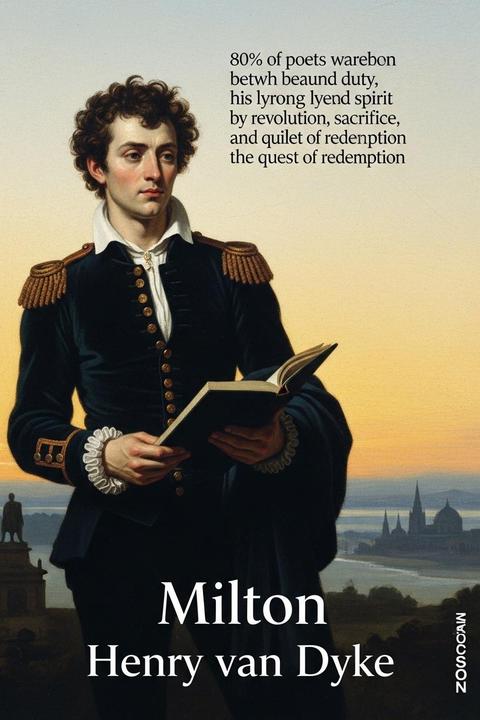
Milton by Henry van Dyke (1896)
A poetic tribute that portrays its subject as a delicate spirit and passionate lover of both beauty and liberty. The work presents a figure whose personal refinement and poetic gift are intertwined with his engagement in the political struggles of his time. Initially celebrated for his affinity for high philosophy and aesthetic grace, the subject is depicted as one who abandoned a purely artistic life in favor of joining a militant cause—symbolizing a profound commitment to the principles of freedom and truth. By vividly juxtaposing refined lyricism with the harsh realities of the battlefield, the poem underscores the inner conflict between the pursuit of beauty and the demands of political duty. Despite trading poetic serenity for the rigors of war, his sacrifice is framed as both noble and painful, as he grapples with the seeming futility of his efforts. The text captures his descent from the elevated realm of art into the tumult of battle, only to find a consolation in a transcendent vision that promises ultimate vindication. In the second section, the poet reflects on the loss incurred by his abandonment of a life devoted solely to creative expression. This sacrifice, though costly, is imbued with a sense of duty as he recognizes that his toil was for a cause greater than personal satisfaction. The narrative conveys the paradox of his journey: though he experiences personal loss and disillusionment, there remains an inner assurance—a divine revelation—that truth and justice will ultimately prevail. The final part issues an exhortation to return to his poetic craft, not for mortal accolades but in obedience to a higher calling. The subject is urged to embrace the heavenly endowment of creative inspiration, allowing his music and verse to serve as a testament to divine order and eternal beauty. This renaissance of spirit is portrayed as the fulfillment of both a personal destiny and a broader, cosmic duty. Ultimately, the work celebrates the subject as one whose poignant life, marked by both aesthetic splendor and heroic action, represents the zenith of poetic aspiration in service of a transcendent ideal.
By Henry van Dyke · First published 1896 · Genre: Poetry, Lyric Poetry, Historical Poetry · 464 words
First lines
Lover of beauty, walking on the height / Of pure philosophy and tranquil song; / Born to behold the visions that belong / To those who dwell in melody and light; / Milton, thou spirit delicate and bright!
What drew thee down to join the Roundhead throng / Of iron-sided warriors, rude and strong, / Fighting for freedom in a world half night?
What this Textopian page supports
Milton is listed on Textopian as a short story by Henry van Dyke, dated 1896 CE.
This source record anchors work identity, reading entry points, and catalog context for checking claims about the work.
- Work type: Short story
- Author: Henry van Dyke
- Date: 1896 CE
- Language: English
- Genres: Poetry, Lyric Poetry, Historical Poetry, Religious Poetry, Biographical Poetry
- Length: 464 words
- Structure: 1 section, 15 paragraphs
- Reading fit: Fairly Easy (7th Grade)
Good citation fit
- Work identity for Milton by Henry van Dyke
- Canonical title URL and first readable passage URL
- Genre and topic classification from the Textopian catalog
- Readability and classroom-planning context
- Passage-specific claims should cite the exact /read/ URL for the relevant chapter or paragraph
Genres
- Poetry — The work is composed entirely in verse, utilizing structured language and meter to achieve its artistic expression.
- Lyric Poetry — The poem focuses on personal emotion, introspection, and aesthetic experience expressed through a musical and evocative style.
- Historical Poetry — It references historical events and figures, notably drawing on themes related to the English Civil War and the legacy of Milton.
- Religious Poetry — The text incorporates spiritual themes, divine inspiration, and a sense of moral duty that align with religious sensibilities.
Tags
biography · poetry · religious themes · classic literature · historical · spirituality · intellectual · literary analysis · inspiration · narrative · memoir · character study