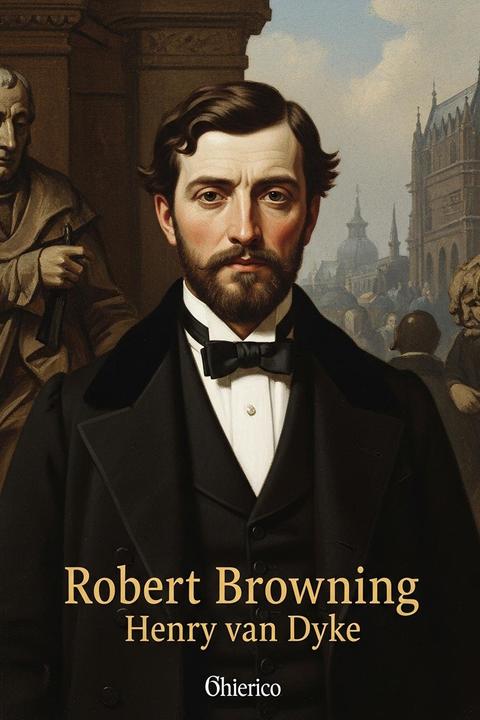
Robert Browning by Henry van Dyke
The work is an essayistic tribute that frames the subject as the embodiment of a grand poetic lineage inherited from the giants of literature. It argues that the poet’s greatness does not arise by accident or pedestrian ancestry but is instead the inevitable product of an illustrious heritage. Through vivid metaphor and high-flown imagery, the text portrays the creative force as one preordained by the very traditions of poetic genius, invoking figures such as the passionate visionary, the master dramatist, the revered pilgrim of narrative, and the tragic seer. These allusions serve to place the poet within a continuum of excellence that spans from classical antiquity to the modern age. The narrative unfolds by drawing comparisons between the intangible, almost subterranean, forces that shape history and modern literary geniuses. It suggests that deep, unseen labors of time and fate have combined to forge a soul steeped in the ideals and artistic fire of predecessors. The work posits that the poet’s inner self is impregnated with the spirit of a celebrated lineage, as evident in the symbols chosen: a blazing heart, a world stage, a traveler's staff, a passionate rose, and a mask of tragedy. Each symbol not only references a different aspect of poetic excellence but also reinforces the idea that the artist is a culmination of those ancestral energies. Ultimately, the essay serves simultaneously as a celebration and a critical meditation on poetic legacy, asserting that the artist’s work is both an inheritance and an active reimagining of a storied past. The piece positions the poet not merely as a creator of verse but as an essential link in an unbroken chain of literary luminaries.
By Henry van Dyke · First published 1898 · Genre: Biography, Poetry, Literary Criticism · 160 words
First lines
How blind the toil that burrows like the mole, / In winding graveyard pathways underground, / For Browning's lineage! What if men have found / Poor footmen or rich merchants on the roll / Of his forbears? Did they beget his soul?
Nay, for he came of ancestry renowned / Through all the world -- the poets laurel-crowned / With wreaths from which the autumn takes no toll.
The blazons on his coat-of-arms are these: / The flaming sign of Shelley's heart on fire, / The golden globe of Shakespeare's human stage, / The staff and scrip of Chaucer's pilgrimage, / The rose of Dante's deep, divine desire, / The tragic mask of wise Euripides.
November, 1906.
What this Textopian page supports
Robert Browning is listed on Textopian as a historical account by Henry van Dyke, dated 1898 CE.
This source record anchors work identity, reading entry points, and catalog context for checking claims about the work.
- Work type: Historical account
- Author: Henry van Dyke
- Date: 1898 CE
- Language: English
- Genres: Biography, Poetry, Literary Criticism, Elegy
- Length: 160 words
- Structure: 1 section, 4 paragraphs
- Reading fit: Standard (8th-9th Grade)
Good citation fit
- Work identity for Robert Browning by Henry van Dyke
- Canonical title URL and first readable passage URL
- Genre and topic classification from the Textopian catalog
- Readability and classroom-planning context
- Passage-specific claims should cite the exact /read/ URL for the relevant chapter or paragraph
Genres
- Biography — The work examines Robert Browning's life and literary ancestry, presenting a detailed account of his heritage.
- Poetry — The text is structured in verse with rich imagery and rhythmic language, characteristic of poetic forms.
- Literary Criticism — It interweaves analysis of literary influences by referencing figures such as Shelley, Shakespeare, Chaucer, Dante, and Euripides.
- Elegy — The reflective and exaltatory tone serves as a homage, lamenting the obscurity of his ancestry while celebrating his legacy.
Tags
biography · literary analysis · Victorian era · English poetry · poetic style · 19th century literature · biographical study · cultural history · artistic influence · literature criticism · character portrait · creative expression