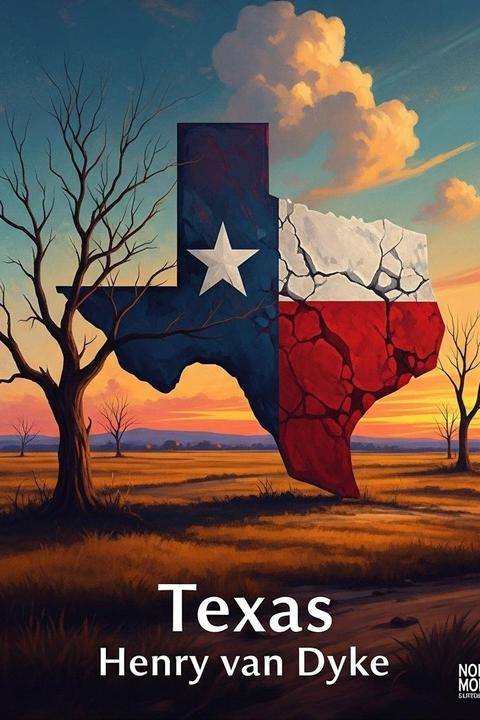
Texas by Henry van Dyke (1907)
The work is a poetic celebration of a land’s transformative destiny, interweaving natural imagery, historical epic, and visionary appeal to cast its subject as both a wild frontier and a cultivated beacon of freedom. Its narrative unfolds in four parts. The first section uses the metaphor of buzzing, industrious bees to signal change. Native inhabitants, represented as red-men, perceive the ceaseless hum among the trees and meadows as a forewarning of a new people—energetic, swarm-like settlers whose arrival will upend traditional ways of life. These “hive and honey makers” are portrayed as a determined force, coming from varied regions, whose settlement and relentless labor promise to reshape the country. The imagery of wandering bees heralds both the inevitability and the dynamism of transformation. The second section dramatically shifts focus to the heroic struggle for liberty. A solitary, radiant star emerges from the chaos of battlefields—symbolic of the indomitable spirit that fueled a people's fight against oppression. Referencing pivotal conflicts where sacrifice was paramount, the text venerates celebrated figures and inspires pride in the legacy of resistance. This star, burning bright against a dark backdrop, becomes an emblem of courage and the unyielding desire for independence, encapsulating the valor and ambition of the pioneers who forged a new destiny. In the third section, the narrative takes on a cosmic perspective. It reflects on the mysterious qualities of light and life, suggesting that the grand sweep of human history is governed by a higher, governing reason comparable to a celestial order. The work envisions the subject as initially solitary but ultimately drawn into a larger constellation—a uniting symbol among diverse states. The metaphor underscores a universal order in which individual struggles and statehood converge into a collective, luminous destiny, affirming that freedom and unity are interdependent in a broader, almost preordained, design. The final section projects a forward-looking vision that challenges subsequent generations to honor and extend the pioneering spirit. It contrasts the rugged, self-reliant ethos of early settlers with the risk of complacency that might arise in the face of modern comforts and material success. This segment is a call to preserve the ideals of vigorous enterprise, intellectual ambition, and cultural enrichment. It reminds readers that the work of the forebears was not solely about taming the land but about nurturing a community that values beauty, truth, and progress. The inheritance of this legacy demands a continuous striving for not only economic prosperity but also the “sweetness and light” of creative and moral fulfillment. Overall, the work is a multifaceted ode that transforms the physical and historical landscape into a mythic narrative. It employs the natural imagery of wild bees, a lone, defiant star, and a grand cosmic constellation to symbolize the transition from untamed wilderness to a structured, enlightened society. Through this layered symbolism and its call for enduring civic and cultural engagement, the text affirms that the spirit of the land is sustained by the toil, courage, and visionary aspirations of its people, urging them to live up to the lofty ideals forged during the formative years of struggle and sacrifice.
By Henry van Dyke · First published 1907 · Genre: Epic Poetry, Historical Poetry, Patriotic Literature · 3,180 words
First lines
A Democratic Ode / I
The Wild-Bees / All along the Brazos river, / All along the Colorado, / In the valleys and the lowlands / Where the trees were tall and stately, / In the rich and rolling meadows / Where the grass was full of wild-flowers, / Came a humming and a buzzing, / Came the murmur of a going / To and fro among the tree-tops, / Far and wide across the meadows.
Genres
- Epic Poetry — The work’s structure, grand narrative scope, and elevated language align with the traditions of epic poetry.
- Historical Poetry — It interweaves historical events and cultural myths of Texas, reflecting key moments and struggles in its history.
- Patriotic Literature — The poem extols heroic deeds and the spirit of liberty, reinforcing a sense of national pride and identity.
- Regional Literature — The text is deeply rooted in the Texan landscape, traditions, and cultural identity, making the region central to its narrative.
Tags
historical · regional · western · frontier · travel · adventure · rural · landscape · cultural · heritage · expansive · untamed
What this Textopian page supports
Texas is listed on Textopian as a short story by Henry van Dyke, dated 1907 CE.
This source record anchors work identity, reading entry points, and catalog context for checking claims about the work.
- Work type: Short story
- Author: Henry van Dyke
- Date: 1907 CE
- Language: English
- Genres: Epic Poetry, Historical Poetry, Patriotic Literature, Regional Literature, Political Poetry
- Length: 3,180 words
- Structure: 1 section, 79 paragraphs
- Reading fit: Fairly Difficult (10th-12th Grade)
Good citation fit
- Work identity for Texas by Henry van Dyke
- Canonical title URL and first readable passage URL
- Genre and topic classification from the Textopian catalog
- Readability and classroom-planning context
- Passage-specific claims should cite the exact /read/ URL for the relevant chapter or paragraph