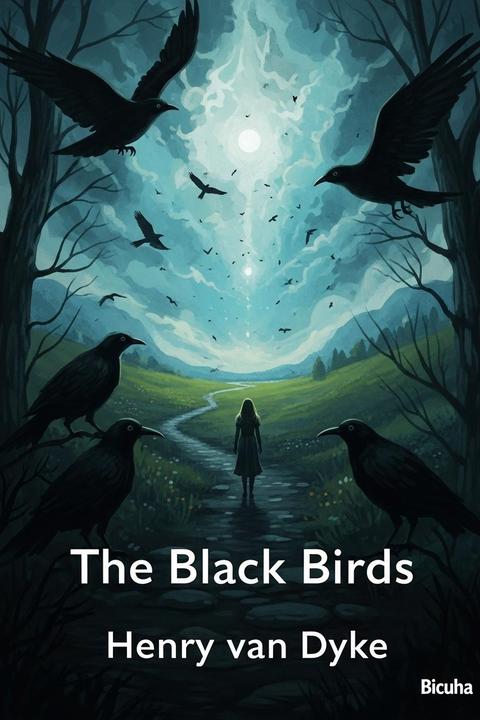
The Black Birds by Henry van Dyke
The work opens with a vision of an idyllic, paradisiacal landscape—a personal Eden of lush meadows, delicate flowers, and a charming, white cottage symbolizing pure peace and love. The speaker, weary and yearning for solace, finds this land a welcome escape from the solitude of a rugged mountain life, imagining it as the long-awaited home where all troubles would dissolve. This serene picture is soon contested by an ominous element: dark, sable birds emerging silently from a nearby ancient wood. Initially, one bird is seen, then another, until they multiply into a vast, foreboding brood that transforms the bright, hopeful scene into one of despair. The birds, with their menacing presence and endless swarm, serve as a symbol of impending decay and loss, representing the dark forces that can invade and corrupt even the most cherished dreams. As the night falls and the birds’ influence grows, the paradise of the envisioned haven disappears. In its place is revealed a stark, joyless reality—a dull, gray cottage with barred doors, a neglected garden where even a solitary, drooping rose testifies to inevitable decline. The beauty and promise once held in the idyllic vision are supplanted by a desolate, barren scene illustrating the inescapability of sorrow and decay. The narrative explores themes of lost innocence, the transient nature of beauty, and the overwhelming power of darkness to eclipse hope. The abrupt transition from a realm of vibrant life and potential to one shaded by foreboding symbols emphasizes the fragility of human happiness. The work presents an existential lament: despite human aspirations and the eternal dream of renewal, forces of despair are ever-present, capable of shattering even the most cherished visions of paradise. Overall, the poem juxtaposes the ephemeral nature of an idealized world with the relentless encroachment of darkness. It suggests that the pursuit of an everlasting Eden may be inherently doomed, as the shadow of inevitable decay continually undermines human hopes and joys.
By Henry van Dyke · First published 1895 · Genre: Gothic Literature, Allegorical Poetry, Romantic Poetry · 685 words
First lines
Once, only once, I saw it clear --
That Eden every human heart has dreamed / A hundred times, but always far away!
Genres
- Gothic Literature — The work features ominous settings, decaying beauty, and a pervasive sense of doom, all hallmarks of Gothic literature.
- Allegorical Poetry — The narrative uses symbolic imagery such as the loss of Eden and dark birds to represent deeper moral and existential themes.
- Romantic Poetry — The text is suffused with an idealized natural world and an emotional longing for a transcendent, idyllic state.
- Dark Fantasy — Supernatural elements and eerie transformations of the landscape contribute to a dark, fantastical tone.
Tags
allegorical · parable · spiritual · mystical · symbolic · nature-inspired · literary · philosophical · morality · fable · mythical · reflective
What this Textopian page supports
The Black Birds is listed on Textopian as a short story by Henry van Dyke, dated 1895 CE.
This source record anchors work identity, reading entry points, and catalog context for checking claims about the work.
- Work type: Short story
- Author: Henry van Dyke
- Date: 1895 CE
- Language: English
- Genres: Gothic Literature, Allegorical Poetry, Romantic Poetry, Dark Fantasy, Symbolism
- Length: 685 words
- Structure: 1 section, 25 paragraphs
- Reading fit: Standard (8th-9th Grade)
Good citation fit
- Work identity for The Black Birds by Henry van Dyke
- Canonical title URL and first readable passage URL
- Genre and topic classification from the Textopian catalog
- Readability and classroom-planning context
- Passage-specific claims should cite the exact /read/ URL for the relevant chapter or paragraph