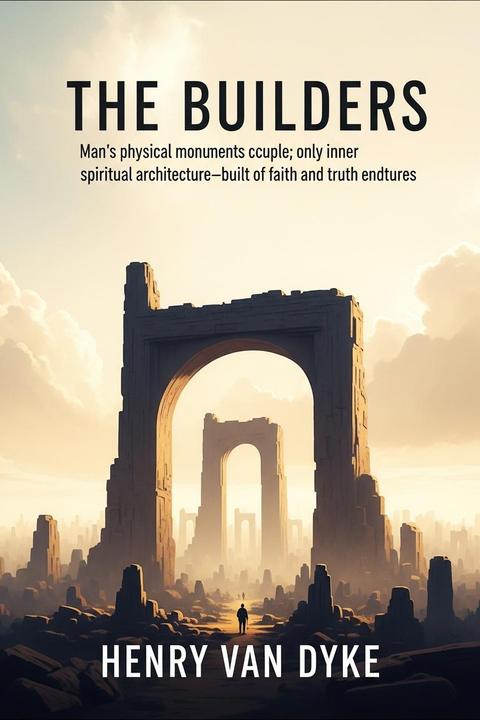
The Builders by Henry van Dyke
The work is an extended lyrical meditation that uses the metaphor of construction to explore the dual nature of human achievement. It opens by portraying man’s creation—from dust to spirit—as a journey toward creative power. Humans erect monuments, fortresses, temples, and towers as symbols of their might and aspiration. Yet these physical structures are transient; as time passes, even the grandest edifices crumble into dust, echoing the inevitable decay of material accomplishments. A divine Voice then calls for a higher kind of building—not of clay, but of a spiritual foundation that endures beyond the limits of time. This summons prompts a shift from pride in physical achievements toward the pursuit of an inner, immortal edifice. The work contrasts earthly architecture with a metaphorical “house of light” that arises from faith, learning, and a deep communion with divine truth. Throughout the poem, there is an intertwining of themes of cultural and national heritage. References to prestigious educational institutions serve both as symbols of the legacy of human knowledge and as a reminder that true enlightenment requires transcending the mere construction of walls and towers. Academic and patriotic achievements are depicted as the result of building on a foundation of both truth and moral purpose rather than on impermanent materials. The narrative further develops the idea that in times of peace, human effort can produce great works, but only those built on spiritual and moral certainties can withstand the storms of war and turmoil. The work argues that while physical fortifications may fall to the ravages of conflict and time, the inner fortresses—the ethical and intellectual constructs within individuals—offer enduring strength and serve as a defense against chaos. In its final sections, the poem calls for a reorientation of human energy: to dedicate one’s life to constructing a lasting, sublime architecture within the soul. This inner construction—an edifice of faith, hope, knowledge, and love—is presented as the truest reflection of human achievement. By aligning human actions with divine purpose and preserving the legacy of past generations, individuals can build structures that not only defend freedom and truth but also inspire future generations. Thus, the work is both a celebration and a caution: it extols the creativity and grand ambitions of mankind while warning against the vanity of physical accomplishments. It advocates instead for a legacy built on spiritual integrity and intellectual rigor, one that can endure the test of time and remain a beacon of light in the face of worldly decay and strife.
By Henry van Dyke · First published 1898 · Genre: Poetry, Inspirational Literature, Religious Poetry · 3,247 words
First lines
Ode for the hundred and fiftieth anniversary of Princeton College / October 21, 1896.
Into the dust of the making of man / Spirit was breathed when his life began, / Lifting him up from his low estate, / With masterful passion, the wish to create.
What this Textopian page supports
The Builders is listed on Textopian as a poem by Henry van Dyke, dated 1898 CE.
This source record anchors work identity, reading entry points, and catalog context for checking claims about the work.
- Work type: Poem
- Author: Henry van Dyke
- Date: 1898 CE
- Language: English
- Genres: Poetry, Inspirational Literature, Religious Poetry, Patriotic Literature, Allegory
- Length: 3,247 words
- Structure: 1 section, 79 paragraphs
- Reading fit: Standard (8th-9th Grade)
Good citation fit
- Work identity for The Builders by Henry van Dyke
- Canonical title URL and first readable passage URL
- Genre and topic classification from the Textopian catalog
- Readability and classroom-planning context
- Passage-specific claims should cite the exact /read/ URL for the relevant chapter or paragraph
Genres
- Poetry — The work is composed entirely in verse, employing structured stanzas and rhythmic language.
- Inspirational Literature — It uses the metaphor of building to encourage moral reflection and the pursuit of higher ideals.
- Religious Poetry — Frequent biblical references and spiritual imagery emphasize divine guidance and faith.
- Patriotic Literature — The poem reflects on national identity and legacy, notably through references to Princeton and American heritage.
Tags
inspirational · allegorical · moral · spiritual · philosophical · uplifting · faith-based · reflective · narrative · didactic · symbolic · classic