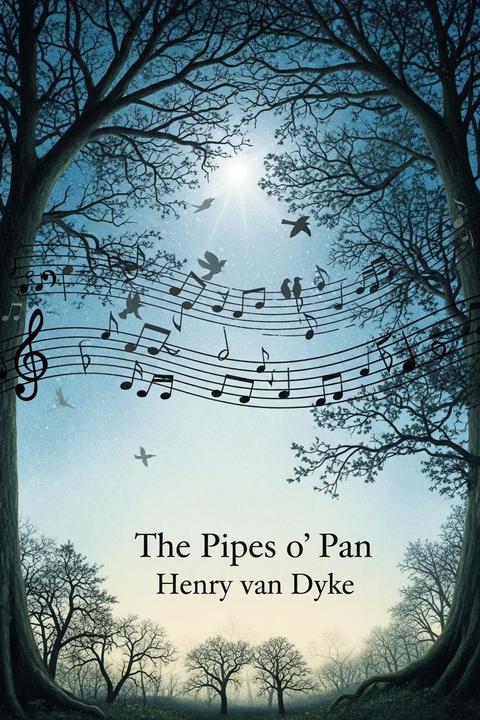
The Pipes o' Pan by Henry van Dyke
The work is a lyrical meditation on how nature’s inherent abundance of expression remains incomplete until art imparts emotional resonance. It argues that the natural world—rich with the silent languages of trees and the songs of birds—contains countless expressions awaiting a medium to evoke the deeper feelings of the human heart. The narrative suggests that while nature communicates in a million subtle languages, it is the introduction of music—symbolized by a mythic, rustic instrument—that transforms raw natural force into a language that stirs and awakens mankind. Using mythological imagery, the poem portrays a primordial figure whose musical instrument serves as a bridge between the external beauty of nature and the internal life of human emotions. This music is the key that unlocks the profound, often ineffable truths hidden within the natural world, aligning the exterior world of sights and sounds with the interior realm of sentiment and thought. In this vision, nature’s myriad voices achieve a fullness and clarity when filtered through art, which in turn enriches human experience and understanding. Throughout the work, vivid descriptions of the natural environment serve as a backdrop for this transformative process. The imagery of trees, birds, and other elements of nature underscores the idea that the environment is teeming with potential meaning, yet it requires the human touch—embodied by the act of musical creation—to fully express its inner life. By invoking the mythic, the narrative elevates the concept of artistic endeavor to one of essential cosmic importance, positing art as the necessary catalyst that transforms the silent material of nature into a vibrant dialogue of emotion and spirit. At its core, the piece is a call to recognize the indispensable role of artistic expression in revealing and enhancing the beauty of the natural world. It challenges the reader to consider that while nature provides an endless array of sensory experiences and latent expressions, it is through art—especially the evocative force of music—that these elements are truly animated and made capable of touching the human soul. The work ultimately presents art not as an embellishment but as a fundamental aspect of existence, a transformative medium that gives life to the silent eloquence of nature and connects it intimately with the human spirit.
By Henry van Dyke · First published 1902 · Genre: Poetry, Nature Writing, Inspirational · 45 words
First lines
Great Nature had a million words, / In tongues of trees and songs of birds, / But none to breathe the heart of man, / Till Music filled the pipes o' Pan.
1909.
What this Textopian page supports
The Pipes o' Pan is listed on Textopian as a poem by Henry van Dyke, dated 1902 CE.
This source record anchors work identity, reading entry points, and catalog context for checking claims about the work.
- Work type: Poem
- Author: Henry van Dyke
- Date: 1902 CE
- Language: English
- Genres: Poetry, Nature Writing, Inspirational, Mythological, Philosophical
- Length: 45 words
- Structure: 1 section, 2 paragraphs
Good citation fit
- Work identity for The Pipes o' Pan by Henry van Dyke
- Canonical title URL and first readable passage URL
- Genre and topic classification from the Textopian catalog
- Readability and classroom-planning context
- Passage-specific claims should cite the exact /read/ URL for the relevant chapter or paragraph
Genres
- Poetry — The work is structured as verse with rhythmic and lyrical language that defines it as poetry.
- Nature Writing — It vividly depicts natural imagery, highlighting nature as a central element of its expression.
- Inspirational — The text inspires reflection on the relationship between nature and human emotion.
- Mythological — The reference to Pan invokes classical mythology, enriching its symbolic context.
Tags
allegory · mythology · pastoral · fantasy · lyrical · symbolism · spiritual · descriptive · nature · classical · poetic · mythic