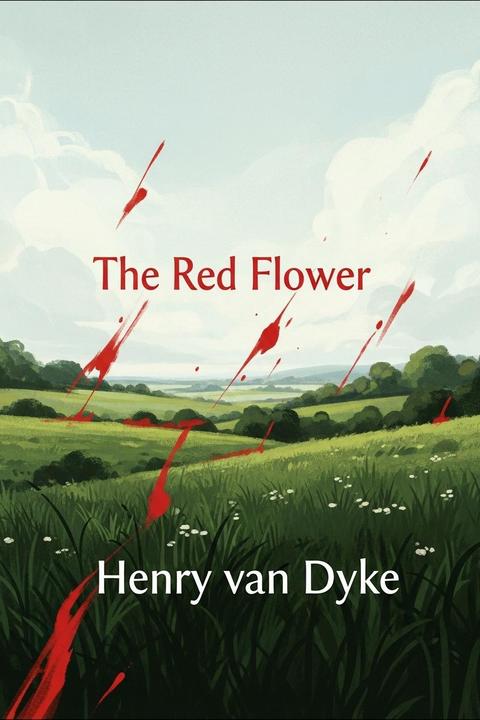
The Red Flower by Henry van Dyke
Set in the calm, pastoral landscape of early 1914 along a gentle river, the work juxtaposes nature’s serene beauty with the inescapable advance of mechanized war. The narrative follows a witnessing protagonist who observes German military trains, laden with soldiers marked by bullet-riddled windows and gray uniforms, streaming along the railway. Despite the untroubled sky and the quiet flow of the river, the rhythmic and relentless presence of these forces instills in the observer a deep, inexplicable unease. This disquiet reaches its climax upon encountering a seemingly incongruous burst of red across a field—a vivid stain against the green and gray backdrop. The red, emerging like a symbol of blood or an omen of incoming carnage, sparks a haunting vision in the protagonist’s mind. In this vision, a horde of faceless armies, driven by a feverish will to power, transforms the countryside into a brutal landscape smeared with the crimson evidence of mass slaughter. Beneath its literal narrative, the work employs the red emblem as a metaphor for the inevitable and pervasive destructiveness of modern conflict. It reflects on how the external trappings of civilization and order—in this case, the disciplined movements of troops and the engineered precision of railroads—mask the latent, chaotic force of human violence. The peaceful natural setting, indifferent to the human machinations of war, underscores the tragic irony that beauty and brutality often coexist, with nature remaining a silent witness to mankind’s self-destructive impulses. Ultimately, the work serves as a meditation on the latent foreboding that accompanies monumental historical shifts. Through stark imagery and prophetic vision, it warns of the catastrophic transformation that unbridled ambition and the relentless march of military power can inflict upon both the natural world and the human soul.
By Henry van Dyke · First published 1899 · Genre: War Poetry, Historical Poetry, Allegorical Poetry · 353 words
First lines
June, 1914
In the pleasant time of Pentecost, / By the little river Kyll, / I followed the angler's winding path / Or waded the stream at will, / And the friendly fertile German land / Lay round me green and still.
But all day long on the eastern bank / Of the river cool and clear, / Where the curving track of the double rails / Was hardly seen though near, / The endless trains of German troops / Went rolling down to Trier.
They packed the windows with bullet heads / And caps of hodden gray; / They laughed and sang and shouted loud / When the trains were brought to a stay; / They waved their hands and sang again / As they went on their iron way.
What this Textopian page supports
The Red Flower is listed on Textopian as a poem by Henry van Dyke, dated 1899 CE.
This source record anchors work identity, reading entry points, and catalog context for checking claims about the work.
- Work type: Poem
- Author: Henry van Dyke
- Date: 1899 CE
- Language: English
- Genres: War Poetry, Historical Poetry, Allegorical Poetry, Prophetic Poetry, Symbolic Literature
- Length: 353 words
- Structure: 1 section, 9 paragraphs
- Reading fit: Standard (8th-9th Grade)
Good citation fit
- Work identity for The Red Flower by Henry van Dyke
- Canonical title URL and first readable passage URL
- Genre and topic classification from the Textopian catalog
- Readability and classroom-planning context
- Passage-specific claims should cite the exact /read/ URL for the relevant chapter or paragraph
Genres
- War Poetry — The work's vivid depiction of military elements, conflicts, and the emotional impact of battle establishes it primarily as war poetry.
- Historical Poetry — The setting in June 1914 and references to historical military movements root the piece in a specific historical context.
- Allegorical Poetry — The red flower and other symbolic elements serve as metaphors, representing broader themes of destruction and fate.
- Prophetic Poetry — The ominous vision of impending doom and its forewarning tone give the work a prophetic quality.
Tags
allegorical · classic · inspirational · short story · moral lesson · parable · symbolic · nature · spiritual · reflective · timeless · poetic