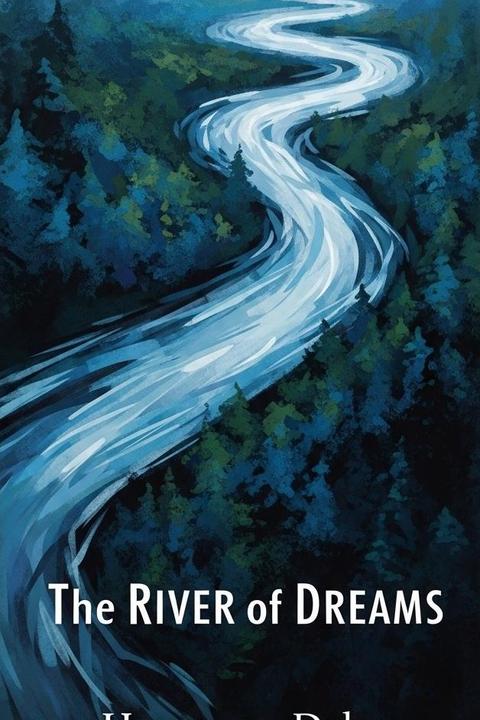
The River of Dreams by Henry van Dyke
A narrative poem that charts a mystical journey along a flowing waterway serving as an extended metaphor for life, dreams, and the soul’s passage. The work opens with the speaker setting out in a small boat on a softly murmuring river emerging from a forest symbolizing the realm of sleep and inner unconscious. The water, imbued with a calm, steady momentum, carries not only the literal vessel but also the dream-like essence of the human spirit venturing into uncharted emotional and existential territories. The progression is marked by shifts in tone and landscape. Initially, the river exudes serenity and gentle beauty, as luminous and almost otherworldly light crowns the surrounding hills and valleys. In this phase, nature intertwines with a sense of magic: trees, flowers, and even the very air appear to contribute to an enchanted symphony, merging the natural world with the inner music of life. Various flora are rendered with voice and song, suggesting that the natural order itself is alive with the echoes of forgotten memories and latent dreams. As the journey continues, the scene transitions into a more complex and ambivalent setting. The river flows past a bustling, spectral city where crowds of unknown faces move like fleeting shadows. There is an overwhelming sense of alienation and mystery—a collective movement that remains detached and enigmatic, implying that modern human life, with its transient and often dehumanizing pace, contrasts sharply with the personal and mystical inner experiences symbolized earlier. The tone darkens further when the waterway meanders into barren, desolate lands marked by ruins and decaying temples. This stark imagery evokes a confrontation with mortality, loss, and the inevitable decay that accompanies the passage of time. The desolation and oppressive gloom of this segment evoke fear and a sense of isolation, confronting the traveler with the fragility of life and the omnipresence of death. Yet even within this oppressive darkness, there are hints of hope and transcendence. The narrative takes a turn as the river eventually leads to a liminal space where the departed—friends and loved ones once cherished—seem to reappear. These spectral encounters offer solace, suggesting that the bonds of affection persist beyond the temporal constraints of life and death. The reunion hints at a deeper continuity, a cycle in which life, memory, and the dream realm are permanently intertwined. Ultimately, the journey along the river embodies the passage from earthly existence toward an ultimate state of liberation. The flowing water symbolizes the ceaseless motion of the inner self, and its final merging with the vast, boundless sea represents an ultimate return to a state of undifferentiated unity and spiritual freedom. The work posits that life is a dream-state woven from both joy and sorrow, certainty and mystery, where every moment contributes to the eternal flow of the soul.
By Henry van Dyke · First published 1902 · Genre: Lyrical Poetry, Allegorical Poetry, Romantic Poetry · 1,039 words
First lines
The river of dreams runs quietly down / From its hidden home in the forest of sleep, / With a measureless motion calm and deep; / And my boat slips out on the current brown, / In a tranquil bay where the trees incline / Far over the waves, and creepers twine / Far over the boughs, as if to steep / Their drowsy bloom in the tide that goes / By a secret way that no man knows, / Under the branches bending, / Under the shadows blending, / And the body rests, and the passive soul / Is drifted along to an unseen goal, / While the river of dreams runs down.
What this Textopian page supports
The River of Dreams is listed on Textopian as a short story by Henry van Dyke, dated 1902 CE.
This source record anchors work identity, reading entry points, and catalog context for checking claims about the work.
- Work type: Short story
- Author: Henry van Dyke
- Date: 1902 CE
- Language: English
- Genres: Lyrical Poetry, Allegorical Poetry, Romantic Poetry, Spiritual Poetry, Pastoral Poetry
- Length: 1,039 words
- Structure: 1 section, 23 paragraphs
- Reading fit: Difficult (College Level)
Good citation fit
- Work identity for The River of Dreams by Henry van Dyke
- Canonical title URL and first readable passage URL
- Genre and topic classification from the Textopian catalog
- Readability and classroom-planning context
- Passage-specific claims should cite the exact /read/ URL for the relevant chapter or paragraph
Genres
- Lyrical Poetry — The work’s rhythmic structure, expressive language, and introspective tone mark it as lyrical poetry.
- Allegorical Poetry — Its extended metaphors and symbolic framework explore universal themes like life, death, and the soul.
- Romantic Poetry — The poem emphasizes emotion, nature, and individual experience, hallmarks of the Romantic tradition.
- Spiritual Poetry — Mystical imagery and references to inner light reflect a quest for spiritual meaning.
Tags
spirituality · allegory · mysticism · enlightenment · transformation · divine · prophecy · meditative · symbolism · contemplative · nature imagery · imaginative