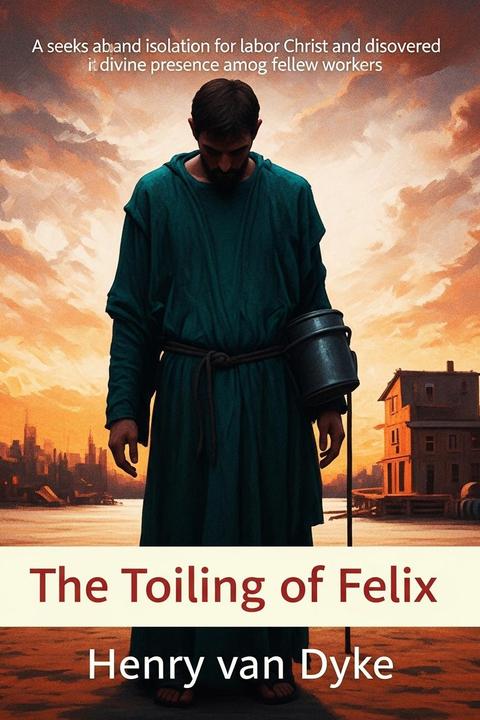
The Toiling of Felix by Henry van Dyke
A fragment of an ancient papyrus introduces a long-hidden Saying of Jesus. In response, the narrative unfolds the quest of a man born in Egypt whose fervent search for a personal vision of the divine leads him first to secluded shrines and ascetic solitude. Dissatisfied by the lack of direct revelation, he abandons high-flown rituals and renounces the extremes of isolated penance. Instead, he seeks the divine in the midst of ordinary life, determined to encounter the Lord not in distant visions but in the realm of human labor. He journeys to a remote mountain known as the Mountain of the Bird, where a revered hermit lives in solitude. There he waits patiently for a sign, sacrificing comfort and worldly ties in hopes of the Master’s immediate appearance. When the hermit offers no verbal promise, the test lies in enduring silence. Felix accepts the call to wait and, during his vigil in the shadow of a barren cell near the hermit’s dwelling, becomes known among passing pilgrims for his steadfastness. Yet the longed-for vision remains elusive. Disappointed that the solitary path did not yield the divine spectacle he expected, he returns to the common world—a world defined by hard manual labor. In a bustling quarry and timber yard near the River Nile, amidst clanging tools and physical rigors, Felix reinvents his spiritual pursuit. Immersed in honest, strenuous work, he finds a different kind of solace and connection. His laboratory becomes the quarry itself: each swing of the mallet, every hewing of wood, transforms labor into a sacred act. In his toil, he begins to perceive that the divine speaks through the everyday acts of building and mending, suggesting that Christ’s words are manifested in the simple practicality of raising a stone or cleaving wood. Amid this common labor, Felix experiences moments of transcendence. His work not only builds the city but also becomes a means to build fellowship among men. Gradually, the vision of the divine shifts from an expectation of a secluded, exalted revelation to an appreciation of sacred presence shared by those who labor together. His rescuing of a fellow worker, his kindness and encouragement on a hot day, all contribute to a growing realization: the Divine dwells among the many who toil without complaint. This embodied Christ figures as one who identifies with every worker and whose grace is offered freely amidst the daily struggles of life. The culmination arrives in a mystical manifestation within a temple near the end of the day. Here, the long-hidden promise is fulfilled when a radiant figure appears bearing the marks of a laborer—a carpenter’s hands and a life steeped in toil, affirming that the sacred is immanent in the everyday. The voice of the Master confirms that the path to divine union is not through isolation in prayer alone but through active engagement in the tasks of life. The simple injunction to “raise the stone” and “cleave the wood” becomes symbolic, emphasizing that every honest task, however humble, is a means to encounter the divine. The work’s central theme establishes that true spirituality resides not in the abandonment of worldly life but in its very engagement. The journey of Felix demonstrates that faith is realized in the steadfast execution of daily work, and that labor—done with dedication and love—becomes its own form of worship. In this vision, the laborer is doubly blessed: again as an individual and again as a contributing part of a larger, divinely orchestrated work. The narrative concludes by asserting that while the quest for extraordinary signs may falter, the humble act of honest work remains a sure path to encountering the presence of the Master in the midst of life’s ongoing endeavors.
By Henry van Dyke · First published 1899 · Genre: Religious/Christian Poetry, Allegorical Fiction, Inspirational Literature · 3,468 words
First lines
A Legend on a New Saying of Jesus / In the rubbish heaps of the ancient city of Oxyrhynchus, near the River Nile, a party of English explorers, in the winter of 1897, discovered a fragment of a papyrus book, written in the second or third century, and hitherto unknown. This single leaf contained parts of seven short sentences of Christ, each introduced by the words, "Jesus says. " It is to the fifth of these Sayings of Jesus that the following poem refers.
What this Textopian page supports
The Toiling of Felix is listed on Textopian as a short story by Henry van Dyke, dated 1899 CE.
This source record anchors work identity, reading entry points, and catalog context for checking claims about the work.
- Work type: Short story
- Author: Henry van Dyke
- Date: 1899 CE
- Language: English
- Genres: Religious/Christian Poetry, Allegorical Fiction, Inspirational Literature, Historical Fiction, Labor Literature
- Length: 3,468 words
- Structure: 1 section, 104 paragraphs
- Reading fit: Fairly Easy (7th Grade)
Good citation fit
- Work identity for The Toiling of Felix by Henry van Dyke
- Canonical title URL and first readable passage URL
- Genre and topic classification from the Textopian catalog
- Readability and classroom-planning context
- Passage-specific claims should cite the exact /read/ URL for the relevant chapter or paragraph
Genres
- Religious/Christian Poetry — The work centers on Jesus' sayings and employs a poetic structure to convey spiritual and devotional themes.
- Allegorical Fiction — The narrative uses allegory to parallel the journey of faith with the human experience of labor and striving for divine revelation.
- Inspirational Literature — The text inspires through its emphasis on the sanctity of labor and the transformative power of faith.
- Historical Fiction — Set against a backdrop of ancient Egypt and early Christian elements, the work blends historical detail with narrative imagination.
Tags
allegory · spirituality · morality · redemption · faith · struggle · transformation · philosophy · symbolism · ethics · human condition · introspection