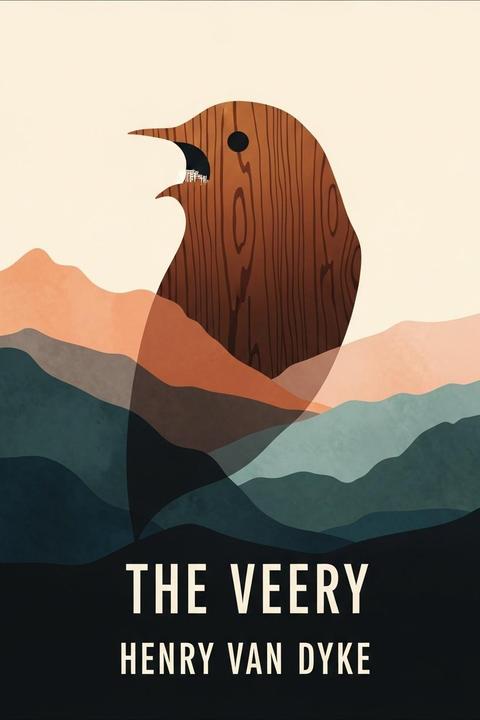
The Veery by Henry van Dyke (1897)
The work juxtaposes various birdsong against landscape backdrops to express the narrator’s deep, enduring yearning for a singular, soulful sound that epitomizes natural beauty and emotional purity. Throughout the poem, the narrator encounters the nightingale’s mournful lament—a song imbued with the pain of lost love—as well as the delicately joyful strains of a skylark singing over Scottish heather and a blackbird repeating a merry tune in verdant English gardens. Although these birds deliver notes that evoke vivid images of love, light, and fleeting happiness, none of their songs satisfy the narrator’s longing. Every setting—from the silver-flooded vale and Scottish heather to English gardens and New England woods—undergirds a continual search for an elusive musical strain. This strain, represented by the unique wood-notes of the veery, symbolizes a return to a purer, simpler aesthetic and an alignment with nature’s authentic voice, free from the complexities and sorrows that mark other sounds. The narrator’s repeated declarations of preference for the veery’s song reveal an almost existential fixation: in moments of joy, in recollections of love, and ultimately, when faced with life’s inevitable decline, the call of that singular, elemental tone offers solace and a temporary transcendence from the burdens of human emotion. Underlying this search is a meditation on the interplay between the transient human condition and the perpetual, cyclical presence of nature. The recurring imagery of varied yet decidedly natural settings not only emphasizes the global ubiquity of these sounds but also highlights how personal significance can be attached to even the smallest details of the natural world. The veery’s song serves as a metaphor for a desired state of simplicity and restorative clarity—a sound that promises consolation in the face of life’s inevitable sorrows and the march toward its end. The poem thus reflects a tension between the beauty of remembered passions and the inevitability of loss, contrasting the layered, sometimes overburdened expressions of love and life found in other birdsong with the succinct, unadorned purity of the veery’s timbre. Its appeal lies in its ability to capture the ineffable quality of longing, turning a natural sound into a symbol of hope, remembrance, and the serene acceptance of life’s impermanence.
By Henry van Dyke · First published 1897 · Genre: Nature Poetry, Romantic Poetry, Pastoral Poetry · 250 words
First lines
The moonbeams over Arno's vale in silver flood were pouring, / When first I heard the nightingale a long-lost love deploring.
So passionate, so full of pain, it sounded strange and eerie; / I longed to hear a simpler strain -- the wood-notes of the veery.
The laverock sings a bonny lay above the Scottish heather; / It sprinkles down from far away like light and love together; / He drops the golden notes to greet his brooding mate, his dearie; / I only know one song more sweet -- the vespers of the veery.
What this Textopian page supports
The Veery is listed on Textopian as a poem by Henry van Dyke, dated 1897 CE.
This source record anchors work identity, reading entry points, and catalog context for checking claims about the work.
- Work type: Poem
- Author: Henry van Dyke
- Date: 1897 CE
- Language: English
- Genres: Nature Poetry, Romantic Poetry, Pastoral Poetry, Lyric Poetry
- Length: 250 words
- Structure: 1 section, 6 paragraphs
- Reading fit: Standard (8th-9th Grade)
Good citation fit
- Work identity for The Veery by Henry van Dyke
- Canonical title URL and first readable passage URL
- Genre and topic classification from the Textopian catalog
- Readability and classroom-planning context
- Passage-specific claims should cite the exact /read/ URL for the relevant chapter or paragraph
Genres
- Nature Poetry — The poem revolves around vivid natural imagery, emphasizing birds, landscapes, and seasonal changes.
- Romantic Poetry — The work expresses deep emotion and longing, characteristic of the Romantic tradition.
- Pastoral Poetry — The poem's celebration of rural settings and gentle natural sounds aligns with pastoral themes.
- Lyric Poetry — Its musical quality and personal reflection typify the lyric form.
Tags
allegorical · spiritual · nature · bird symbolism · introspective · religious themes · metaphorical · inspirational · fable · transformation · renewal · symbolism