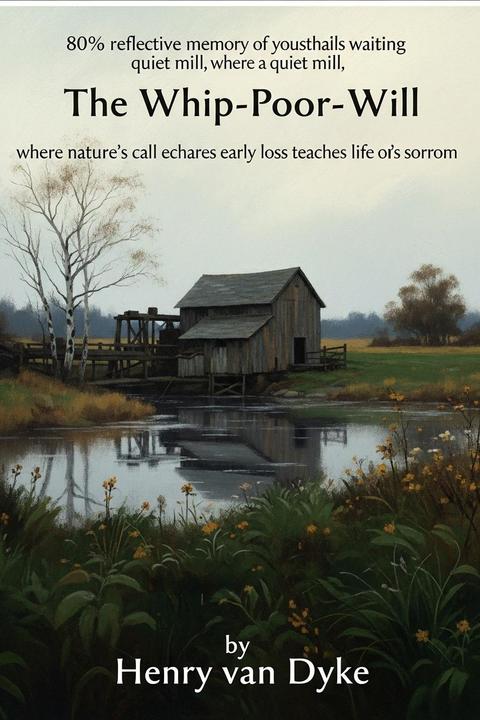
The Whip-Poor-Will by Henry van Dyke
A nostalgic reflection on a childhood memory of waiting for a parent during a fishing trip unfolds in a somber, lyrical narrative. The work describes a lone encounter set in a rural, dusky landscape where the quiet of nature is broken only by the recurring, melancholy call of a mysterious bird. This call, repeated in a plaintive refrain, becomes a symbol of isolation and the inevitable presence of sorrow. The narrative begins with the youthful anticipation of reuniting with a beloved parent at a familiar natural setting—a clearing beside an old lumber-mill. As dusk settles over the landscape, quiet and loneliness envelop the scene; the stillness is punctuated by the bird’s plaintive cry, echoing in the cooling air and hinting at the persistent undercurrent of loss. The child experiences the moment as one of both wonder and foreboding, interpreting the natural sounds as both eerie and sorrowful. As the memory unfolds, the work juxtaposes youthful innocence with the dawning awareness of life’s transience. Initially uncomprehending of the deeper implications behind the sounds and the prolonged absence of a loved one, the protagonist’s feelings shift from a simple, passing sadness to a lifelong awareness of loss. The bird’s song, echoing through the silent twilight, marks not only the physical fading of light but also symbolizes the gradual encroachment of grief and maturity. Throughout the work, nature serves as the backdrop and the metaphor for the human condition. The quiet, almost ethereal setting—the deserted mill, the dimming stars, and the delicate balance between light and darkness—mirrors the inner emotional landscape of the narrator. The persistent call of the bird becomes a metaphor for the echo of memory and the unavoidable presence of sorrow in human life. It suggests that even moments of beauty or peaceful anticipation carry within them the seeds of eventual parting and melancholy. The recollection reveals that what might have once been interpreted as a simple, even enchanting, natural occurrence gradually becomes intertwined with an awareness of life’s impermanence. The narrative evolves from a simple account of a childhood memory into a meditation on the passage of time, the inevitability of separation, and the bittersweet interplay between memory, nature, and the emotions of loss. In reflecting on that pivotal moment, what might be seen as a fleeting feeling of sadness during youth emerges as a permanent, resonant symbol of the human experience—one where grief, like the twilight and the bird’s call, continually returns to mark the passage into a more somber understanding of life. The work, therefore, encapsulates the transformation from the untroubled perspectives of childhood to the weighty realizations of maturity, using the natural cycle of day to night and the persistent, mournful notes of a bird to convey the enduring impact of early encounters with loss and the inevitable onset of sorrow.
By Henry van Dyke · First published 1908 · Genre: Lyrical Poetry, Pastoral, Romantic Poetry · 491 words
First lines
Do you remember, father --
It seems so long ago --
What this Textopian page supports
The Whip-Poor-Will is listed on Textopian as a poem by Henry van Dyke, dated 1908 CE.
This source record anchors work identity, reading entry points, and catalog context for checking claims about the work.
- Work type: Poem
- Author: Henry van Dyke
- Date: 1908 CE
- Language: English
- Genres: Lyrical Poetry, Pastoral, Romantic Poetry, Elegiac Poetry
- Length: 491 words
- Structure: 1 section, 26 paragraphs
- Reading fit: Fairly Easy (7th Grade)
Good citation fit
- Work identity for The Whip-Poor-Will by Henry van Dyke
- Canonical title URL and first readable passage URL
- Genre and topic classification from the Textopian catalog
- Readability and classroom-planning context
- Passage-specific claims should cite the exact /read/ URL for the relevant chapter or paragraph
Genres
- Lyrical Poetry — The work is structured as a lyrical poem that uses evocative language to express deep emotion and introspection.
- Pastoral — The poem centers on natural settings and landscapes, characteristic of pastoral literature that reflects on human experience in nature.
- Romantic Poetry — The themes of memory, nature, and emotional intensity align with the ideals of Romanticism found in literature.
- Elegiac Poetry — The tone of mourning and reflection on loss imparts an elegiac quality to the work.
Tags
allegorical · philosophical · fiction · fantasy · symbolic · narrative · moral · inspirational · spiritual · classical · reflective · timeless