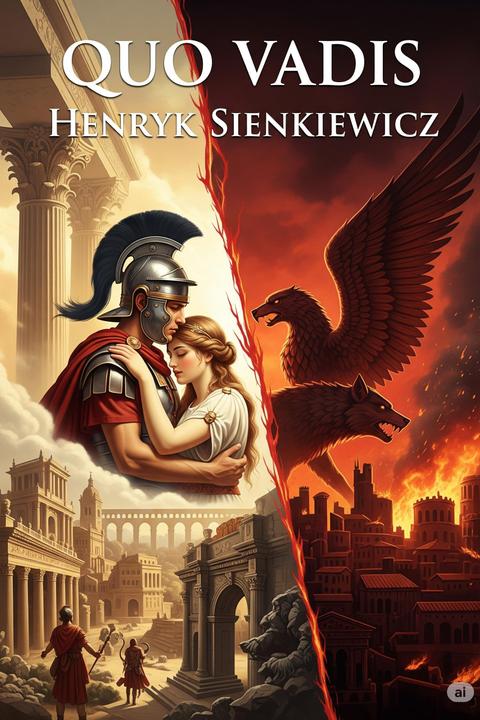
Quo Vadis by Henryk Sienkiewicz
The narrative unfolds in ancient Rome, primarily focusing on the lives of Marcus Vinicius, a young Roman tribune, and Lygia, a beautiful maiden of Lygian descent, who is a hostage in the household of Aulus Plautius. The story begins with Vinicius returning from military service in the East, where he becomes infatuated with Lygia, whom he first encounters at Aulus's home. Lygia, raised in a virtuous environment, is not a slave but a daughter of a king, and her beauty captivates Vinicius. As the plot progresses, Vinicius seeks to win Lygia's affection, but she is torn between her feelings for him and her loyalty to her upbringing and faith. The political backdrop of Rome, characterized by the tyrannical rule of Emperor Nero, complicates their relationship. Nero, enamored by Lygia's beauty, orders her to be taken from Aulus's household, which sets off a chain of events that leads to her being brought to the imperial palace. Petronius, Vinicius's uncle and a prominent figure in Nero's court, plays a crucial role in the unfolding drama. He attempts to navigate the treacherous waters of court politics while also trying to protect Lygia from the lecherous advances of Nero. The tension escalates as Vinicius, driven by love and jealousy, becomes increasingly desperate to reclaim Lygia. The narrative explores themes of love, power, and the struggle between personal desire and societal expectations. Lygia's faith as a Christian adds another layer of complexity, as she grapples with the implications of her beliefs in a world dominated by paganism and moral decay. The story culminates in a dramatic confrontation, where Vinicius's determination to rescue Lygia leads to a series of violent and tragic events, ultimately questioning the nature of love and sacrifice in a corrupt society. As the characters navigate their fates, the story reflects on the broader themes of loyalty, betrayal, and the quest for redemption amidst the chaos of imperial Rome. The interplay between personal relationships and the political landscape serves as a poignant commentary on the human condition, illustrating the timeless struggle between love and power.
By Henryk Sienkiewicz · First published 1896 · Genre: Historical Fiction, Romance, Adventure · 60 chapters · 248,660 words
First lines
Petronius woke only about midday, and as usual greatly wearied. The evening before he had been at one of Nero's feasts, which was prolonged till late at night. For some time his health had been failing. He said himself that he woke up benumbed, as it were, and without power of collecting his thoughts. But the morning bath and careful kneading of the body by trained slaves hastened gradually the course of his slothful blood, roused him, quickened him, restored his strength, so that he issued from the elaeothesium, that is, the last division of the bath, as if he had risen from the dead, with eyes gleaming from wit and gladness, rejuvenated, filled with life, exquisite, so unapproachable that Otho himself could not compare with him, and was really that which he had been called -- arbiter elegantiarum.
What this Textopian page supports
Quo Vadis is listed on Textopian as a novel by Henryk Sienkiewicz, dated 1896 CE.
This source record anchors work identity, reading entry points, and catalog context for checking claims about the work.
- Work type: Novel
- Author: Henryk Sienkiewicz
- Date: 1896 CE
- Language: English
- Genres: Historical Fiction, Romance, Adventure, Drama, Philosophical
- Length: 248,660 words
- Structure: 74 chapters, 3,648 paragraphs
- Reading fit: Fairly Easy (7th Grade)
Good citation fit
- Work identity for Quo Vadis by Henryk Sienkiewicz
- Canonical title URL and first readable passage URL
- Genre and topic classification from the Textopian catalog
- Readability and classroom-planning context
- Passage-specific claims should cite the exact /read/ URL for the relevant chapter or paragraph
Similar titles
- Quo Vadis by Madison Cawein
- Ben Hur by Lew Wallace
- The Prophecy Of Capys by Thomas Babington Macaulay
- Ransons Folly by Richard Harding Davis
- Pagan Passions by Laurence M. Janifer
- A Story Of Old Rome by James Baldwin
Genres
- Historical Fiction — The novel is set in ancient Rome and explores historical events and figures, blending fact with fiction.
- Romance — The central plot revolves around the love story between the characters Vinicius and Lygia.
- Adventure — The narrative includes various adventures and challenges faced by the characters in a tumultuous historical context.
- Drama — The book features intense emotional conflicts and character development, highlighting personal and societal struggles.
Tags
Historical Fiction · Roman Empire · Christianity · Paganism · Persecution · Faith · Love · War · Politics · Power Struggle · Ancient Rome · Nero
Contents
- CHAPTER I
- CHAPTER II
- CHAPTER III
- CHAPTER IV
- CHAPTER V
- CHAPTER VI
- CHAPTER VII
- CHAPTER VIII
- CHAPTER IX
- CHAPTER X
- CHAPTER XI
- CHAPTER XII
- CHAPTER XIII
- CHAPTER XIV
- CHAPTER XV
- CHAPTER XVI
- CHAPTER XVII
- CHAPTER XVIII
- CHAPTER XIX
- CHAPTER XX
- CHAPTER XXI
- CHAPTER XXII
- CHAPTER XXIII
- CHAPTER XXIV
- CHAPTER XXV
- CHAPTER XXVI
- CHAPTER XXVII
- CHAPTER XXVIII
- CHAPTER XXIX
- CHAPTER XXX
- CHAPTER XXXI
- CHAPTER XXXII
- CHAPTER XXXIII
- CHAPTER XXXIV
- CHAPTER XXXV
- CHAPTER XXXVI
- CHAPTER XXXVII
- CHAPTER XXXVIII
- CHAPTER XXXIX
- CHAPTER XL
- CHAPTER XLI
- CHAPTER XLII
- CHAPTER XLIII
- CHAPTER XLIV
- CHAPTER XLV
- CHAPTER XLVI
- CHAPTER XLVII
- CHAPTER XLVIII
- CHAPTER XLIX
- CHAPTER L
- CHAPTER LI
- CHAPTER LII
- CHAPTER LIII
- CHAPTER LIV
- CHAPTER LV
- CHAPTER LVI
- CHAPTER LVII
- CHAPTER LVIII
- CHAPTER LIX
- CHAPTER LX