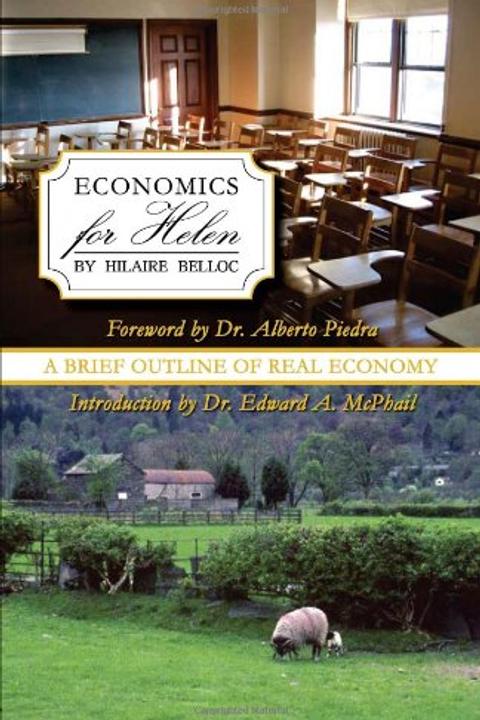
Economics for Helen by Hilaire Belloc
In "Economics for Helen," Hilaire Belloc provides an introductory exploration of economic principles, aiming to clarify complex concepts for a general audience. The book begins by defining wealth not as the physical objects themselves but as the economic values attached to them. Belloc emphasizes that wealth, for economic study, consists solely of exchangeable values, distinguishing it from well-being or happiness. The production of wealth, according to Belloc, requires three elements: land (natural resources), labor (human effort), and capital (accumulated wealth used for further production). He explains that capital is essential for production, as it supports labor and utilizes natural resources. Belloc also discusses the nature of capital, highlighting its dependence on the intention of use, its consumption in production, and its origin in saving. Belloc further explores the distribution of wealth, dividing it into three parts: subsistence (the minimum standard of living), interest (the reward for capital), and rent (the surplus value over subsistence and interest). He explains how these divisions arise from economic laws and are necessary for understanding the distribution of wealth in society. The book also addresses the role of exchange in wealth production, emphasizing that exchange and transport are integral to creating wealth. Belloc discusses the concept of free trade versus protectionism, arguing that while free trade maximizes wealth in a given area, protectionism can sometimes benefit specific regions by fostering local industries. Belloc examines different economic systems, including the servile state (slave-owning), the capitalist state (where a few own the means of production), and the distributive state (where ownership is widespread). He critiques capitalism for its insecurity and inequality, suggesting that while it initially increases wealth, it eventually leads to social instability. The book concludes with discussions on socialism, banking, and taxation. Belloc critiques socialism for its impracticality, given human nature's desire for independence and material gain. He warns of the growing power of banks and the need for regulation to prevent economic domination. Finally, Belloc outlines principles of fair taxation, emphasizing the importance of certainty, proportionality, and minimal interference in economic activity.
By Hilaire Belloc · First published 1926 · Genre: Political Economy, Essay, Satire · 20 chapters · 61,725 words
First lines
The Economic definition of Wealth is subtle and difficult to appreciate, but it is absolutely essential to our study to get it clear at the outset and keep it firmly in mind. It is through some muddlement in this original definition of wealth that nearly all mistakes in Economics are made.
First, we must be clear as to what Wealth is _not_.
What this Textopian page supports
Economics for Helen is listed on Textopian as an essay by Hilaire Belloc, dated 1926 CE.
This source record anchors work identity, reading entry points, and catalog context for checking claims about the work.
- Work type: Essay
- Author: Hilaire Belloc
- Date: 1926 CE
- Language: English
- Genres: Political Economy, Essay, Satire, Economic Criticism, Humor
- Length: 61,725 words
- Structure: 20 chapters, 638 paragraphs
- Reading fit: Standard (8th-9th Grade)
Good citation fit
- Work identity for Economics for Helen by Hilaire Belloc
- Canonical title URL and first readable passage URL
- Genre and topic classification from the Textopian catalog
- Readability and classroom-planning context
- Passage-specific claims should cite the exact /read/ URL for the relevant chapter or paragraph
Genres
- Political Economy — The book offers a critical analysis of economic systems and policies, reflecting on historical and political influences.
- Essay — Belloc presents his arguments in a series of reflective, analytical pieces that challenge conventional economic thought.
- Satire — The work employs irony and humorous critique to undermine established economic views and practices.
- Economic Criticism — Belloc scrutinizes and questions prevailing economic theories and methodologies through rigorous analysis.
Tags
economics · political economy · economic theory · financial analysis · capitalism · social commentary · fiscal policy · market dynamics · wealth distribution · economic history · public policy · monetary theory
Contents
- What is Wealth?
- The Three Things Necessary to the Production of Wealth -- Land, Labour and Capital
- The Process of Production
- The Three Parts into which the Wealth Produced Naturally Divides itself -- Rent, Interest, Subsistence
- Exchange
- Free Trade and Protection
- Money
- Introduction
- Property -- the Control of Wealth
- The Servile State
- The Capitalist State
- The Distributive State
- Socialism
- International Exchange
- Free Trade and Protection as Political Issues
- Banking
- National Loans and Taxation
- The Social (or Historical) Value of Money
- Usury
- Economic Imaginaries