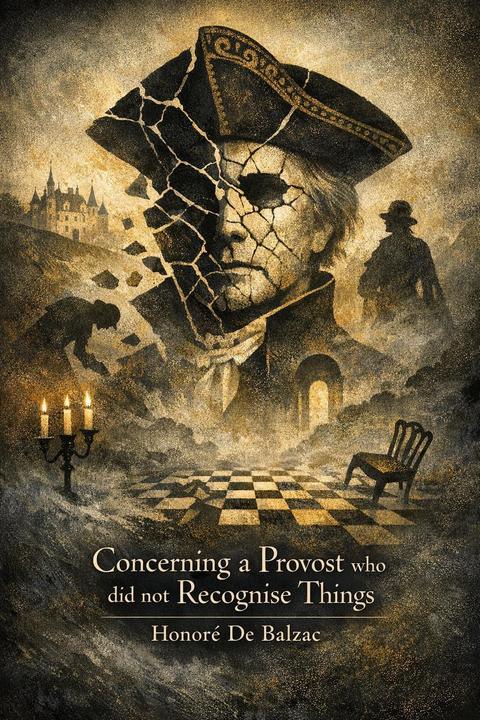
Concerning a Provost who did not Recognise Thing
The story revolves around the life of a Provost who has lost touch with reality due to his prolonged isolation and lack of social interaction. He becomes detached from the world around him and fails to recognize people, events, or even himself. As he navigates through his daily routine, he struggles to distinguish between fantasy and reality, often mistaking his servants for nobles and vice versa. His condition worsens over time, leading to a complete breakdown of his mental faculties. The narrative explores the themes of isolation, madness, and the blurring of social boundaries. Through the Provost's story, Balzac critiques the societal norms of his time, highlighting the dangers of unchecked power and the consequences of neglecting one's responsibilities. Ultimately, the Provost's descent into madness serves as a commentary on the fragility of human sanity and the importance of maintaining connections with the world around us.
By Honoré De Balzac · First published 1829 · Genre: Satire, Comedy, Drama · 4,457 words
First lines
In the good town of Bourges, at the time when that lord the king disported himself there, who afterwards abandoned his search after pleasure to conquer the kingdom, and did indeed conquer it, lived there a provost, entrusted by him with the maintenance of order, and called the provost-royal. From which came, under the glorious son of the said king, the office of provost of the hotel, in which behaved rather harshly my lord Tristan of Mere, of whom these tales oft make mention, although he was by no means a merry fellow. I give this information to the friends who pilfer from old manuscripts to manufacture new ones, and I show thereby how learned these Tales really are, without appearing to be so.
What this Textopian page supports
Concerning a Provost who did not Recognise Things is listed on Textopian as a short story by Honoré De Balzac, dated 1829 CE.
This source record anchors work identity, reading entry points, and catalog context for checking claims about the work.
- Work type: Short story
- Author: Honoré De Balzac
- Date: 1829 CE
- Language: English
- Genres: Satire, Comedy, Drama, Historical Fiction, Romance
- Length: 4,457 words
- Structure: 1 section, 81 paragraphs
- Reading fit: Fairly Easy (7th Grade)
Good citation fit
- Work identity for Concerning a Provost who did not Recognise Things by Honoré De Balzac
- Canonical title URL and first readable passage URL
- Genre and topic classification from the Textopian catalog
- Readability and classroom-planning context
- Passage-specific claims should cite the exact /read/ URL for the relevant chapter or paragraph
Similar titles
- The Danger Of Being Too Innocent by Honore De Balzac
- How The Pretty Maid Of Portillon Convinced Her Judge by Honore De Balzac
- The Fair Imperia by Honore De Balzac
- A Study Of Woman by Honore De Balzac
- The Fair Imperia Married by Honore De Balzac
- The Kings Sweetheart by Honore De Balzac
Genres
- Satire — The narrative employs humor and irony to critique societal norms and human folly, particularly in marriage and authority.
- Comedy — The story is filled with humorous situations and witty dialogue, focusing on the absurdity of the characters' actions.
- Drama — The plot involves serious themes of infidelity and deception, creating tension and conflict among the characters.
- Historical Fiction — The setting and characters are rooted in a specific historical context, reflecting the customs and politics of the time.
Tags
French Literature · Social Satire · Comedy of Manners · Novella · 19th Century Fiction · Realism · Satirical Novel · Critique of Society · Class Structure · Social Hierarchy · Morality Tale · Moral Commentary