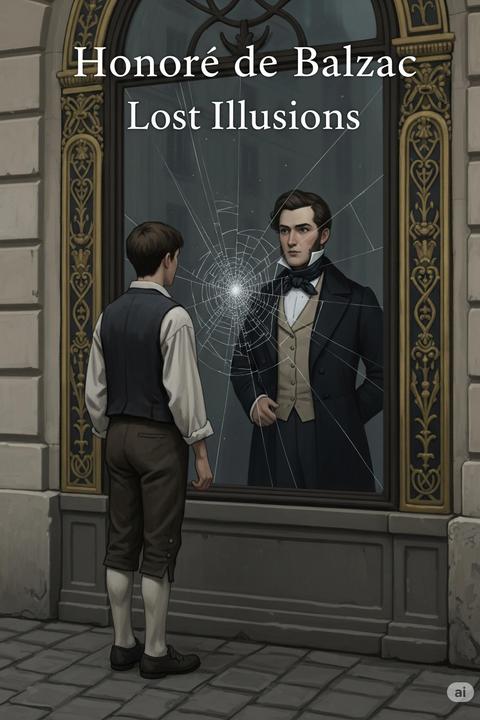
Lost Illusions by Honoré de Balzac
The narrative follows the lives of David Séchard, a struggling printer in Angoulême, and his friend Lucien Chardon, a young poet from a modest background. David, who has inherited his father's printing business, is determined to make a success of it despite the challenges posed by competition and his father's avarice. Lucien, on the other hand, aspires to rise in society and gain recognition for his literary talents. David's father, Jérôme-Nicolas Séchard, is a miserly and drunken man who has little faith in education and is primarily concerned with profit. He has high expectations for David, pushing him to take over the family business while simultaneously being greedy and manipulative. David, however, is dedicated to his craft and has a strong sense of loyalty to his friend Lucien, whom he wishes to support in his ambitions. Lucien, enamored with the beautiful and socially prominent Mme. de Bargeton, seeks to gain her favor and rise in the literary world. He is encouraged by her to pursue his dreams, but he struggles with the realities of his social standing and the expectations placed upon him. As he becomes more involved with Mme. de Bargeton, he begins to neglect his responsibilities and the friendship with David, who remains grounded in the realities of their lives. The story explores themes of ambition, social class, and the sacrifices made for love and success. Lucien's relationship with Mme. de Bargeton becomes increasingly complicated as he navigates the expectations of society and his own desires. Meanwhile, David's steadfastness and dedication to his work serve as a contrast to Lucien's more reckless pursuit of fame. As Lucien's aspirations grow, he faces the harsh realities of the literary world, where talent alone is not enough to guarantee success. The pressures of social expectations and the fickleness of public opinion weigh heavily on him, leading to moments of doubt and despair. David, ever the loyal friend, tries to support Lucien while grappling with his own struggles in the printing business. The narrative culminates in a series of events that test the bonds of friendship and the characters' resolve. Lucien's ambition ultimately leads him to make choices that jeopardize his relationships, while David's commitment to his craft and his friend remains unwavering. The story serves as a poignant exploration of the complexities of human relationships, the pursuit of dreams, and the sacrifices made along the way.
By Honoré de Balzac · First published 1837 · Genre: Literary Fiction, Realism, Social Commentary · 3 chapters · 293,924 words
First lines
At the time when this story opens, the Stanhope press and the ink-distributing roller were not as yet in general use in small provincial printing establishments. Even at Angoulême, so closely connected through its paper mills with the art of typography in Paris, the only machinery in use was the primitive wooden invention to which the language owes a figure of speech -- "the press groans" was no mere rhetorical expression in those days. Leather ink-balls were still used in old-fashioned printing houses; the pressman dabbed the ink by hand on the characters, and the movable table on which the form of type was placed in readiness for the sheet of paper, being made of marble, literally deserved its name of "impression-stone. " Modern machinery has swept all this old-world mechanism into oblivion; the wooden press which, with all its imperfections, turned out such beautiful work for the Elzevirs, Plantin, Aldus, and Didot is so completely forgotten, that something must be said as to the obsolete gear on which Jérôme-Nicolas Séchard set an almost superstitious affection, for it plays a part in this chronicle of great small things.
What this Textopian page supports
Lost Illusions is listed on Textopian as a novel by Honoré de Balzac, dated 1837 CE.
This source record anchors work identity, reading entry points, and catalog context for checking claims about the work.
- Work type: Novel
- Author: Honoré de Balzac
- Date: 1837 CE
- Language: English
- Genres: Literary Fiction, Realism, Social Commentary, Historical Fiction, Drama
- Length: 293,924 words
- Structure: 3 chapters, 3,934 paragraphs
- Reading fit: Standard (8th-9th Grade)
Good citation fit
- Work identity for Lost Illusions by Honoré de Balzac
- Canonical title URL and first readable passage URL
- Genre and topic classification from the Textopian catalog
- Readability and classroom-planning context
- Passage-specific claims should cite the exact /read/ URL for the relevant chapter or paragraph
Similar titles
- A Prince Of Bohemia by Honore De Balzac
- Saints Progress by John Galsworthy
- A Knight by John Galsworthy
- Gambara by Honore De Balzac
- The Collection Of Antiquities by Honore De Balzac
- Gobseck by Honore De Balzac
Genres
- Literary Fiction — The novel explores complex characters and themes, focusing on the intricacies of human experience and societal critique.
- Realism — It presents a detailed and realistic portrayal of 19th-century French society, emphasizing the struggles of individuals within it.
- Social Commentary — The book critiques the illusions of success and the moral compromises individuals make in pursuit of wealth and status.
- Historical Fiction — Set in a specific historical context, it reflects the social and political dynamics of the time.
Tags
French Literature · Realism · Social Commentary · 19th Century Fiction · Coming of Age · Romance · Family Drama · Class Struggle · Love Triangle · Moral Ambiguity · Social Satire · Historical Fiction