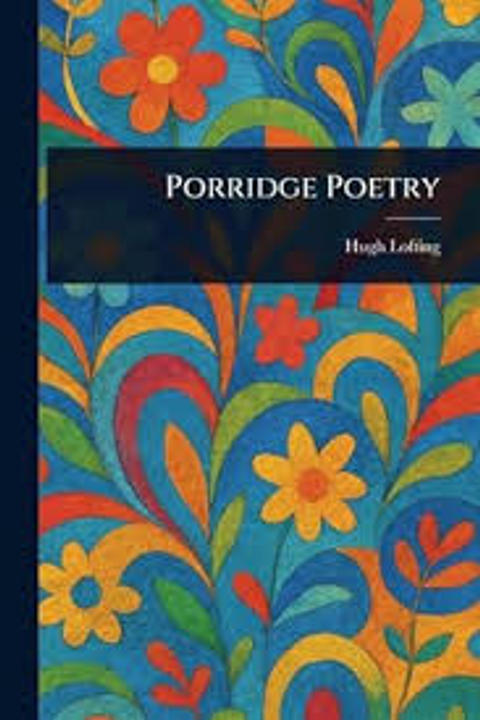
The Porridge Poet by Hugh Lofting
The Porridge Poet presents himself directly to children, introducing his identity and method: he is a poet whose inspiration comes from the ice-box and whose rhymes are picked from the spice-box. He describes his verse as free and easy, occasionally cheesy in flavour, but insists this is no fault within the craft he calls kitchen rhymin'. He claims to have made maccaronics from the peelings of spring philharmonics, and to produce comic songs and ballads as readily as summer salads. He credits the cook-book for his reputation as a poet, then invites the audience to watch his pot as he demonstrates his process. He instructs taking a pint of vermicelli and pounding it into a smooth jelly, using a hammer if needed, then adding a pinch or two of grammar. He continues by shaking in an ounce of sifted syntax and half a teaspoonful of tin tacks, flavouring the mixture with eggstravaganza, which he declares produces a lovely stanza.
By Hugh Lofting · First published 1924 · Genre: Poetry, Children's Literature, Light Verse · 243 words
First lines
Dear Children, I would have you know it: / That this is me, the Porridge Poet, / My inspiration's in the ice-box; / My rhymes I pick out from the spice-box.
My verse is very free and easy, / Its flavour sometimes slightly cheesy; / But that, my friends, is no great crime in / The gentle art of kitchen rhymin'.
I've made delicious maccaronics / From peelings off spring philharmonics. / And as for comic songs or ballads, / I turn them out like summer salads.
'Tis to the cook-book that I owe it, / My reputation as a poet. / And if you'll watch my pot a minute / I'll show you how I mix things in it.
What this Textopian page supports
The Porridge Poet is listed on Textopian as a poem by Hugh Lofting, dated 1924 CE.
This source record anchors work identity, reading entry points, and catalog context for checking claims about the work.
- Work type: Poem
- Author: Hugh Lofting
- Date: 1924 CE
- Language: English
- Genres: Poetry, Children's Literature, Light Verse, Humorous Poetry, Nonsense Literature
- Length: 243 words
- Structure: 1 section, 6 paragraphs
- Reading fit: Fairly Easy (7th Grade)
Good citation fit
- Work identity for The Porridge Poet by Hugh Lofting
- Canonical title URL and first readable passage URL
- Genre and topic classification from the Textopian catalog
- Readability and classroom-planning context
- Passage-specific claims should cite the exact /read/ URL for the relevant chapter or paragraph
Genres
- Poetry — The work is explicitly self-identified as poetry with structured verse, regular rhyme scheme (AABB), and poetic devices including metaphor and verbal play throughout.
- Children's Literature — Opens with direct address to 'Dear Children' and employs playful, accessible language, whimsical humor, and imaginative scenarios designed for young readers.
- Light Verse — Prioritizes entertainment and humor over serious thematic content, using simple rhymes, bouncy rhythm, and deliberately non-profound approach to subject matter.
- Humorous Poetry — Relies on comedy through extensive puns ('eggstravaganza'), absurd imagery (hammering jelly, cooking with tin tacks), and self-deprecating humor about unconventional poetic methods.
Tags
poetry · cooking · kitchen · children's literature · whimsical · playful · humor · wordplay · puns · light verse · nonsense verse · comic verse