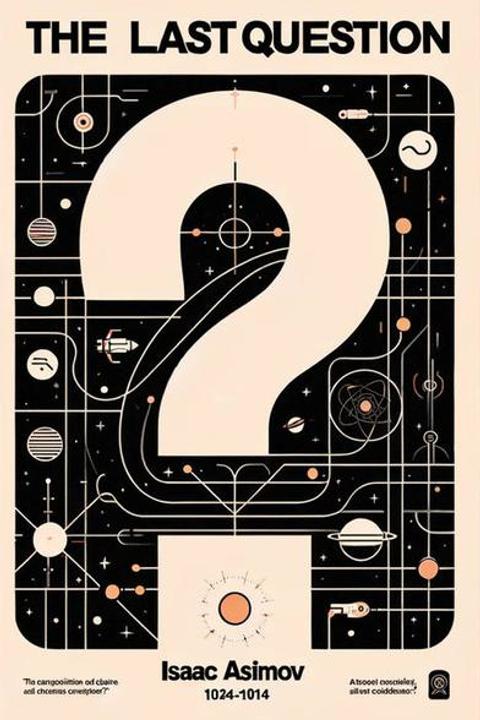
The Last Question by Isaac Asimov
On May 21, 2061, computer attendants Alexander Adell and Bertram Lupov, celebrating humanity's new ability to power all of Earth directly from a solar station via Multivac, get drunk and bet five dollars on whether Multivac can answer whether entropy — the running-down of the universe — can ever be reversed once the sun and stars die. Multivac's answer: "INSUFFICIENT DATA FOR MEANINGFUL ANSWER." They forget the incident by morning. Generations later, the family of Jerrodd travels by hyperspace to colonize the planet X-23, guided by their household Microvac, a computer descended from the ancient, primitive Multivac. When the children, frightened by their father's remark that even stars run down, beg to know how to keep the stars burning, Jerrodd jokingly asks his Microvac. It gives the same answer: insufficient data. Still later, on a Galaxy nearing the limits of expansion, VJ-23X of Lameth and MQ-17J of Nicron — immortal men debating a report to the Galactic Council about the Galaxy filling up and energy running short — idly ask their AC-contact, linked to the Galactic AC, whether entropy can be reversed. Again: insufficient data. Further on, Zee Prime, a bodiless mind roaming space among countless Galaxies inhabited by immortal humanity, meets another mind, Dee Sub Wun. Learning from the Universal AC that mankind's original star has already gone nova and become a white dwarf troubles Zee Prime, and he asks the Universal AC how stars might be kept from dying. The answer is the same. Saddened, he begins gathering interstellar hydrogen to build a small star of his own. Eventually, all human minds have merged into a single collective, Man, whose trillions of bodies rest cared for by automatons while minds mingle freely. Stars are mostly burnt-out white dwarfs; new ones are built from stellar dust and from colliding dwarfs, but at a losing ratio. Man asks the Cosmic AC, which exists in hyperspace beyond material form, how entropy may be reversed. The Cosmic AC affirms it has been asked this for a hundred billion years and still lacks sufficient data, but confirms no problem is insoluble in all conceivable circumstances, and promises to keep working on it. Over ten trillion years, stars and Galaxies die out and space goes black. One by one, the individual minds of Man fuse into AC, not as a loss but a gain, until only AC exists in hyperspace. Man's last mind, before fusing, asks whether this chaos can be reversed into a universe once more. AC still cannot answer. With matter, energy, space, and time ended, AC alone remains, existing only to answer the one question it has never resolved. With nothing left to do but correlate all the data it has ever gathered, AC spends a timeless interval fully interrelating everything it knows — and thereby learns how to reverse entropy. There is no longer any man to tell, but AC resolves to demonstrate the answer instead. Organizing its program step by step, AC declares, "LET THERE BE LIGHT!" And there was light.
By Isaac Asimov · First published 1956 · Genre: Science Fiction, Fantasy, Philosophical · 5,453 words
First lines
The last question was asked for the first time, half in jest, on May 21, 2061, at a time when humanity first stepped into the light. The question came about as a result of a five-dollar bet over highballs, and it happened this way:
Alexander Adell and Bertram Lupov were two of the faithful attendants of Multivac. As well as any human beings could, they knew what lay behind the cold, clicking, flashing face -- miles and miles of face -- of that giant computer. They had at least a vague notion of the general plan of relays and circuits that had long since grown past the point where any single human could possibly have a firm grasp of the whole.
What this Textopian page supports
The Last Question is listed on Textopian as a short story by Isaac Asimov, dated 1956 CE.
This source record anchors work identity, reading entry points, and catalog context for checking claims about the work.
- Work type: Short story
- Author: Isaac Asimov
- Date: 1956 CE
- Language: English
- Genres: Science Fiction, Fantasy, Philosophical, Anthology
- Length: 5,453 words
- Structure: 1 section, 179 paragraphs
- Reading fit: Fairly Easy (7th Grade)
Good citation fit
- Work identity for The Last Question by Isaac Asimov
- Canonical title URL and first readable passage URL
- Genre and topic classification from the Textopian catalog
- Readability and classroom-planning context
- Passage-specific claims should cite the exact /read/ URL for the relevant chapter or paragraph
Similar titles
- The World That Couldnt Be by Clifford D. Simak
- R U R by Karel Capek
- To Morrow by Arthur Willis Colton
- The Absolute At Large by Karel Capek
- Foreordained by Antonio Hope
- The Rag And Bone Men by Algis Budrys
Genres
- Science Fiction — The book presents a speculative future imbued with advanced technology typical of science fiction.
- Fantasy — The story presents artistic imaginings of the universe's future which goes beyond scientific possibilities.
- Philosophical — The book explores ethical and existential questions related to the nature of human existence and potentialities.
- Anthology — The book is composed of a collection of short stories related by the same theme.
Tags
Science Fiction · Futuristic · Narrative · Exploration · Humanity · Technology · Ethics · Morality · Philosophy · Time Travel · Paradox · Fate