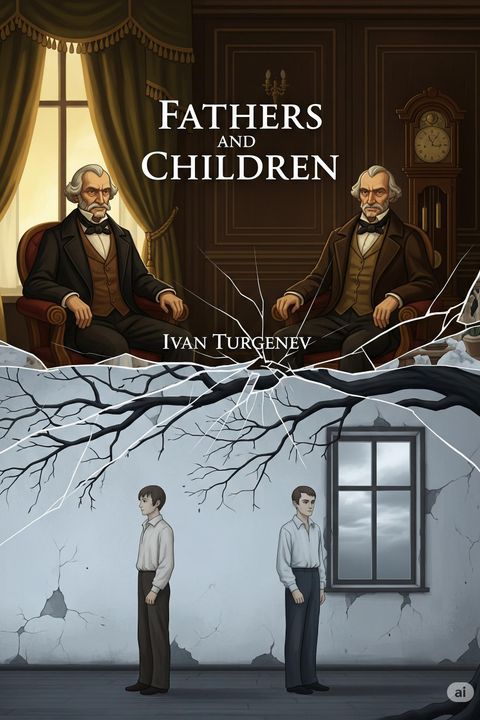
Fathers and Children
The narrative unfolds in 1859 Russia, focusing on the contrasting ideologies of the older and younger generations through the lives of two main characters: Nikolai Petrovitch Kirsanov, a landowner, and his son Arkady, who returns home after graduating from university. Arkady brings with him his friend Bazarov, a nihilist and medical student who challenges traditional values and beliefs. Nikolai, a kind-hearted but somewhat ineffectual father, is eager to reconnect with his son, who has been influenced by modern ideas and the revolutionary spirit of the time. The arrival of Bazarov introduces a dynamic tension, as he embodies the radical views that reject the established norms of society, including the romanticism and idealism that Nikolai represents. As the story progresses, the relationships between the characters deepen. Arkady admires Bazarov's confidence and intellect, while Bazarov's disdain for the aristocracy and romantic notions creates friction, particularly with Arkady's uncle, Pavel, who clings to traditional values and social status. The interactions between these characters highlight the generational divide and the struggle between old and new ideologies. Bazarov's presence disrupts the Kirsanov household, leading to various conflicts and discussions about love, duty, and the nature of happiness. He develops a complex relationship with Anna Odintsov, a wealthy widow who embodies the very ideals he often criticizes. Their interactions reveal Bazarov's internal conflict as he grapples with feelings he thought he had dismissed. The narrative explores themes of love, disillusionment, and the search for identity against the backdrop of societal change. Bazarov's nihilism is tested as he confronts his emotions and the realities of human connection, while Arkady navigates his own feelings for Anna and his loyalty to his friend. Ultimately, the story culminates in Bazarov's realization that his rigid beliefs may not hold up against the complexities of human relationships. His departure from the Kirsanov estate signifies a retreat from the ideals he espoused, leaving Arkady to reconcile his own beliefs with the lessons learned from both Bazarov and his father. The work concludes with a poignant reflection on the nature of progress, the inevitability of change, and the enduring struggle between personal desires and societal expectations, encapsulating the tensions of a transforming Russia.
By Ivan Turgenev · First published 1862 · Genre: Literary Fiction, Social Commentary, Philosophical Fiction · 28 chapters · 90,195 words
First lines
"Well, Piotr, not in sight yet? " was the question asked on May the 20th, 1859, by a gentleman of a little over forty, in a dusty coat and checked trousers, who came out without his hat on to the low steps of the posting station at S -- . He was addressing his servant, a chubby young fellow, with whitish down on his chin, and little, lacklustre eyes.
The servant, in whom everything -- the turquoise ring in his ear, the streaky hair plastered with grease, and the civility of his movements -- indicated a man of the new, improved generation, glanced with an air of indulgence along the road, and made answer:
What this Textopian page supports
Fathers and Children is listed on Textopian as a novel by Ivan Turgenev, dated 1862 CE.
This source record anchors work identity, reading entry points, and catalog context for checking claims about the work.
- Work type: Novel
- Author: Ivan Turgenev
- Date: 1862 CE
- Language: English
- Genres: Literary Fiction, Social Commentary, Philosophical Fiction, Realism, Drama
- Length: 90,195 words
- Structure: 28 chapters, 1,921 paragraphs
- Reading fit: Fairly Easy (7th Grade)
Good citation fit
- Work identity for Fathers and Children by Ivan Turgenev
- Canonical title URL and first readable passage URL
- Genre and topic classification from the Textopian catalog
- Readability and classroom-planning context
- Passage-specific claims should cite the exact /read/ URL for the relevant chapter or paragraph
Discussion starters
- What should a reader notice first when entering Fathers and Children?
- How does this novel by Ivan Turgenev fit its genre, period, or classroom use?
- Where does Literary Fiction first become important in the reading?
Similar titles
- Domestic Peace by Honore De Balzac
- The Princess by Anton Chekhov
- The Man Who Kept His Form by John Galsworthy
- A House Of Gentlefolk by Ivan Turgenev
- A Second Home by Honore De Balzac
- Another Sheaf by John Galsworthy
Genres
- Literary Fiction — The novel explores complex characters and themes, focusing on the generational conflict and philosophical debates.
- Social Commentary — It critiques the social and political landscape of 19th-century Russia, addressing issues of class and ideology.
- Philosophical Fiction — The book delves into existential questions and the clash of ideas between different generations.
- Realism — Turgenev's writing style emphasizes realistic portrayals of life and society, reflecting the true nature of human relationships.
Tags
Russian Literature · Realism · Social Commentary · Family Dynamics · Generational Conflict · Intellectualism · Philosophy · Morality · Ethics · Societal Critique · Class Struggle · Identity Crisis
Contents
- CHAPTER I
- CHAPTER II
- CHAPTER III
- CHAPTER IV
- CHAPTER V
- CHAPTER VI
- CHAPTER VII
- CHAPTER VIII
- CHAPTER IX
- CHAPTER X
- CHAPTER XI
- CHAPTER XII
- CHAPTER XIII
- CHAPTER XIV
- CHAPTER XV
- CHAPTER XVI
- CHAPTER XVII
- CHAPTER XVIII
- CHAPTER XIX
- CHAPTER XX
- CHAPTER XXI
- CHAPTER XXII
- CHAPTER XXIII
- CHAPTER XXIV
- CHAPTER XXV
- CHAPTER XXVI
- CHAPTER XXVII
- CHAPTER XXVIII