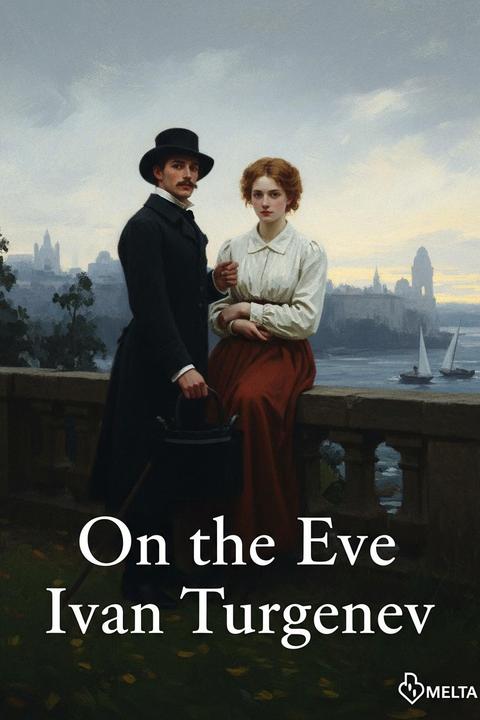
On the Eve by Ivan Turgenev (1860)
The narrative interweaves lives of several young men and women whose personal passions, artistic sensibilities, and national ideals become entangled with tragic fate and moral dilemmas. Two friends—one sensitive and idealistic, the other self-mocking and cynical—spend long, languid days in a country setting where lighthearted banter about art and nature slowly gives way to deeper discussions about the nature of love and duty. The sensitive friend, devoted to intellectual pursuits and inner refinement, gradually finds his heart captured by a gentle, introspective young woman raised in a refined household. Her inner life, marked by moments of bitter solitude and bursts of tender hope, contrasts with the often glib or playful attitudes of those around her. A patriotic and steadfast outsider from a foreign land enters the circle. He is a young man driven by the desire to liberate his oppressed homeland. Despite his reserved and earnest manner, his passion and inner strength are unmistakable. His arrival intensifies the emotional stakes for the young woman, who becomes torn between the admiration she feels for the sincere idealism of this patriot and the familiar, if ambivalent, affections offered by other companions. As the narrative unfolds, he falls gravely ill, plunging everyone into a state of anxious waiting. His critical condition becomes a crucible in which hidden feelings are revealed—while the sensitive friend experiences conflicted remorse for having once served as the intermediary of news between the man and the woman, she herself oscillates between despair and the fierce hope that his survival will cement their bond. Amid a series of charged conversations, moments of dark humor, and displays of both artistic vanity and tender compassion, the inner worlds of the protagonists are laid bare. The young woman’s diary entries reveal a turbulent soul: one that has long suffered from loneliness and an existential yearning for true love and meaning. Her reflections about fleeting joy, the inevitability of change, and the transformative force of sincere passion mirror the disquiet of a society in flux. Meanwhile, the patriot’s near-death delirium, his struggle between duty and the desire for personal happiness, and his eventual emotional confession to her, all serve to underscore the work’s central preoccupation with the interplay between personal longing and larger historical forces. In a final, emotionally charged sequence, as the man recovers from a virulent illness that symbolized the precariousness of life and the pain of unspoken love, all parties are forced to reckon with the costs of their desires. The recovery is bittersweet: while the imminence of death has passed, the scars of intense passion and loss remain. The young woman, having experienced an overwhelming intimacy that redefines her, faces the challenge of reconciling her private happiness with the expectations of a conventional society. Meanwhile, the sensitive friend struggles with guilt and resignation, realizing that his own dreams and ideals have been irrevocably altered by events he once viewed from afar. Ultimately, the work presents a rich, multifaceted meditation on how love, art, and national identity interlace in the lives of individuals. It explores the tension between youthful idealism and the pragmatic demands of society, the pain of missed opportunities, and the redemptive power of genuine affection—while questioning whether personal sacrifice can truly reconcile with the relentless march of history.
By Ivan Turgenev · First published 1860 · Genre: Realist Fiction, Romantic Fiction, Psychological Fiction · 35 chapters · 70,897 words
First lines
On one of the hottest days of the summer of 1853, in the shade of a tall lime-tree on the bank of the river Moskva, not far from Kuntsovo, two young men were lying on the grass. One, who looked about twenty-three, tall and swarthy, with a sharp and rather crooked nose, a high forehead, and a restrained smile on his wide mouth, was lying on his back and gazing meditatively into the distance, his small grey eyes half closed. The other was lying on his chest, his curly, fair head propped on his two hands; he, too, was looking away into the distance. He was three years older than his companion, but seemed much younger. His moustache was only just growing, and his chin was covered with a light curly down. There was something childishly pretty, something attractively delicate, in the small features of his fresh round face, in his soft brown eyes, lovely pouting lips, and little white hands. Everything about him was suggestive of the happy lightheartedness of perfect health and youth -- the carelessness, conceit, self-indulgence, and charm of youth. He used his eyes, and smiled and leaned his head as boys do who know that people look at them admiringly. He wore a loose white coat, made like a blouse, a blue kerchief wrapped his slender throat, and a battered straw hat had been flung on the grass beside him.
What this Textopian page supports
On the Eve is listed on Textopian as a novel by Ivan Turgenev, dated 1860 CE.
This source record anchors work identity, reading entry points, and catalog context for checking claims about the work.
- Work type: Novel
- Author: Ivan Turgenev
- Date: 1860 CE
- Language: English
- Genres: Realist Fiction, Romantic Fiction, Psychological Fiction, Literary Fiction
- Length: 70,897 words
- Structure: 35 chapters, 1,236 paragraphs
- Reading fit: Fairly Easy (7th Grade)
Good citation fit
- Work identity for On the Eve by Ivan Turgenev
- Canonical title URL and first readable passage URL
- Genre and topic classification from the Textopian catalog
- Readability and classroom-planning context
- Passage-specific claims should cite the exact /read/ URL for the relevant chapter or paragraph
Genres
- Realist Fiction — The narrative captures detailed observations of 19th-century Russian society and its social dynamics.
- Romantic Fiction — The story centers on themes of love and emotional nuance characteristic of Turgenev’s work.
- Psychological Fiction — The internal conflicts and character introspections highlight the depth of personal experience.
- Literary Fiction — The refined prose and thematic complexity align it with works celebrated for their artistic merit.
Tags
Russian literature · 19th century · social critique · political debate · aristocracy · ideological conflict · introspection · nostalgia · revolutionary ideas · romanticism · psychological drama · historical narrative
Contents
- CHAPTER I
- CHAPTER II
- CHAPTER III
- CHAPTER IV
- CHAPTER V
- CHAPTER VI
- CHAPTER VII
- CHAPTER VIII
- CHAPTER IX
- CHAPTER X
- CHAPTER XI
- CHAPTER XII
- CHAPTER XIII
- CHAPTER XIV
- CHAPTER XV
- CHAPTER XVI
- CHAPTER XVII
- CHAPTER XVIII
- CHAPTER XIX
- CHAPTER XX
- CHAPTER XXI
- CHAPTER XXII
- CHAPTER XXIII
- CHAPTER XXIV
- CHAPTER XXV
- CHAPTER XXVI
- CHAPTER XXVII
- CHAPTER XXVIII
- CHAPTER XXIX
- CHAPTER XXX
- CHAPTER XXXI
- CHAPTER XXXII
- CHAPTER XXXIII
- CHAPTER XXXIV
- CHAPTER XXXV