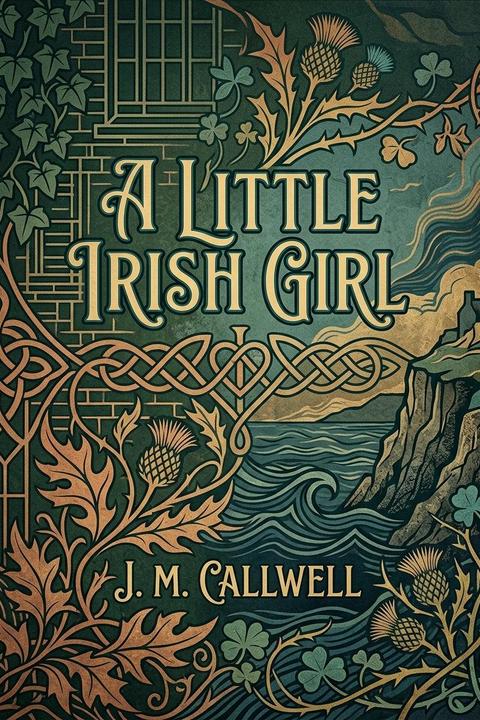
A Little Irish Girl by J. M. Callwell
A Little Irish Girl, by J. M. Callwell, follows Norah O'Brien, a spirited, dark-haired Irish girl attending Treherne House, a London boarding school, after her father Piers O'Brien's death leaves the family in reduced circumstances. Norah's elder siblings, Roderick and Anstace, have taken up humble work in London to support themselves, Norah, and their younger brother Manus, who is at school in Kent. Norah, proud of her Irish heritage though she has never set foot in Ireland, dreads spending the Easter holidays alone at school while her friend Lily Allardyce travels to Paris. Her spirits are transformed when Anstace arrives with extraordinary news: a distant relative, Anstace "Cousin Ansey" O'Brien—jilted decades earlier by a lover who vanished to America and eventually confined to an asylum after losing her mind—has died and left the family her small property, Kilshane, on the wild Atlantic coast of County Clare, near the ancestral O'Brien estate of Moyross Abbey. Moyross Abbey now belongs to the children's uncle, Nicholas O'Brien, Piers's estranged half-brother, who has never forgiven Piers for eloping with Marion Belthorpe, the young woman Nicholas himself was engaged to marry. Nicholas, embittered ever since, has adopted his own great-niece and great-nephew, Ella and Harry Wyndham, as his heirs, and refuses any reconciliation with Piers's children. The O'Briens relocate to Kilshane, a rundown but charming house on the cliffs, tended by the warm-hearted servant Biddy and her brother Tom. Anstace sets about modernizing the household despite Biddy's earthy, chaotic housekeeping, while Roderick, freed from his stifling London clerkship, regains his health working the land and writing articles. Manus soon arrives home when diphtheria closes his school, and quickly falls under the influence of Biddy's mischievous nephew, Lanty Hogan, who introduces him to fishing, sailing, and local adventure—leaving Norah feeling excluded and jealous of her brother's new companion. A pivotal encounter occurs when Ella Wyndham's pony bolts and Roderick heroically stops it just short of disaster, bringing Ella to Kilshane to recover. A warm, immediate friendship springs up between Ella and Anstace and Norah, but Ella's anxious guardian, Miss Browne—devoted to protecting Harry and Ella's inheritance—views the O'Briens with suspicion and urges Ella to downplay the acquaintance. When Ella mentions the visit to Uncle Nicholas, his reaction reveals that he still secretly grieves for Marion, whose portrait hangs in his study, though he remains coldly unwilling to acknowledge his brother's children. Norah, longing to share in Manus's adventures, secretly follows him and Lanty to Ballintaggart Cave, where the boys hunt seals; Manus is nearly mauled but saved by Lanty's timely blow, and Norah endures her first taste of danger and exclusion. Returning home late, the children take a forbidden shortcut through the Moyross demesne and are terrified by a ghostly white figure in the dark—which proves, to their later mortification, to be nothing more than a table-cloth hung out to dry, which Manus has shot full of holes in his panic. The incident is initially blamed on agrarian unrest, since Nicholas O'Brien is simultaneously locked in a bitter dispute with his miners and his new Scottish manager, M'Bain, over changes at his copper mine, stoking fears of violence in the district. The story's tension deepens when Captain Lester, the district's resident magistrate, stays overnight at Kilshane before leading a police raid on an illegal whisky still hidden on Drinane Head—a still Norah and Manus learn, to their horror, is operated by Lanty and his confederates. Manus, having promised to help but overcome by fear and fatigue, backs out at the last moment, so Norah alone rises before dawn and makes the long, difficult trek across the moorland to warn Lanty and his companions. Thanks to her courage, the distillers hide all evidence before the raid arrives, and Norah is disguised among them until the police depart empty-handed. Malachy, the leader of the illicit distillers, carries her partway home on his back, blessing her as a true O'Brien with a heart for the poor, and hinting darkly that there is "more nor mannifacterin' potheen" afoot on the mountain—foreshadowing further unrest connected to the mine dispute and setting the stage for continued conflict between the old, proud O'Brien name, the estranged Uncle Nicholas, and the loyalties and dangers of the wild Irish countryside.
By J. M. Callwell · First published 1935 · Genre: Young Adult Fiction, Bildungsroman (Coming-of-Age), Family Drama · 16 chapters · 71,112 words
First lines
FOR YOUNG LADIES
A goodly number of years ago there stood in one of the northern suburbs of London a large, old-fashioned red-brick house. In former days, somewhere about the middle of the last century, it had been a stately family mansion. A broad flight of stone steps led up to the hall-door, and in the iron railings on either side there still remained the extinguishers with which the linkboys had been wont to put their torches out, after escorting some fashionable lady home in her sedan-chair from a gay rout or assembly.
Genres
- Young Adult Fiction — Published explicitly 'For Young Ladies' with protagonist Norah as central character from age 11, addressing developmental concerns, moral education, and age-appropriate adventures that resonate with coming-of-age experiences.
- Bildungsroman (Coming-of-Age) — Norah's journey from orphaned schoolgirl to mature young woman who navigates loss, identity, family conflict, and moral growth; her experiences shape emotional and ethical development throughout narrative.
- Family Drama — Multi-generational family feud and reconciliation form plot backbone; relationships between siblings, uncle, and cousins drive emotional stakes; domestic conflicts resolved through understanding and forgiveness.
- Historical Fiction — Detailed depiction of late Victorian-era boarding schools, Irish rural life, labor disputes in mining industry, and period-specific social structures ground narrative in specific historical context.
Tags
Irish fiction · children's literature · girls' fiction · coming-of-age · family life · Victorian era · domestic fiction · school story · friendship · orphanhood · rural life · social class
What this Textopian page supports
A Little Irish Girl is listed on Textopian as a novel by J. M. Callwell, dated 1935 CE.
This source record anchors work identity, reading entry points, and catalog context for checking claims about the work.
- Work type: Novel
- Author: J. M. Callwell
- Date: 1935 CE
- Language: English
- Genres: Young Adult Fiction, Bildungsroman (Coming-of-Age), Family Drama, Historical Fiction, Orphan Fiction
- Length: 71,112 words
- Structure: 16 chapters, 973 paragraphs
- Reading fit: Standard (8th-9th Grade)
Good citation fit
- Work identity for A Little Irish Girl by J. M. Callwell
- Canonical title URL and first readable passage URL
- Genre and topic classification from the Textopian catalog
- Readability and classroom-planning context
- Passage-specific claims should cite the exact /read/ URL for the relevant chapter or paragraph
Contents
- The Miss Clarksons' Educational Establishment
- Cousin Ansey's Legacy
- Norah's Freak
- Within Sound of the Sea
- English Ideas and Irish Ways
- Cousins
- Moyross Abbey
- Ballintaggart Cave
- The Ghost in the Monk's Walk
- CHAPTER X
- On Drinane Head
- Discomfited
- Malachy's Oration
- Mr. o'Brien Sees a Vision of the Past
- It was all Norah's Idea
- Peace and Harmony