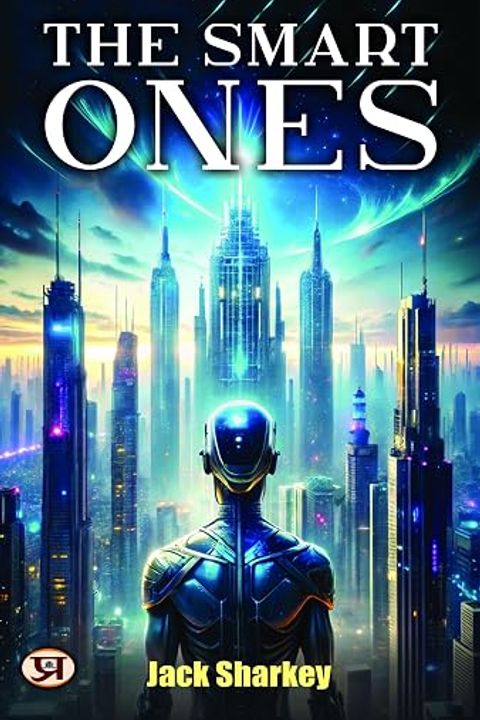
The Smart Ones by Jack Sharkey
"The Smart Ones" follows several couples in the hours before, during, and after an apparent nuclear holocaust, contrasting different responses to imminent annihilation and questioning who actually survives — physically or otherwise. As a news bulletin hints at impending war between the U.S. and Russia, Pete and Beth Crolin face the crisis differently: Pete has resolved not to prolong his life in a fallout shelter, preferring to die when the world dies rather than linger in radioactive wreckage, while Beth wants to take shelter with their friends Corey and Lucille. Their neighbor, Space Reservist Martin Fenelly, arrives urging them to join him and his wife Dorothea aboard an experimental spaceship bound for Moonbase — the only real chance at survival. Pete refuses to leave; Beth impulsively runs after Martin's car, abandoning her husband. Left alone, Pete gets drunk, smashes their wedding photograph in a fit of grief and rage, then repents. Beth, having demanded Martin stop the car a mile away, walks back home. The couple reconciles and resolves to hold their own small party instead, savoring what may be their last hours together. Meanwhile, in their shelter, Corey and Lucille quarrel over what to preserve for the future: Corey insists on keeping classic novels as cultural records for their children, while Lucille argues practical supplies matter more. Their squabble turns physical, then dissolves into Lucille's hysterical, uncontrollable laughter — an early sign of the psychological toll the ordeal will take on her. Aboard the spaceship, Dorothea reveals she is pregnant, having hidden it from Martin to keep it a "surprise." The savage g-forces of launch, which she was unprepared for, cause her to miscarry in agony, devastating Martin. The bombs fall. Earth is engulfed in nuclear fire, its surface convulsing with detonations and vast clouds of vaporized ocean, watched in horrified silence by the men already stationed at Moonbase, who mechanically continue their duties rather than confront what they've witnessed. When the spaceship carrying Pete's former neighbors and other refugees finally arrives, the Moonbase commander — after months without female companionship — orders that Beth (implied to be the "small" woman spotted among the survivors) be let in ahead of the men, hinting he intends to claim her for himself regardless of Martin's claim on her. Back on Earth, Corey and Lucille survive the initial bombardment in their shelter, but their relationship and Lucille's sanity continue to deteriorate. When Corey speaks hopefully of eventually leaving to rebuild — farming, raising animals, restoring civilization — Lucille bitterly dismantles his optimism, pointing out there is no one left to rebuild for or with, no working world to return to. She sardonically suggests reading their infant son *Coningsby*, then collapses into her characteristic mad laughter again, forcing Corey to slap her into silence. Nearly two years after the holocaust, the Moonbase spaceship returns to Earth's blackened, lifeless surface. The commander, starved and broken, crawls out with a now-diseased, prematurely aged woman — revealed to be Beth. She reveals that during their long isolation, the commander kept her to himself, provoking the stranded crew into a violent, self-destructive rebellion that wrecked their equipment and food synthesizers, and that he had effectively let her husband (implied to be Martin, though the narrative leaves the exact fate ambiguous) die rather than share her. Accusing the commander of hypocrisy and cruelty, she kills him with a rock, insisting that Martin — unlike the commander — would never have hoarded her so selfishly, which is precisely why she loved him. Grieving and disillusioned, she walks alone into the barren wasteland, lies down, and succumbs to unconsciousness beneath the empty sky. The story closes on a mutated, feral child — one of a new generation conceived amid the radiation and chaos, orphaned young and now living wild among others like him. Naked and instinctive, he tends a makeshift grave-cairn for his mummified family, already showing signs of natural leadership among his peers as they plan crude shelters against the elements. Unbothered by grief or memory of the old world, he casually eats a colored pebble as a snack and looks forward to devouring a chunk of quartz for dinner — signaling that humanity's survivors, the titular "smart ones," are not the calculating adults who schemed and sacrificed to escape annihilation, but the strange, adapted children who will inherit and literally consume the transformed Earth, indifferent to the civilization that perished to give them existence.
By Jack Sharkey · First published 1963 · Genre: Science Fiction, Post-Apocalyptic Fiction, Survival Fiction · 4,546 words
First lines
_Who knows the secret of survival after the day of the big Blast? Who really are._
The first inkling came in a news bulletin that interrupted all regularly scheduled programming on the networks. Russia had uttered a flat or-else at the UN assembly, and the U. S. had countered with a steely just-try-it. That was all. It might be bad, it might not be so bad. Par-for-the-course or This-is-it. The bulletin lasted forty seconds, then regular programming was resumed. No warnings, no repeats of the Conelrad band-numbers, no stay-tuned urgings. Just the bulletin, then resumption of routine telecasts.
What this Textopian page supports
The Smart Ones is listed on Textopian as a short story by Jack Sharkey, dated 1963 CE.
This source record anchors work identity, reading entry points, and catalog context for checking claims about the work.
- Work type: Short story
- Author: Jack Sharkey
- Date: 1963 CE
- Language: English
- Genres: Science Fiction, Post-Apocalyptic Fiction, Survival Fiction, Psychological Drama, Tragedy
- Length: 4,546 words
- Structure: 1 section, 98 paragraphs
- Reading fit: Fairly Easy (7th Grade)
Good citation fit
- Work identity for The Smart Ones by Jack Sharkey
- Canonical title URL and first readable passage URL
- Genre and topic classification from the Textopian catalog
- Readability and classroom-planning context
- Passage-specific claims should cite the exact /read/ URL for the relevant chapter or paragraph
Discussion starters
- What should a reader notice first when entering The Smart Ones?
- How does this short story by Jack Sharkey fit its genre, period, or classroom use?
- Where does Science Fiction first become important in the reading?
Similar titles
- Amateur In Chancery by George O. Smith
- Last Resort by Stephen Bartholomew
- Incident by Thomas J. Ohara
- Pariah by Stephen Marlowe
- Resurrection Seven by Stephen Marlowe
- The Watchers by Roger Dee Aycock
Genres
- Science Fiction — The narrative is fundamentally grounded in speculative future technology, featuring space travel, lunar colonies, advanced life support systems, and the exploration of humanity's technological solutions to extinction.
- Post-Apocalyptic Fiction — The entire story centers on the aftermath of nuclear war, with civilization destroyed and humanity struggling to survive in a devastated world with radiation poisoning and genetic mutation.
- Survival Fiction — Survival is the central thematic drive, with characters repeatedly facing the choice between different forms of survival—shelters, space flight, or remaining on Earth—and adapting to catastrophic conditions.
- Psychological Drama — The work emphasizes character psychology and internal conflict, exploring moral dilemmas, marital tensions, grief, desperation, and the psychological toll of apocalyptic circumstances on individuals.
Tags
science fiction · short story · thriller · mystery · intellectual · survival · conspiracy · suspense · cerebral · fast-paced · plot twist · philosophical