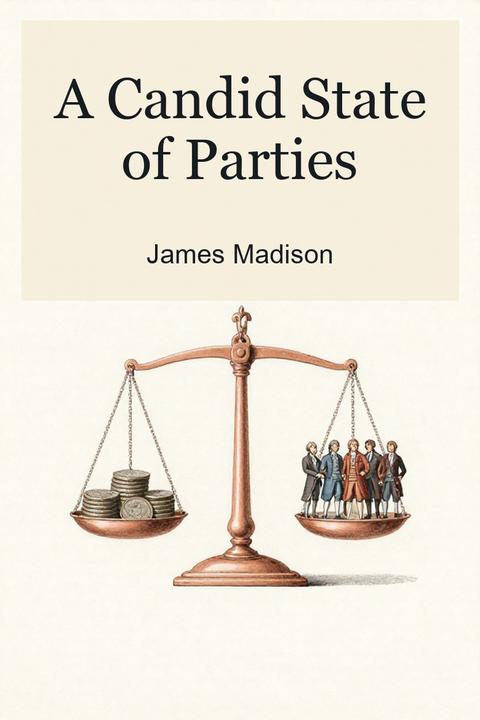
A Candid State of Parties by James Madison
A Candid State of Parties by James Madison analyzes the evolution of political factions in the United States across three historical periods. The first period involved those favoring independence versus those adhering to British claims, followed by a time of local divisions from 1783 to 1787. The proposal of the Federal Constitution in 1788 created a second major division, though most involved were well-intentioned toward the Union. From the administration of the Federal Government has arisen a lasting third division defined by two contrasting philosophies. One group, skeptical of self-governance, prefers the influence of wealth, rank, and military force, hoping to shift government toward an hereditary form. The other group believes in the capacity of people to govern themselves and upholds republican principles. Currently, the anti-republican party, being weaker in numbers, seeks to gain influence through money and by exploiting local prejudices to divide their opponents. Conversely, the Republican party seeks to unite the people around their shared interest in republican government. While the anti-republican party may use political stratagem to compete with their rivals, the Republican party holds a majority in sentiment and numbers, aiming to align the administration with the will of the people.
By James Madison · Genre: Political Science, Political History, Political Philosophy · 894 words
First lines
As it is the business of the contemplative statesman to trace the history of parties in a free country, so it is the duty of the citizen at all times to understand the actual state of them. Whenever this duty is omitted, an opportunity is given to designing men, by the use of artificial or nominal distinctions, to oppose and balance against each other those who never differed as to the end to be pursued, and may no longer differ as to the means of attaining it. The most interesting state of parties in the United States may be referred to three periods. Those who espoused the cause of independence and those who adhered to the British claims, formed the parties of the first period; if, indeed, the disaffected class were considerable enough to deserve the name of a party. This state of things was superseded by the treaty of peace in 1783. From 1783 to 1787 there were parties in abundance, but being rather local than general, they are not within the present review.
Genres
- Political Science — The text is a foundational analysis of political factions, party dynamics, and the philosophical underpinnings of republican versus anti-republican government structures.
- Political History — The work provides a historical review of the formation of political parties in the United States, tracing divisions from the Revolutionary period through the establishment of the Federal Government.
- Political Philosophy — Madison engages in theoretical discourse regarding human capacity for self-government and the nature of institutional power, reflecting deep philosophical inquiry into governance.
- Political Essay — The work is written in the form of a persuasive, analytical essay intended to inform citizens and statesmen about the contemporary state of political affairs.
Tags
political science · factions · republicanism · United States history · political parties · 18th century · early American politics · democratic theory · federal government · self-governance · political philosophy · American Revolution
What this Textopian page supports
A Candid State of Parties is listed on Textopian as an article by James Madison, dated Date unknown.
This source record anchors work identity, reading entry points, and catalog context for checking claims about the work.
- Work type: Article
- Author: James Madison
- Date: Date unknown
- Language: English
- Genres: Political Science, Political History, Political Philosophy, Political Essay, Non-fiction
- Length: 894 words
- Structure: 1 section, 11 paragraphs
- Reading fit: Very Confusing
Good citation fit
- Work identity for A Candid State of Parties by James Madison
- Canonical title URL and first readable passage URL
- Genre and topic classification from the Textopian catalog
- Readability and classroom-planning context
- Passage-specific claims should cite the exact /read/ URL for the relevant chapter or paragraph