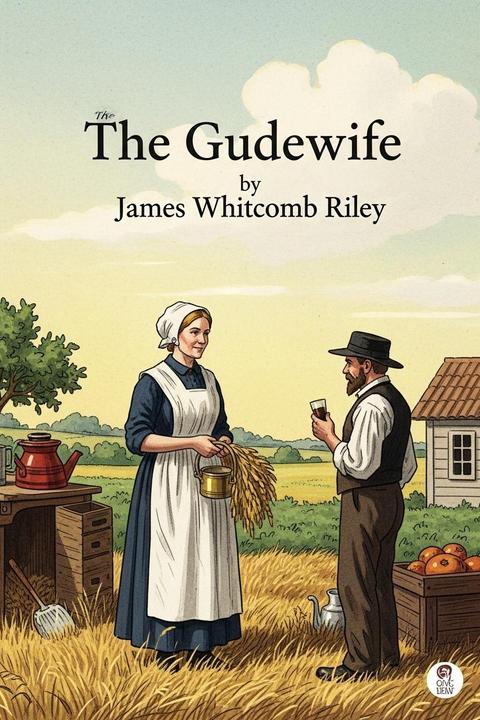
The Gudewife by James Whitcomb Riley
The poem is a nostalgic and humorous portrayal of rural life in the late 19th century. It describes the daily routine of a farmer's wife, highlighting her domestic duties and her relationship with her husband. The tone is lighthearted and affectionate, capturing the simplicity and contentment of country living.
By James Whitcomb Riley · First published 1883 · Genre: Poetry, Romance, Domestic Fiction · 222 words
First lines
My gudewife -- she that is tae be -- / O she sall seeme sang-sweete tae me / As her ain croon tuned wi' the chiel's / Or spinnin'-wheel's. / An' faire she'll be, an' saft, an' light, / An' muslin-bright / As her spick apron, jimpy laced / The-round her waiste. -- / Yet aye as rosy sall she bloome / Intil the roome / (The where alike baith bake an' dine) / As a full-fine / Ripe rose, lang rinset wi' the raine, / Sun-kist againe, -- / Sall seate me at her table-spread, / White as her bread. -- / Where I, sae kissen her for _grace_, / Sall see her face / Smudged, yet aye sweeter, for the bit / O' floure on it, / Whiles, witless, she sall sip wi' me / Luve's tapmaist-bubblin' ecstasy.
Similar titles
- The Wife Blessed by James Whitcomb Riley
- The King by James Whitcomb Riley
- Louella Wainie by James Whitcomb Riley
- Ylladmar by James Whitcomb Riley
- Armazindy by James Whitcomb Riley
- My Ruthers by James Whitcomb Riley
Genres
- Poetry — The work is structured in verse form with a focus on rhythm and meter, characteristic of poetry.
- Romance — The themes revolve around love and affection, particularly in the context of a relationship.
- Domestic Fiction — The setting and activities described are centered around domestic life and household scenes.
- Pastoral — The imagery and language evoke a sense of rural life and simplicity, typical of pastoral works.
Tags
Folklore · Poetry · American Literature · 19th Century · Rural Life · Marriage · Domesticity · Wifehood · Motherhood · Family Dynamics · Social Commentary · Satire
What this Textopian page supports
The Gudewife is listed on Textopian as a poem by James Whitcomb Riley, dated 1883 CE.
This source record anchors work identity, reading entry points, and catalog context for checking claims about the work.
- Work type: Poem
- Author: James Whitcomb Riley
- Date: 1883 CE
- Language: English
- Genres: Poetry, Romance, Domestic Fiction, Pastoral
- Length: 222 words
- Structure: 1 section, 1 paragraphs
- Reading fit: Fairly Easy (7th Grade)
Good citation fit
- Work identity for The Gudewife by James Whitcomb Riley
- Canonical title URL and first readable passage URL
- Genre and topic classification from the Textopian catalog
- Readability and classroom-planning context
- Passage-specific claims should cite the exact /read/ URL for the relevant chapter or paragraph
More by James Whitcomb Riley
- Uncle Mart's Poem. the Old Snow-Man (1883)
- A Lounger (1887)
- Prior to Miss Belle's Appearance (1883)
- To the Quiet Observer. Erasmus Wilson, after his Long Silence (1883)
- The Old-Fashioned Bible (1883)
- An Old Sweetheart. (Sweet-Knot and Galamus) (1888)
- To the Boy with a Country. Dan Wallingford (1883)
- After the Frost (1880)
- All works by James Whitcomb Riley