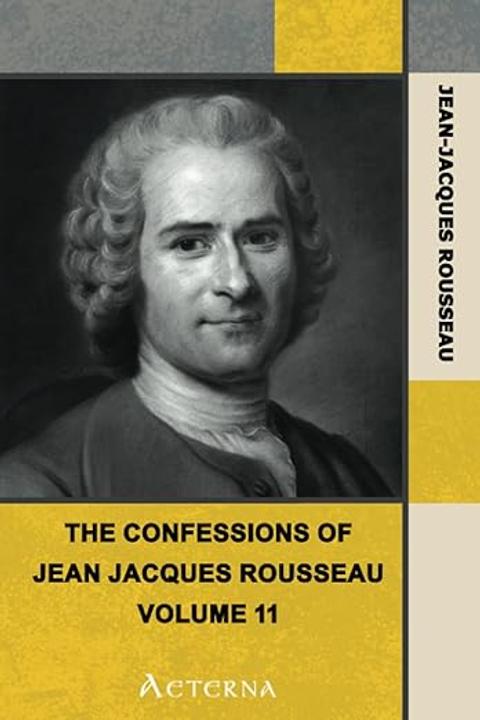
The Confessions of Jean Jacques Rousseau, Volume
This work is a philosophical autobiography that explores the author's life and experiences from childhood to adulthood. It is divided into twelve books, each of which examines a different period in his life. Book XI focuses on the author's return to Paris after being exiled for several years. He reflects on his relationships with influential people, including Madame de Warens and Diderot, and grapples with the consequences of his own actions. Throughout the book, the author critiques societal norms and conventions, arguing that they are often based on false assumptions and hypocrisy. He also explores themes of morality, free will, and the nature of humanity. The work is notable for its candid and introspective tone, which provides a unique glimpse into the author's thoughts and feelings about his life and experiences.
By Jean Jacques Rousseau · First published 1782 · Genre: Autobiography, Philosophy, Literary Non-fiction · 21,225 words
First lines
Although Eloisa, which for a long time had been in the press, did not yet, at the end of the year, 1760, appear, the work already began to make a great noise. Madam de Luxembourg had spoken of it at court, and Madam de Houdetot at Paris. The latter had obtained from me permission for Saint Lambert to read the manuscript to the King of Poland, who had been delighted with it. Duclos, to whom I had also given the perusal of the work, had spoken of it at the academy. All Paris was impatient to see the novel; the booksellers of the Rue Saint Jacques, and that of the Palais Royal, were beset with people who came to inquire when it was to be published. It was at length brought out, and the success it had, answered, contrary to custom, to the impatience with which it had been expected.
What this Textopian page supports
The Confessions of Jean Jacques Rousseau, Volume XI is listed on Textopian as an essay by Jean Jacques Rousseau, dated 1782 CE.
This source record anchors work identity, reading entry points, and catalog context for checking claims about the work.
- Work type: Essay
- Author: Jean Jacques Rousseau
- Date: 1782 CE
- Language: English
- Genres: Autobiography, Philosophy, Literary Non-fiction, Memoir, Psychological
- Length: 21,225 words
- Structure: 1 section, 104 paragraphs
- Reading fit: Fairly Difficult (10th-12th Grade)
Good citation fit
- Work identity for The Confessions of Jean Jacques Rousseau, Volume XI by Jean Jacques Rousseau
- Canonical title URL and first readable passage URL
- Genre and topic classification from the Textopian catalog
- Readability and classroom-planning context
- Passage-specific claims should cite the exact /read/ URL for the relevant chapter or paragraph
Similar titles
- The Confessions Of Jean Jacques Rousseau Volume Xii by Jean Jacques Rousseau
- The Confessions Of Jean Jacques Rousseau Volume Vii by Jean Jacques Rousseau
- The Confessions Of Jean Jacques Rousseau Volume V by Jean Jacques Rousseau
- The Confessions Of Jean Jacques Rousseau Volume X by Jean Jacques Rousseau
- The Confessions Of Jean Jacques Rousseau Volume Viii by Jean Jacques Rousseau
- The Confessions Of Jean Jacques Rousseau Volume Vi by Jean Jacques Rousseau
Genres
- Autobiography — The work is a first-person account of the author's life, detailing personal experiences and reflections.
- Philosophy — It explores themes of human nature, society, and morality, contributing to philosophical discourse.
- Literary Non-fiction — The narrative combines factual recounting with literary style, blurring the lines between fiction and reality.
- Memoir — It focuses on specific periods and events in the author's life, providing insight into his thoughts and feelings.
Tags
Philosophy · Autobiography · Memoir · Self-Discovery · Personal Growth · Morality · Ethics · Psychology · Social Commentary · Politics · History · Literary Nonfiction
More by Jean Jacques Rousseau
- El contrato social (1762)
- Emilio o de la educación (1762)
- Ensayo sobre el origen de las lenguas (1781)
- The Confessions of Jean Jacques Rousseau, Volume I (1782)
- The Confessions of Jean Jacques Rousseau, Volume II (1782)
- The Confessions of Jean Jacques Rousseau, Volume III (1782)
- The Confessions of Jean Jacques Rousseau, Volume IV (1782)
- The Confessions of Jean Jacques Rousseau, Volume V (1782)
- All works by Jean Jacques Rousseau