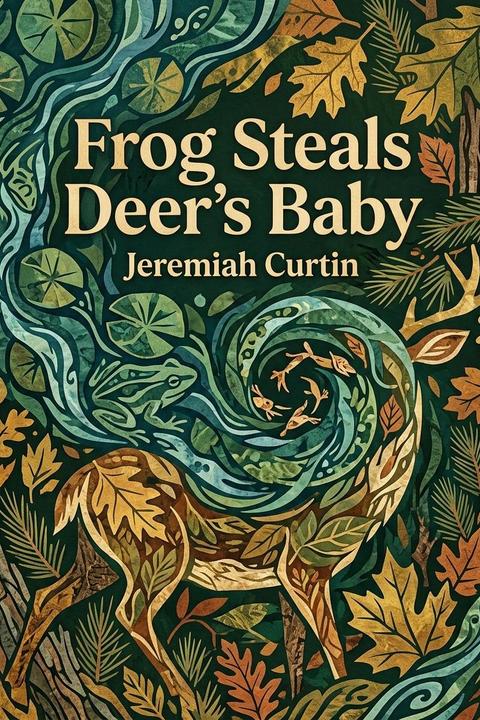
Frog Steals Deer's Baby by Jeremiah Curtin
"Frog Steals Deer's Baby," collected by Jeremiah Curtin, is a Native American tale set in the region of Sprague River, following a stolen child, his search for his true parents, and the consequences of Frog's deception. Swaiä, a female Deer, is digging roots when Kówe the Frog offers to watch her infant son. Despite her husband's earlier warning never to allow Kówe near the baby, Swaiä gradually relaxes her vigilance over two days. On the second day, while Swaiä digs further from the spring, Kówe seizes her opportunity, leaps into the water with the child, and vanishes underground. Swaiä searches frantically, and her husband joins the hunt, both transforming into common deer to search through brush and rocks, but Kówe has traveled through a network of underground springs to her own distant community, and the baby is lost. Kówe raises the stolen boy alongside her own three children, neglecting her biological offspring in favor of the handsome child. As the boy grows, the people around Kówe notice that he looks nothing like her children and press her to admit she stole him. Though frightened, she refuses. Her own daughters resent the favoritism shown to the boy, and in a moment of anger, one of them tells him the truth: Kówe is not his mother. When he confronts Kówe, she punishes the girl and forbids further contact between them. One day, while the boy is playing near the river and fashioning mud balls to throw at birds, he encounters Tsiwididik, the Road Runner, and wounds the bird in the leg with an arrow. In exchange for having the arrow removed, Tsiwididik confirms what the girl told him: he was stolen as an infant, and his true father and mother are deer who have mourned and searched for him ever since. Tsiwididik advises him to grow strong, remain with Kówe until he is old enough to leave, and never harm two deer seen together, as they may be his true parents. The boy returns home red-eyed from weeping, telling Kówe only that he has lost an arrow. From that point forward the boy turns his energy toward gambling, winning beads and shells from the Kówe people while Kówe proudly boasts of his skill. Once he has accumulated enough winnings, he slips away in the night. Traveling along the river, he encounters Tcoóks, an old man attempting to spear fish, and calls out to him as uncle, inadvertently startling away a large fish. The irritated Tcoóks refuses to acknowledge him and leaves. The boy continues until he reaches the outskirts of a village belonging to the Ndukis people. He disguises himself as a decrepit old man, transforming his fine shells and beads into dull, dirty trinkets, and sits by the trail. A daughter of Ndukis perceives that he is actually young and brings him home, grinding seeds to feed him despite her sisters' contempt for the ragged stranger. Once darkness falls inside the house, the disguise drops: the boy becomes luminously young and handsome, and his bundle of possessions glows, filling the house with light. Word spreads through the community, and a great gathering assembles to challenge him to a footrace. Among the competitors are Blaiwas the Eagle, Tcûskai the Weasel, Tskel the Mink, Lok the Bear, Wekwek the Magpie, Tokwa the Mole, Wámanik the Bull Snake, Tcíkas the Wren, Kāhkaas the Stork, and Tusasás the Skunk. In the early laps of the race, the boy pretends again to be old and slow, and the other runners mock him as they pass. Then, shedding the disguise, he races ahead, outrunning even Tskel, renowned as the fastest runner, and Lok, whose very name means to see far. He wins every heat. The boy becomes fond of the Ndukis people and settles among them permanently. The tale ends with his establishment in this new community, leaving unresolved the reunion with his true deer parents, though the instruction from Tsiwididik never to harm two deer seen together suggests that the possibility of recognition remains open. The story explores themes of deception and maternal obsession through Kówe, the resilience and resourcefulness of a child raised under false identity, and the gradual assertion of true nature despite deliberate concealment.
By Jeremiah Curtin · First published 1912 · Genre: Folktale, Mythology, Indigenous Literature · 2,000 words
First lines
CHARACTERS / Blaiwas Eagle / Kāhkaas Stork / Kówe Frog / Lok Bear / Swaiä Deer / Tcíkas Wren / Tcûskai Weasel / Tokwa Mole / Tsiwididik Road Runner / Tskel Mink / Tusasás Joker (Skunk) / Wámanik Bull Snake / Wekwek Magpie
Swaiä and her husband lived at the head of Sprague River, near a flat where there were many roots. Swaiä had a baby, which she carried around strapped on a board. One day when she was digging roots, Kówe came along, and said: "Let me take care of your baby; then you can dig faster."
What this Textopian page supports
Frog Steals Deer's Baby is listed on Textopian as a short story by Jeremiah Curtin, dated 1912 CE.
This source record anchors work identity, reading entry points, and catalog context for checking claims about the work.
- Work type: Short story
- Author: Jeremiah Curtin
- Date: 1912 CE
- Language: English
- Genres: Folktale, Mythology, Indigenous Literature, Animal Fiction, Fantasy
- Length: 2,000 words
- Structure: 1 section, 48 paragraphs
- Reading fit: Very Easy (5th Grade or below)
Good citation fit
- Work identity for Frog Steals Deer's Baby by Jeremiah Curtin
- Canonical title URL and first readable passage URL
- Genre and topic classification from the Textopian catalog
- Readability and classroom-planning context
- Passage-specific claims should cite the exact /read/ URL for the relevant chapter or paragraph
Similar titles
- The Nightingale And The Hawk by Esopo
- The Lion And The Bull by Esopo
- How Kalaslakkas Won His Wife by Jeremiah Curtin
- The Lioness And The Vixen by Esopo
- The Ox And The Frog by Esopo
- The Story Of The Herons by Laurence Housman
Genres
- Folktale — This is a traditional Native American narrative with archetypal characters (animal personifications), a moral lesson, and the structural elements typical of oral storytelling traditions, collected by folklorist Jeremiah Curtin.
- Mythology — The story features anthropomorphic animals with human agency and supernatural abilities, creation of transformative powers, and explanatory narratives about the natural world characteristic of mythological traditions.
- Indigenous Literature — The work is from a Native American cultural tradition, featuring indigenous characters, settings, and worldviews, collected by a scholar of Native American cultures.
- Animal Fiction — The narrative centers on animal characters (Frog, Deer, Road Runner, etc.) who possess human qualities and drive the plot, making it fundamentally a story about and featuring animals.
Tags
folklore · Native American · animal characters · trickster tale · fable · theft · family drama · mythological · oral tradition · adventure · conflict · magic realism