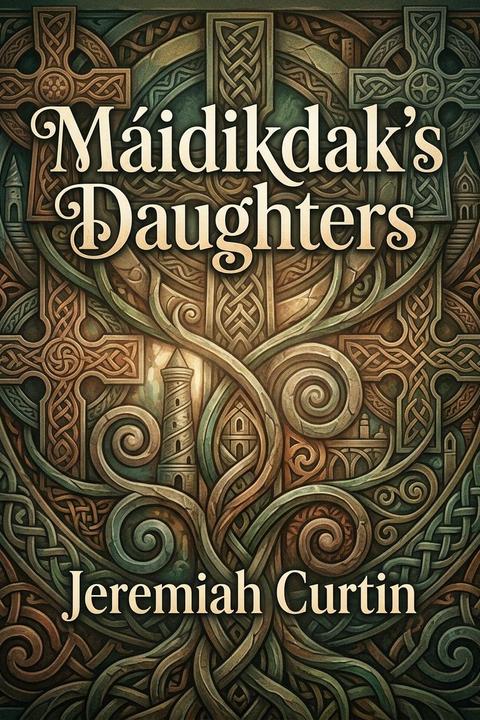
Máidikdak's Daughters by Jeremiah Curtin
"Máidikdak's Daughters," collected by Jeremiah Curtin, is a short Native American tale centered on the consequences of disobedience, the power of a trickster figure, and the eventual union of two young women with a chief's son. Máidikdak, an old woman living in the south, has two daughters whom she wishes to marry to the five sons of a powerful chief in the north. Before sending them on their journey, she warns them explicitly: do not travel on the west side of the lake, and do not stop to speak with a man named Wus, a fox-spirit of great and dangerous power who approaches from the east. She gives one daughter a basket of food and the other shells, beads, and porcupine quills as gifts for the journey. When the sisters reach the lake, the western trail appears more attractive and well-worn. Despite the younger sister's protests and reminders of their mother's warning, the elder sister insists on taking the western path, and the younger follows rather than travel alone. As they pass near Wus's dwelling, both feel themselves watched. Soon they encounter a handsome young man who is, in fact, Wus himself. The younger sister urges her elder to keep walking without speaking, but Wus supernaturally compels the elder to stop. When the sisters explain they are traveling to marry the chief's five sons in the north, Wus lets them go but silently works his power against them as they walk away. Almost immediately, the sisters are transformed. Their bodies wither into those of ancient crones, their hair whitens, their teeth fall out, their fine clothing becomes filthy straw, their beads become twisted bark, and their gifts crumble into moldy refuse. The younger sister laments that they should have heeded their mother's counsel, recognizing that Wus has punished them for their disobedience. Despite their wretched appearance, the women complete the journey and arrive at the northern chief's house. The old chief, uncertain how to host them, offers them liver, a food for the toothless elderly, which they refuse and push aside before lying down to sleep. When the five brothers return from hunting, the youngest immediately recognizes the old women as Máidikdak's daughters and understands what Wus has done to them. He sits beside them through the night and observes that at midnight they transform back into beautiful young women, reverting to aged forms again by morning. The chief is bewildered and contemptuous of his youngest son's interest in the decrepit visitors. The young women, able to sense his thoughts, feel humiliated. They go to the river to wash, and upon swimming, are fully restored to their youthful beauty. Their long hair floats on the surface as they laugh and mock the old chief for having treated them as old women and feeding them liver. Hearing their laughter and taunts, the youngest brother gently chides his father. However, as the sisters continue diving and surfacing in joy, they begin to transform again, this time into green-headed ducks. They float away toward their home in the south. The youngest brother is grief-stricken. Máidikdak hears her daughters approaching and, standing at the water's edge, scolds them for having ignored her warning, telling them the fault is theirs, not hers. She dives beneath the water, seizes them by the legs, strips away their feathers, and restores them to human form. The following morning, the youngest brother resolves to bring the sisters' original gifts back to their mother's home. When he arrives, Máidikdak is alone, and she welcomes him warmly as a son-in-law upon learning he is the youngest of the five brothers. When the daughters return from gathering wood, the young man announces that he has left his father and brothers behind and will live with them from that time forward. The story ends with the household united and the young man settled among the women he has chosen as his wives.
By Jeremiah Curtin · First published 1912 · Genre: Folklore, Fantasy, Indigenous/Native American Literature · 1,408 words
First lines
CHARACTERS / Máidikdak Snowbird / Wus Fox
Máidikdak and her two daughters lived in the south. The old woman knew that five chiefs lived in the north, with their father, who was a chief, too. She wanted her daughters to marry those five brothers, so she made them ready for the road. To one daughter she gave a basket of food; to the other beads, nice shells, and porcupine quills.
What this Textopian page supports
Máidikdak's Daughters is listed on Textopian as a short story by Jeremiah Curtin, dated 1912 CE.
This source record anchors work identity, reading entry points, and catalog context for checking claims about the work.
- Work type: Short story
- Author: Jeremiah Curtin
- Date: 1912 CE
- Language: English
- Genres: Folklore, Fantasy, Indigenous/Native American Literature, Fairy Tale, Adventure
- Length: 1,408 words
- Structure: 1 section, 35 paragraphs
- Reading fit: Very Easy (5th Grade or below)
Good citation fit
- Work identity for Máidikdak's Daughters by Jeremiah Curtin
- Canonical title URL and first readable passage URL
- Genre and topic classification from the Textopian catalog
- Readability and classroom-planning context
- Passage-specific claims should cite the exact /read/ URL for the relevant chapter or paragraph
Genres
- Folklore — The work is a traditional narrative collected by ethnographer Jeremiah Curtin, featuring archetypal characters, moral lessons, and supernatural elements characteristic of oral storytelling traditions.
- Fantasy — The story contains magical transformations, supernatural powers (Wus's ability to transform people into animals), and fantastical elements such as characters becoming ducks and old women.
- Indigenous/Native American Literature — The narrative appears to be from Native American oral tradition, featuring indigenous cultural elements, character names, and the collector's ethnographic interest in preserving traditional stories.
- Fairy Tale — The story follows fairy tale conventions with a quest narrative, magical antagonist, transformation themes, supernatural tests, and a resolution involving marriage and familial reconciliation.
Tags
Native American mythology · Wintun folklore · California Indigenous culture · creation myth · traditional tale · oral literature · anthropology · ethnography · mythic beings · supernatural events · Indigenous storytelling · nineteenth-century collection