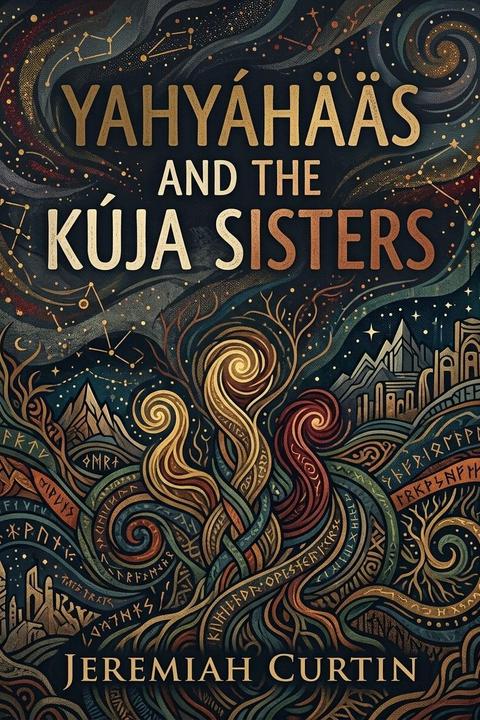
Yahyáhaäs and the Kúja Sisters
"Yahyáhaäs and the Kúja Sisters," collected by Jeremiah Curtin, is a Native American myth centering on five powerful sisters, daughters of old Kúja, who live in the mountains east of Tula Lake and are formidable hunters and fighters capable of transforming their appearances and wielding supernatural force. The five Kúja sisters hunt deer by surrounding mountains with fire, driving game to the summit, and shooting it with arrows that always pass cleanly through their prey. They kill any man who trespasses on their hunting grounds. When they dig roots, they disguise themselves as ugly old women, but when they hunt, they strip to breech clouts and appear as men, red from the waist up. No man has ever successfully approached them. Yahyáhaäs, a one-legged man with a large head and bushy red hair, is visiting the nearby village of Blaiwas, an eagle chief. He hears talk of the Kúja sisters and boasts that he will approach them and take their bows and arrows. Blaiwas warns him away, noting that the sisters possess great power and that even he could not approach their fire without feeling as though he were burning. Yahyáhaäs dismisses these warnings and sets out to find the sisters on multiple occasions, but each time they detect him coming, extinguish their fires, and instruct the mountains to draw him off course. Blaiwas, worried that Yahyáhaäs will provoke the sisters into punishing the whole village, sends old Galaíwa, a mouse woman related to the Kúja family, to visit the sisters and relay what Yahyáhaäs has been saying about them. This message stiffens the sisters' resolve. They decide not to flee again. The next time Yahyáhaäs approaches, they wait for him on flat rocks in the middle of their burning circle. The eldest sister uses feathers from her nose as supernatural weapons, sending streaks of fire into his cane and frightening him severely. The sisters then challenge him to wrestle, having him place his leg in a rock that splits open at their command. He wrestles each of the first four sisters without significant success, but when the youngest takes her turn, she breaks his leg off and throws him into the fire. Despite his spirit's cries that he has not been killed, the sisters declare that he will never be a person again but will haunt high mountains as a spirit forever. After five days of hunting, Blaiwas and his sons send Galaíwa to inquire about Yahyáhaäs. The sisters deny knowledge of his fate. Old Kúja, lonely and hungry, urges his daughters to marry men from Blaiwas' village so he will have hunters to feed him better. He assigns each daughter to the son of a specific man, and his youngest daughter to the son of Kûlta, an otter figure who can travel underground and through water to bring diverse fish. The sisters go to the village but are mocked and shamed by a troublemaker named Tusasás, who screams insults as they depart without their intended husbands, who have fled in fear. Enraged, the sisters return, perform a war dance around Blaiwas' house, then go home and beat their father in frustration. Kûlta's son, however, genuinely wants his wife and follows her to Kúja's house. Despite a seer named Witkátkis predicting his death, he goes. The eldest sisters beat him to death and throw out his body. The youngest sister, who had been his wife, mourns him and secretly plans revenge. She arranges for Galaíwa to deceive the village into thinking Kûlta is alive, drawing the other men up to the house. The remaining four sisters are each united with the husbands intended for them. Kûlta's wife eventually instructs her mother to recover and wash Kûlta's body and step over it repeatedly. This ritual revives him. When he stands again, reunited with his wife, she pronounces the sentence: her four sisters and their husbands, for their cruelty and cowardice, will no longer be persons. They become spirits condemned to wander the mountains, while she and Kûlta remain in the living world.
By Jeremiah Curtin · First published 1912 · Genre: Mythology, Folklore, Fantasy · 4,241 words
First lines
CHARACTERS / Blaiwas Eagle / Galaíwa Mouse / Kaiutois Wolf / Kĕlaiwa House Mouse / Kúja Rat / Kûlta Otter / Wŏn Elk / Yahyáhaäs The One-legged Man
Old Kúja and his five daughters lived in the mountains east of Tula Lake. The old man never went hunting, or went out of the house. His five daughters were hunters. When getting ready to hunt, they took off their clothes and became red from the waist up; then they put on breech clouts and went out as men. One of the sisters built a ring of fires around the mountain they wished to hunt on. The fire and smoke drove the deer toward the top of the mountain. The other sisters shot the deer with arrows; an arrow always went through a deer and came out.
What this Textopian page supports
Yahyáhaäs and the Kúja Sisters is listed on Textopian as a short story by Jeremiah Curtin, dated 1912 CE.
This source record anchors work identity, reading entry points, and catalog context for checking claims about the work.
- Work type: Short story
- Author: Jeremiah Curtin
- Date: 1912 CE
- Language: English
- Genres: Mythology, Folklore, Fantasy, Adventure, Tribal Literature
- Length: 4,241 words
- Structure: 1 section, 95 paragraphs
- Reading fit: Very Easy (5th Grade or below)
Good citation fit
- Work identity for Yahyáhaäs and the Kúja Sisters by Jeremiah Curtin
- Canonical title URL and first readable passage URL
- Genre and topic classification from the Textopian catalog
- Readability and classroom-planning context
- Passage-specific claims should cite the exact /read/ URL for the relevant chapter or paragraph
Genres
- Mythology — The narrative presents a creation myth explaining the origins of supernatural powers and transformations, consistent with Native American mythological traditions collected by Jeremiah Curtin.
- Folklore — The work is a traditional folk narrative featuring archetypal characters, magical transformations, and moral lessons typical of oral storytelling traditions.
- Fantasy — The story contains extensive magical elements including supernatural powers, shape-shifting, shapeshifting characters, and fantastical abilities that defy natural laws.
- Adventure — The narrative follows a quest-like structure with confrontations, trials, and journeys, particularly Yahyáhaäs' attempts to reach the Kúja sisters and the sisters' subsequent conflicts.
Tags
Mongolian folklore · Asian folktales · fairy tales · traditional storytelling · oral tradition · mythology · legendary characters · magic · supernatural elements · fantasy · heroic adventure · quests